© Wikimedia Commons contributor · CC BY-SA 3.0 · Commons
Eyebright
CautionAugentrost · (Euphrasia officinalis)
Broomrape family (Orobanchaceae)
Description
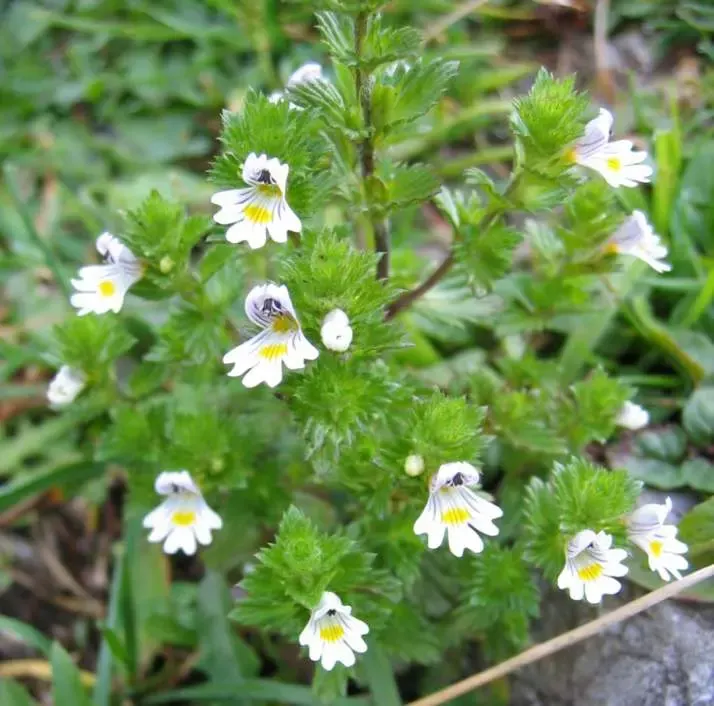
Eyebright is a delicate annual barely a hand tall, whose small white lipped flowers recall a human eye through their yellow blotches and violet veins — the source of its name. Botanically it is a hemiparasite: its roots tap into those of grasses, which is why it resists cultivation and thrives only on poor grassland. The flowering herb is gathered, carrying iridoid glycosides such as aucubin and catalpol, flavonoids including luteolin, and tannins. Under the medieval doctrine of signatures — resemblance implies effect — it was used for ailments of the eye, a tradition that persists in folk medicine. Today an infusion is drunk mainly for catarrh of the upper airways. Home-made eye baths are not advisable because of the risk of contamination; persistent eye trouble belongs with an eye doctor.
Infusion of the flowering herb (1–2 g per cup, steep 10 min) for catarrh of the upper respiratory tract, hay fever, and sinusitis. Astringent tannins and iridoid glycosides support mucous membrane integrity and mild anti-inflammatory activity.
Preparation & dosage
- Dry amount
- 1–2 g
- Doses per day
- 3×
Cooled, double-filtered infusion as a moist compress for mild, non-infectious eyelid irritation. Use only with freshly prepared sterile water – do not use as an eyebath (infection risk). Does not replace ophthalmological examination.
Preparation & dosage
Anthroposophic and homeopathic preparations (mother tincture in eye ointments, D3 dilution in eye drops) are used for non-purulent conjunctivitis and increased lacrimation. Such finished medicinal products are subject to pharmaceutical quality control.
Diluted infusion as a gargle for mild inflammation of the oral mucosa and throat. Astringent phenolic acids (caffeic acid, ferulic acid) and tannins exert a mild tightening effect.
Preparation & dosage
Dried, ground herb was historically used in herbal smoking mixtures for chronic bronchial complaints (PFAF). This application is now obsolete and not recommended.
Sources: [4]
Occasionally used in folk medicine as a mildly tonic tea for digestive complaints. Bitter compounds and iridoid glycosides (aucubin, catalpol) stimulate digestive glands.
For persistent or serious eye complaints, always consult an ophthalmologist — eyebright does not replace medical treatment. Self-prepared eye baths are not hygienically acceptable and are explicitly not recommended by EMA HMPC. Use only a compress on the closed eyelid with sterile water. Prefer finished medicinal products (eye drops, ointments).
Insufficient data on use during pregnancy; avoid as a precaution.
Insufficient data on use during lactation; avoid as a precaution.
No paediatric data; do not use in children without medical advice.
Contraindications
- Known hypersensitivity to Euphrasia species.
- Infectious eye conditions — treat exclusively under medical supervision.
Harvested part: flowering herb
- Time of day:
- Morning after the dew has dried.
- Drying:
- Spread thinly and dry at max. 40 °C; harvest stems, leaves and flowers together while flowers are fresh.
- Storage:
- 12 months — Dry, protected from light, in airtight containers.
- AucubinGlycosideAerial parts
Iridoid glycoside; astringent and mildly anti-inflammatory; one of the key active compounds of the genus Euphrasia.
- CatalpolGlycosideAerial parts
Iridoid glycoside; co-occurs with aucubin; contributes to tonic and antioxidant properties.
- LuteolinFlavonoidContent: ca. 0.38 % (Gesamtflavonoide)Aerial parts
Flavone with antioxidant and anti-inflammatory properties; detected in Euphrasia alongside apigenin and quercetin.
- Kaffeesäure (Caffeic acid)Phenolic acidAerial parts
Phenolic acid with antioxidant properties; detected in Euphrasia officinalis.
- Ferulasäure (Ferulic acid)Phenolic acidAerial parts
Phenolic acid; found in high concentrations in E. officinalis; astringent and antioxidant.
- Tannine (kondensiert und hydrolysierbar)TanninAerial parts
Tannins responsible for the astringent action on mucous membranes; help dry up catarrh.
- Ätherisches ÖlEssential oilAerial parts
Small amounts of volatile oils; contribute to the aromatic character of the herb.
- [3]MonographEMA HMPC: Public Statement on Euphrasia officinalis and Euphrasia rostkoviana, herba (2011)(accessed: 2026-05-21)
- [5]MonographArzneipflanzenlexikon — Euphrasia officinalis (medicinal use, dosage, interactions)(accessed: 2026-05-21)
- [6]MonographCliniTox Giftpflanzen — Euphrasia rostkoviana Hayne s.l.: schwach giftig (+) (Institut für Veterinärpharmakologie und -toxikologie, Universität Zürich)(accessed: 2026-08-10)
- [4]BookPlants For A Future — Euphrasia officinalis(accessed: 2026-05-21)
- [1]WikipediaAugentrost (Wikipedia DE)(accessed: 2026-05-21)
- [2]WikipediaEuphrasia (Wikipedia EN)(accessed: 2026-05-21)
Classical quotes
"Eyebright is the comfort-plant for weak and tired eyes."