Legal notice
Narcotic; the coca leaf is internationally controlled under the 1961 UN Single Convention (Schedule I), as is the cocaine derived from it.
Legal regulation differs by country (e.g. legal traditional chewing in parts of the Andes, strict prohibition elsewhere). Inform yourself about the law that applies to you. This is not a permission to consume.
For education and documentation only. Not a consumption guide, not legal or medical advice. Possession, cultivation and use are regulated differently by country and species — check the law that applies to you.
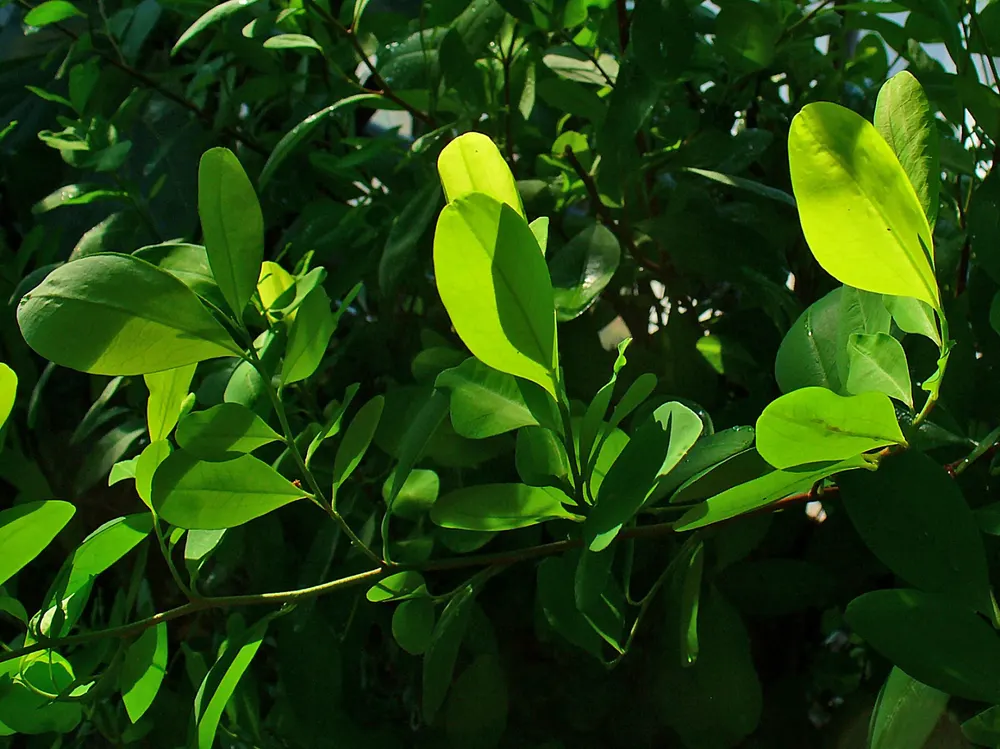
© H. Zell · CC BY-SA 3.0 · Commons
Coca
Toxic🐾Kokastrauch (Coca) · (Erythroxylum coca)
Coca family (Erythroxylaceae)
Description
The coca shrub (Erythroxylum coca) is an evergreen bush of the family Erythroxylaceae, native to the eastern Andean slopes of Peru, Bolivia and Colombia at 300–2000 m elevation. It grows 2–3 m tall, with reddish bark, leathery oval leaves marked by characteristic curved lines, small yellowish-white flowers, and red single-seeded drupes. Chewing coca leaves has been documented in the Andes for at least several thousand years and was deeply embedded in the labour, religion and trade of the Inca empire. In 1860 the alkaloid cocaine was isolated from the leaves, and from the 1880s it became the first effective local anaesthetic, transforming medicine. Today the coca leaf is internationally controlled as a narcotic, while traditional chewing and coca tea remain legal in several Andean states.
- TinctureLeafExternalTraditional use
The alkaloid cocaine, isolated from the leaves in 1860, became from the 1880s the first clinically used local anaesthetic, in ophthalmic, dental and general surgery. A historical/medical use of the isolated compound — now largely replaced by synthetic anaesthetics.
Historical documentation only — do NOT use
These internal applications are historically documented. This plant is highly toxic — self-treatment can cause severe poisoning or death. For documentation only, explicitly NOT a recommendation.
- RawLeafInternalTraditional use
Traditional chewing of dried coca leaves (often with lime/ash as an alkaline additive) by Indigenous Andean peoples for millennia to relieve fatigue, hunger, thirst and altitude sickness. This is a historical-cultural practice, not a consumption recommendation.
- TeaLeafInternalTraditional use
Coca tea (mate de coca) brewed from the leaves is a common mild stimulant and folk remedy for altitude sickness in Andean regions — documented traditional use.