© Mike Dickison · CC BY 4.0 · Commons
Field Horsetail
Caution🐾Acker-Schachtelhalm · (Equisetum arvense)
Horsetail family (Equisetaceae)
Description
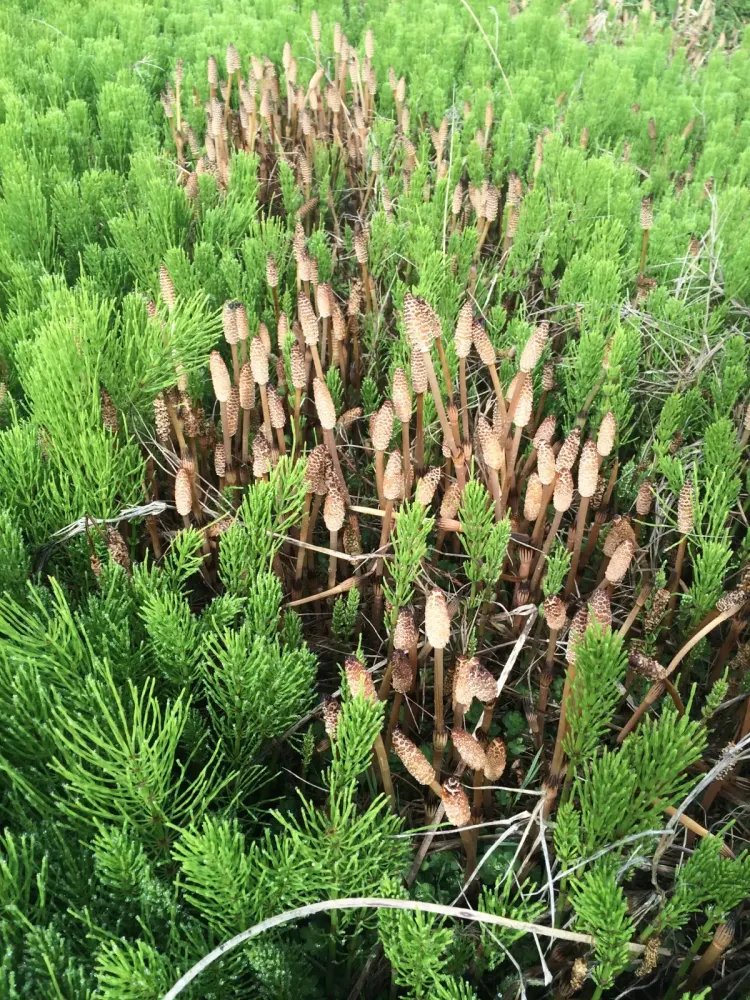
Field horsetail is a spore-bearing plant widespread across Europe, whose green summer shoots have been used in folk medicine for centuries. It is rich in silica and minerals and prefers moist, loamy soils along paths and on fallow ground. The pale, spore-bearing shoots appear first in spring, followed later by the distinctive green summer shoots.
🌿 Risk of confusion — read before wild-harvesting!
CRITICAL FORAGING WARNING: NEVER confuse field horsetail (E. arvense) with POISONOUS marsh horsetail (E. palustre). Field horsetail identifier: first internode of side branches LONGER than stem sheath. Poisonous E. palustre: equal or shorter. When in doubt, do not collect. — Irrigation therapy: drink at least 2 L fluid/day. NO irrigation for oedema from cardiac/renal insufficiency. Seek immediate medical attention for fever, blood in urine, severe pain or urinary retention. Limit use to max. 4 weeks (thiaminolytic enzymes theoretically relevant in long-term use).
CONTRAINDICATED during pregnancy
Horsetail preparations not to be used in pregnancy — insufficient safety data (EMA monograph).
CONTRAINDICATED during breastfeeding
Do not use in lactation — insufficient data.
CONTRAINDICATED for children
Not for children under 12 years — lack of data (EMA monograph).
- TeaAerial partsInternalTraditional use
Irrigation therapy for mild urinary tract complaints (irritable bladder, infection prevention). The decoction increases urine volume through its content of soluble silica, flavonoids and saponins. Not for oedema from cardiac or renal insufficiency.
Preparation & dosage
DECOCTION (silica is poorly water-soluble and requires boiling to release): 2–3 g crushed dried horsetail herb in 200–250 ml cold water, bring to rolling boil for 5 min, steep 10–15 min, strain. 3× daily freshly prepared, between meals. IMPORTANT: Drink at least 2 litres of fluid daily throughout — irrigation therapy only works with sufficient total fluid intake.
- Dry amount
- 2–3 g
- Doses per day
- 3×
- Max duration
- 4 weeks
⚠ Age restriction: ≥ 12 years — Per EMA monograph only from 12 years.
- BathAerial partsExternalTraditional use
External bath for superficial, poorly healing wounds. The combination of silica and tannins acts astringently and promotes wound contraction. Traditionally also used as a sitz bath for rheumatic and gout complaints.
Preparation & dosage
FULL BATH or SITZ BATH: 100–200 g dried horsetail herb boiled in 2–3 litres water, steep 10–15 min, strain, add to bath water. Bath temperature 35–38 °C, bathing time 10–20 min. Once daily.
- Dry amount
- 100–200 g
- Doses per day
- 1×
- Max duration
- 2 weeks
⚠ Age restriction: ≥ 12 years — From 12 years.
- CompressAerial partsExternalTraditional use
Moist compress to support wound healing for small superficial wounds. Astringent action from silica, tannins and phenolic acids.
Preparation & dosage
MOIST COMPRESS: 10–20 g crushed horsetail herb in 200 ml water, boil 5 min, steep 10 min, strain. Soak clean linen cloth, apply to skin area, leave 15–20 min. 1–2× daily freshly prepared.
- Dry amount
- 10–20 g
- Doses per day
- 2×
- Max duration
- 2 weeks
⚠ Age restriction: ≥ 12 years — From 12 years.
- TeaAerial partsInternalFolk medicine
Folk medicine long-term use of horsetail tea to strengthen connective tissue, hair, skin and nails. Soluble silica is said to support collagen synthesis. Clinical evidence lacking — traditional use in Austrian and Central European folk medicine for rheumatism and gout.
Preparation & dosage
DECOCTION as for urinary tea (boil 5 min + steep 15 min). 2× daily for 4 weeks. For connective tissue support and hair/nails as long-term tea — not for acute indications.
- Dry amount
- 2–3 g
- Doses per day
- 2×
- Max duration
- 4 weeks
- BathAerial partsExternalFolk medicine
Folk medicine horsetail herb bath for rheumatic complaints, gout and excessive foot sweating — Austrian folk medicine tradition. Warmth and mineral-rich extract act together muscle-relaxing and circulation-promoting.
Preparation & dosage
HORSETAIL HERB BATH for rheumatism/gout/nerve pain: 100–200 g horsetail herb boiled in 2–3 L water, strain, add to full bath. Temperature 37–39 °C, 15–20 minutes. Austrian folk medicine tradition.
- Dry amount
- 100–200 g
- Doses per day
- 1×
- Max duration
- 3 weeks
Classical quotes
"Horsetail is an excellent plant for the kidneys and the blood."