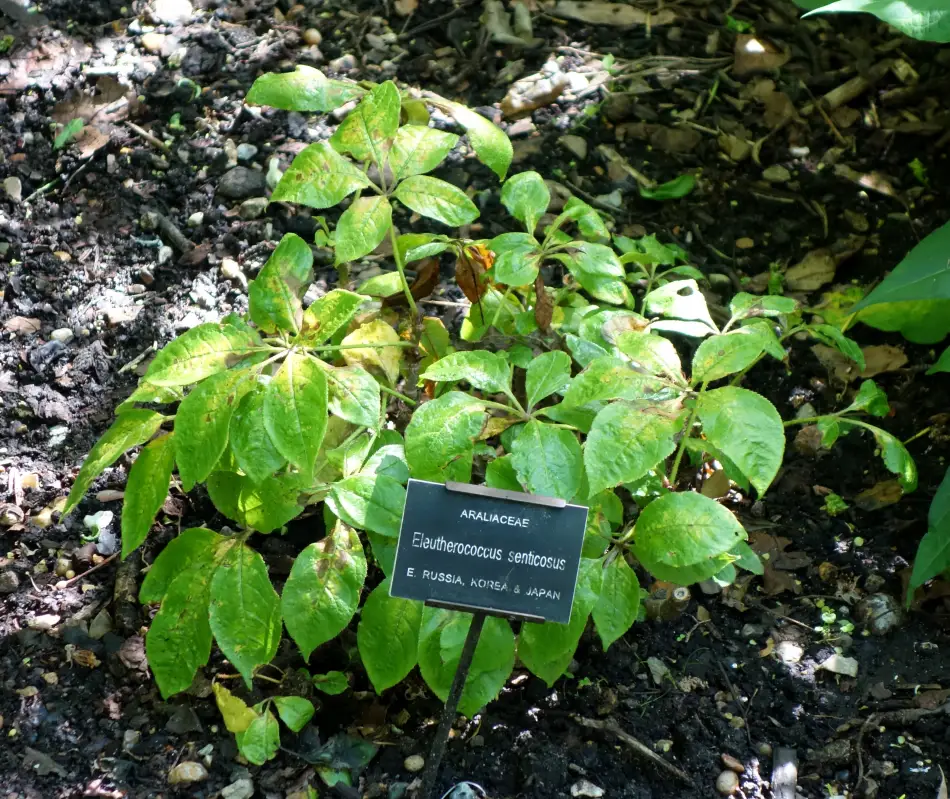
© Daderot · CC0 · Commons
Eleuthero
Borstige Taigawurzel · (Eleutherococcus senticosus)
Ginseng family (Araliaceae)
Description
Eleuthero (Eleutherococcus senticosus), also called Siberian ginseng or taiga root, is a deciduous, densely spiny shrub of the ginseng family (Araliaceae). It reaches heights of roughly 2 to over 6 metres and bears palmate, usually five-part leaves with leaflets up to 13 cm long. Small, inconspicuous flowers open in July and give rise to rounded, blue-black, drupe-like berries of 6 to 9 mm. The species is native to north-eastern Asia - Siberia, the Amur region, Sakhalin, North Korea, north-eastern China (Manchuria) and northern Japan (Hokkaidō), where it grows in mixed and coniferous forests. Its medicinal parts are the woody root and rhizome (Eleutherococci radix). Despite the name 'Siberian ginseng', the plant is not the same as true ginseng (Panax ginseng), though it belongs to the same family and is regarded as a classic adaptogen.
CONTRAINDICATED during pregnancy
The EMA monograph advises against use in pregnancy owing to a lack of safety data; use is not recommended.
CONTRAINDICATED for children
There are insufficient data for children under 12 years; per the EMA the use is restricted to adults and adolescents over 12 years.
- TinctureRootInternalTraditional use
Main use with EMA-recognised 'traditional use' evidence: for the relief of symptoms of asthenia (abnormal loss of strength and energy) such as tiredness and weakness. This recognition rests solely on long-standing traditional use, not on high-quality clinical trials. As an adaptogen the root is held to support non-specific resistance to physical and mental stress.
Preparation & dosage
Traditional use as a standardised dry extract or tincture of the comminuted root, corresponding to roughly 0.5 to 4 g of comminuted root per day (product-dependent, divided into several single doses). Take preferably earlier in the day, as the herb may be mildly stimulating. For adults and adolescents over 12 years only. Do not use for longer than 2 months without medical advice; if symptoms do not improve or persist for more than 2 weeks, seek medical advice.
- Dry amount
- 0.5–4 g
- Doses per day
- 3×
- Max duration
- 8 weeks
⚠ Age restriction: ≥ 12 years — Per the EMA monograph, for adults and adolescents over 12 years only; there are insufficient data for younger children.
[#src_ema_medicine] [#src_ema_monograph] [#src_wikipedia_de] [#src_wikipedia_en]
- TeaRootInternalTraditional use
Folk and traditional preparation of the comminuted root as a decoction for supportive use in exhaustion, tiredness and weakness. The comminuted root as an infusion/decoction is one of the preparation forms named by the EMA within the traditional-use framework.
Preparation & dosage
Traditionally as a decoction: bring about 2 to 3 g of comminuted root to the boil with roughly 150 ml of water, simmer for a few minutes and let it draw for about 10 minutes in total, then strain. Once or twice daily, preferably earlier in the day. For adults and adolescents over 12 years only; not longer than 2 months without medical advice.
- Dry amount
- 2–3 g
- Doses per day
- 2×
- Max duration
- 8 weeks
⚠ Age restriction: ≥ 12 years — As with the extract/tincture form, for adults and adolescents over 12 years only.
🤝 Permaculture Partners
In your garden, this plant acts as: