© Unknown (see Commons) · Public domain · Commons
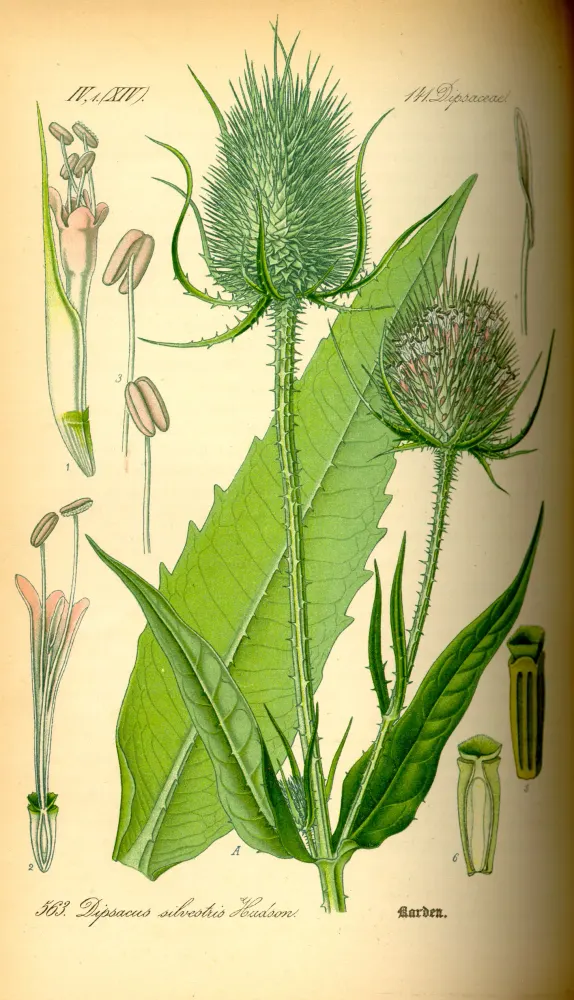
Dipsacus fullonum
CautionWilde Karde · (Dipsacus fullonum)
Honeysuckle family (Caprifoliaceae)
Description
Dipsacus fullonum, syn. Dipsacus sylvestris, is a species of flowering plant known by the common names wild teasel or fuller's teasel, although the latter name is usually applied to the cultivated variety D. fullonum var.
CONTRAINDICATED during pregnancy
No safety data available for pregnancy. Iridoids and saponins may have uterine-stimulating effects. Self-application during pregnancy is contraindicated.
CONTRAINDICATED during breastfeeding
No safety data for lactation. Transfer of constituents into breast milk not investigated. Internal self-application during lactation not recommended.
- TinctureRootInternalFolk medicine
Dipsacus fullonum root tincture is promoted in the Buhner protocol (2005) and internet folk medicine as an adjunct therapy for Lyme borreliosis. IMPORTANT: No clinical trials in Borrelia patients demonstrating efficacy exist. In-vitro extract analyses (Vaher 2018) identified bioactive compounds in D. fullonum; clinical efficacy against Borrelia burgdorferi in humans has not been demonstrated thereby. No health claims; medical treatment of borreliosis (antibiotics) takes absolute precedence.
Preparation & dosage
- TinctureRootInternalClinical trial
Extracts from Dipsacus species (mainly D. asper, closely related to D. fullonum) show in vitro antimicrobial activity against various bacterial and fungal strains. Saponin fractions from D. asper roots inhibit phytopathogenic fungi in vitro (Choi et al. 2017). Extrapolation to D. fullonum and to clinical indications in humans is not validated.
Preparation & dosage
[#src_dipsacus_antifungal_saponins] [#src_dipsacus_iridoids_ferox]
- TeaAerial partsExternalTraditional use
In European folk medicine, compresses and washes with D. fullonum tea were applied topically for eczema, warts, acne, and poorly healing wounds. The water collected in the leaf axils ('Venus's basin') was traditionally used as an eye wash and against warts. No clinical evidence.
Preparation & dosage
Steep 3–5 g dried aerial parts in 250 ml hot water for 10 minutes. Allow to cool, apply externally as wash or compress.
- Dry amount
- 3–5 g
- TeaRootInternalFolk medicine
In Traditional Chinese Medicine (TCM), Xu Duan (Dipsacus asper, closely related) is used for back and joint pain and fracture healing. D. fullonum was occasionally used in European folk medicine for joint and muscle pain as a tea. No Kommission E or EMA monograph for D. fullonum.
Preparation & dosage
Simmer 2–4 g dried root in 200 ml water for 15 minutes. 2 cups daily. Not longer than 4 weeks without medical consultation.
- Dry amount
- 2–4 g
- Doses per day
- 2×
[#src_dipsacus_pfaf] [#src_dipsacus_iridoids_asper_molecules]
- SalveRootExternalFolk medicine
Folk medicine tradition in parts of Europe: root extract externally for skin conditions, fistulas, and abscesses. Iridoid glycosides from D. asper roots show anti-inflammatory properties in vitro (inhibition of chondrocyte apoptosis — molecular mechanism). Direct evidence for D. fullonum topically is lacking.
Preparation & dosage
[#src_dipsacus_pfaf] [#src_dipsacus_iridoids_asper_molecules]
- TeaAerial partsInternalFolk medicine
Occasionally in Central European folk medicine for gastrointestinal complaints, appetite stimulation, and as a bitter tonic. Bitter compounds and iridoids stimulate bile secretion reflexively. No evidence from clinical studies; very weak data basis.
Preparation & dosage
Steep 2–3 g dried herb in 200 ml water for 10 minutes. Drink before meals.
- Dry amount
- 2–3 g
- Doses per day
- 2×