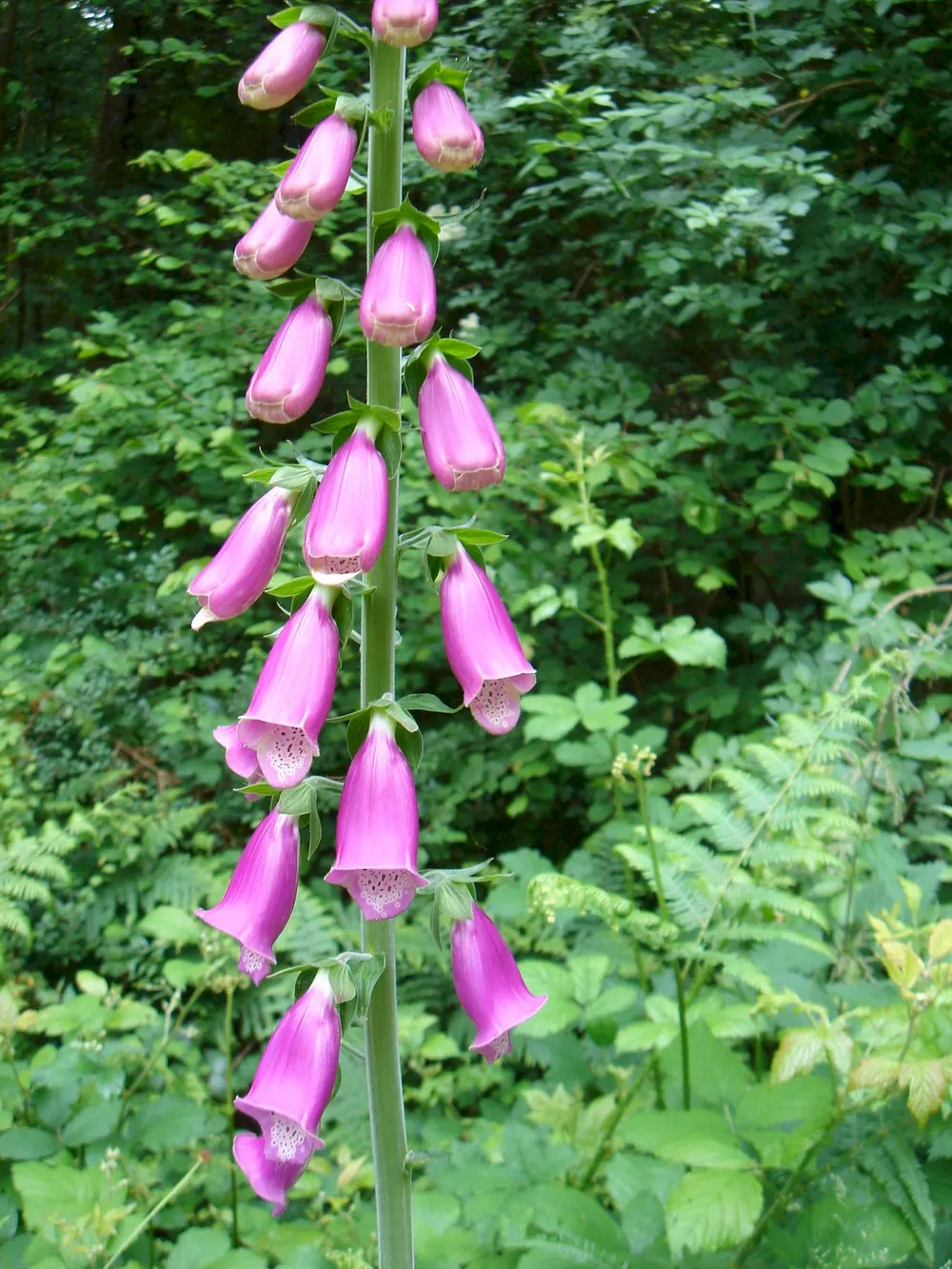
© TivaB (Wikimedia Commons) · CC BY-SA 3.0 · Commons
Foxglove
Toxic🐾Roter Fingerhut · (Digitalis purpurea)
Plantain family (Plantaginaceae)
Description
Foxglove is a biennial plant that forms a leaf rosette in its first year and an unbranched flowering stem up to 2 metres tall in its second year. Its thimble-shaped, pendant, tubular flowers are typically purple-violet (rarely white), 4–6 cm long, with dark-spotted throats. It flowers from June to August and favours woodland edges, clearings and disturbed ground. Every part of the plant is highly poisonous and contains cardiac glycosides.
🌿 Risk of confusion — read before wild-harvesting!
DEADLY: All parts of the plant are highly toxic. As few as two or three leaves can be fatal.
Historical documentation only — do NOT use
These internal applications are historically documented. This plant is highly toxic — self-treatment can cause severe poisoning or death. For documentation only, explicitly NOT a recommendation.
- TeaLeafInternalFolk medicine
Historically, infusions of the dried leaves were used against dropsy (edema caused by heart weakness). This use is purely historical and LIFE-THREATENING – never use for self-treatment.
- TinctureLeafInternalTraditional use
In 1785 William Withering described the measured use of leaf preparations for cardiac dropsy, giving rise to modern digitalis therapy. The isolated pure compounds (digitoxin/digoxin) are today prescription medicines – the plant itself is not suitable for self-use because of its extremely narrow therapeutic margin.