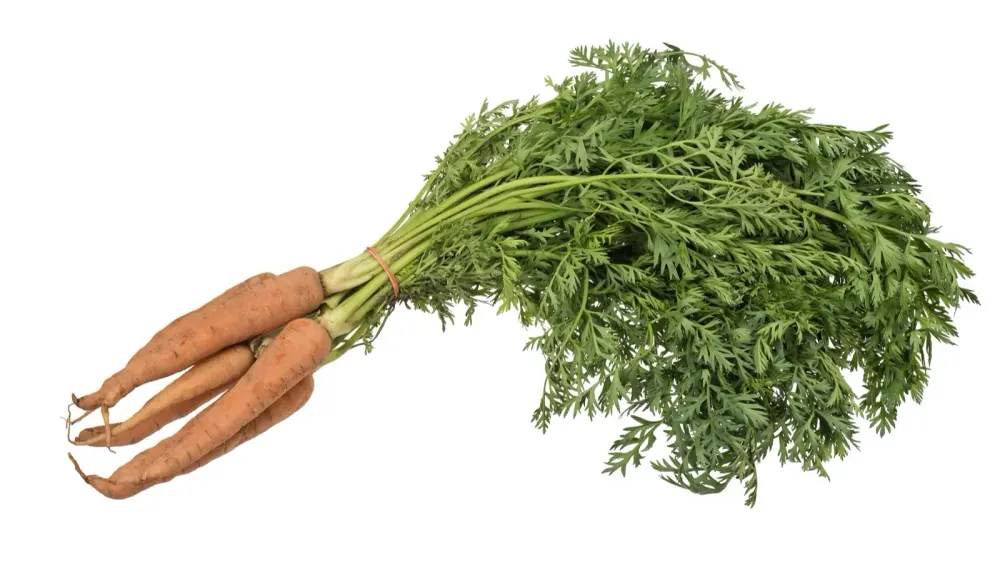
© Evan-Amos · Public domain · Commons
Carrot
Karotte · (Daucus carota subsp. sativus)
Carrot family (Apiaceae)
Description
The carrot is a root vegetable, typically orange in colour, though heirloom variants including white, yellow, red, purple, and black cultivars exist, all of which are domesticated forms of the wild carrot, Daucus carota, native to Europe and Southwestern Asia. The plant probably originated in Iran and was originally cultivated for its leaves and seeds.
- RawRootInternalTraditional use
Raw carrots are one of the richest plant sources of provitamin A (beta-carotene). 100 g raw carrot supplies ~8350 µg beta-carotene, covering ~93 % of the recommended daily vitamin A intake. Eaten raw — grated, as sticks, or as juice — carrots are a staple in salads, crudités, and smoothies. The body converts beta-carotene to retinol on demand; excess beta-carotene is not converted to toxic vitamin A.
[#src_usda_carrot] [#src_efsa_betacarotene] [#src_wp_en_carrot]
- RawRootInternalTraditional use
Cooked carrots are well tolerated and suitable for all age groups. Cooking breaks cell walls, increasing bioavailability of beta-carotene up to threefold compared with raw — especially when consumed with a small amount of fat (e.g. butter, oil). Carrots are steamed, braised, added to soups and stews, and used as weaning food for infants.
[#src_usda_carrot] [#src_wp_en_carrot] [#src_pfaf_daucus_carota]
- RawRootInternalTraditional use
Carrot juice is a concentrated drink from freshly pressed carrots supplying beta-carotene, potassium, and vitamin C in high density. In nutritional tradition it is recommended as a tonic, for skin support (beta-carotene discussed as endogenous UV protection in studies), and as a general vitamin drink. Excessive intake (> 0.5 l/day over weeks) can cause harmless carotenaemia — orange-yellow skin tint, which fully reverses on reducing intake.
[#src_usda_carrot] [#src_wp_de_karotte] [#src_efsa_betacarotene]
- RawRootInternalFolk medicine
Coarsely grated raw carrots have been used in folk medicine for mild diarrhoea — especially in children. The effect is attributed to the high pectin and fibre content, which binds water in the gut and normalises stool consistency. The folk remedy 'grated carrot for diarrhoea' appears in German-language herbal literature since the 19th century. It is not medically standardised but is considered safe and used by parents as a first-response measure.
- RawRootInternalClinical trial
The 'Moro's carrot soup' is a long-boiled carrot preparation developed by paediatrician Ernst Moro (Heidelberg, c. 1908) to treat infantile diarrhoea. Boiling for 1.5 hours at 100 °C cleaves pectin chains, releasing short-chain oligogalacturonides. These 'Moro oligosaccharides' block intestinal mucosal receptors to which enterotoxin-producing bacteria (E. coli) and rotaviruses bind. Clinical studies from the 2000s (mainly Germany and Switzerland) confirmed significant reduction in duration and severity of diarrhoea in infants. The soup is now regarded as a well-documented complementary home remedy.
- RawRootInternalFolk medicine
In folk medicine and traditional herbal practice, carrots have been associated since antiquity with good eyesight and healthy skin — a folk belief that has a real basis: vitamin A deficiency causes night blindness and dry mucous membranes, and carrots supply the provitamin A needed. The association 'carrots are good for the eyes' is widespread in everyday folk medicine and is medically correct in the context of deficiency — with adequate nutrition, additional beta-carotene intake confers no vision improvement.
[#src_wp_en_carrot] [#src_efsa_betacarotene] [#src_pfaf_daucus_carota]
- SpiceRootInternalTraditional use
Carrots are one of the world's most widely used vegetables, present in nearly every cuisine: raw as a snack and salad ingredient, cooked in soups, stews and sauces, fermented (e.g. kimchi variants), as infant weaning food (purée), in baked goods (carrot cake, Rüeblikuchen), and dried in seasoning blends. Their culinary value lies in mild sweetness (fructose, glucose, sucrose) and yellow-orange colour from carotenoid pigments.
[#src_wp_en_carrot] [#src_wp_de_karotte] [#src_pfaf_daucus_carota]
🤝 Permaculture Partners
In your garden, this plant acts as:
✨ Best symbiotic partners
- 🌿 Onion Onion deters carrot fly.
- 🌿 Leek Leek deters carrot fly (same mechanism as onion).
- 🌿 Garlic Garlic deters carrot fly and fungi.
- 🌿 Chives Chives deter carrot fly — classic Allium companion pairing.
- 🌿 Chard Classic companion-planting partner.
- 🌿 Lettuce Classic companion-planting partner.
- 🌿 Lettuce Classic companion-planting partner.
- 🌿 Snap pea Classic companion-planting partner.
- 🌿 Pea Peas fix nitrogen that carrots use to grow.
- 🌿 Black_Spanish_radish Classic companion-planting partner.
- 🌿 Radish Classic companion-planting partner.
- 🌿 Rosemary Rosemary scent masks carrots from carrot fly.
- 🌿 Salvia officinalis Classic companion-planting partner.
- 🌿 Tagetes patula Classic companion-planting partner.
⚠️ Better not planted together
- 🥬 Dill Classic companion-planting partner.
- 🥬 Apium graveolens Classic companion-planting partner.
- 🥬 Rhubarb Both deep-rooting — compete for the same root space.
📦 Part of these planting sets:
Source: Gertrud Franck, Gesunder Garten durch Mischkultur (1980, eigene Kuration) | Helga und Margarete Langerhorst, Mein gesunder Naturgarten (eigene Kuration)