© Unknown · Public domain · Commons
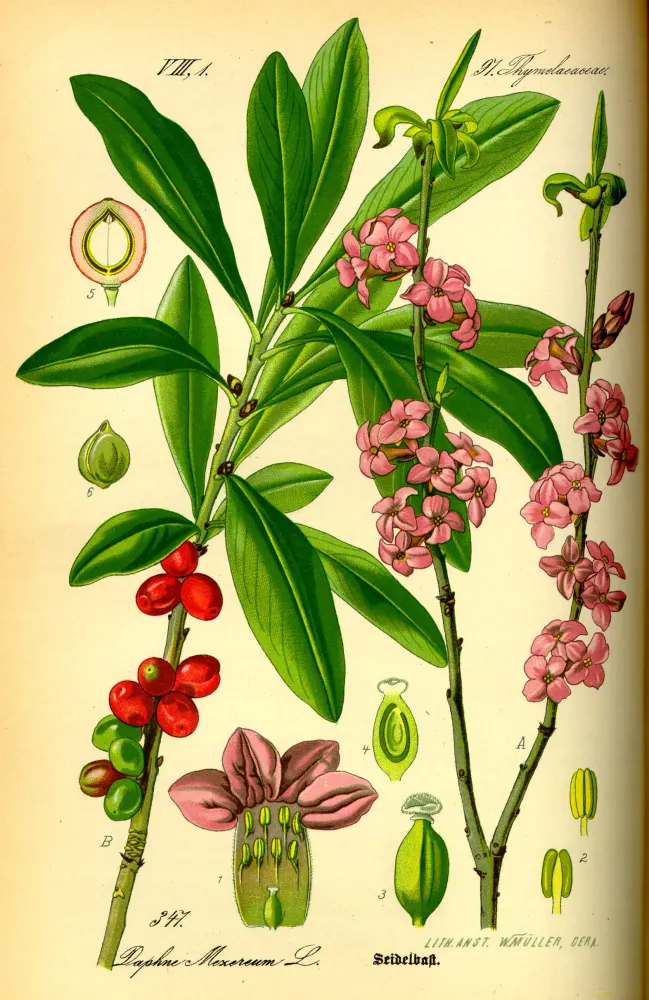
Daphne mezereum
Toxic🐾Echter Seidelbast · (Daphne mezereum)
Daphne family (Thymelaeaceae)
Description
Daphne mezereum, the mezereon, is a species of Daphne in the flowering plant family Thymelaeaceae, native to most of Europe and Western Asia, north to northern Scandinavia and Russia. In southern Europe it is confined to medium to higher elevations in the subalpine vegetation zone, but descends to sea level in northern Europe. It is generally confined to soils derived from limestone.
External use only!
This plant must NOT be taken internally. Use only as compress, salve, or bath.
CONTRAINDICATED during pregnancy
Diterpene esters (mezerein, daphnetoxin) are potent PKC activators with tumour-promoter activity; any oral, dermal or homeopathic application below D6 is absolutely contraindicated in pregnancy. Placental transfer very likely.
CONTRAINDICATED during breastfeeding
Due to diterpene toxicity and co-carcinogenic action, any use during lactation is strictly contraindicated. Skin contact with plant sap during garden pruning should also be avoided.
CONTRAINDICATED for children
Children are extremely at risk — the bright-red berries appear particularly tempting to toddlers. As few as 4–5 berries can be fatal. Mezereon must not be planted in home gardens with small children; if present: remove berries consistently, cut before ripening. Berries swallowed: IMMEDIATELY call poison control.
Critical drug interactions with:
Topische Reizmittel und Rubefacientia (Capsaicin-Pflaster, Senfmehl, Cantharidin) · Phorbol-Ester-haltige Forschungssubstanzen (TPA / PMA) und PKC-Modulatoren · Schleimhaut-reizende Medikamente (NSAR, Bisphosphonate, Kaliumchlorid-Retardpräparate)
- CompressBarkExternalTraditional use
Historical topical use of mezereon bark plaster (Cortex Mezerei) as a vesicant (blistering agent) and counter-irritant in chronic rheumatism, sciatica and joint pain. Per Maud Grieve (1931), the moist bark was softened in hot vinegar-water and applied as a compress — within 24–48 hours redness and blisters formed as a derivative irritant therapy. Roughly 3 cm² of bark are sufficient to induce a severe skin lesion with percutaneous diterpene absorption. Strictly obsolete today due to the unpredictable systemic toxicity of mezerein and daphnetoxin.
Preparation & dosage
[#src_grieve_daphne_mezereum] [#src_henriette_daphne_mezereum] [#src_pfaf_daphne_mezereum]
- SalveRootExternalFolk medicine
Historical application of a root-bark ointment to indolent ulcers, cold abscesses and poorly healing skin lesions — the ointment was meant to 'excite suppuration' by chemical irritation and accelerate healing. Maud Grieve and King's American Dispensatory document this use; the irritation rests on mezerein and daphnetoxin, which are massively absorbed through damaged skin. Strictly contraindicated today.
Preparation & dosage
[#src_grieve_daphne_mezereum] [#src_henriette_daphne_mezereum] [#src_pfaf_daphne_mezereum]
- CompressBarkExternalFolk medicine
Folk-medicinal application of softened bark to sore gums and toothache ('Kellerhals' — the German vernacular name refers to the burning in the throat on chewing). The chewing irritation was meant to produce salivation and a 'derivative' effect; in reality it causes severe mucosal corrosion with swelling of lips, tongue and pharynx. Considered obsolete since the 19th century.
Historical documentation only — do NOT use
These internal applications are historically documented. This plant is highly toxic — self-treatment can cause severe poisoning or death. For documentation only, explicitly NOT a recommendation.
- TinctureBarkInternalTraditional use
Historical internal use of Decoctum Mezerei and mezereum fluid extract in the 18th and 19th centuries as an 'alterative' for syphilis (especially mercurio-syphilis after mercury treatments), scrofula and chronic skin diseases. Usual dosing per King's American Dispensatory (1898): decoction 1–3 fluid ounces, powder 10 grains, fluid extract 2–10 drops. Despite these very low doses, poisonings were regularly recorded. Strictly obsolete today — no therapeutic window, co-carcinogenic risk via mezerein as tumour promoter.
Preparation & dosage
[#src_grieve_daphne_mezereum] [#src_henriette_daphne_mezereum] [#src_wp_de_daphne_mezereum]
- TinctureWhole plantInternalFolk medicine
Homeopathic use of Mezereum (mother tincture from fresh bark, proven by Samuel Hahnemann; typical dilution levels D6, D12, D30) for herpes zoster (shingles), post-herpetic neuralgia, itching eruptions with crust formation and bone pain. From D6 onwards preparations contain no pharmacologically active diterpene amount; licensed under medicinal-products law in Germany, Austria and Switzerland. Mother tincture and low potencies (D1–D3) remain highly toxic.
Preparation & dosage
- RawFruitInternalFolk medicine
Early modern folk medicine: use of the red berries as a drastic emetic and purgative — documented inter alia by Johannes Lonicer (16th century). A few berries were chewed to induce vomiting and diarrhoea; exceeding the arbitrary threshold caused mucosal corrosion and systemic poisoning. Lethal dose in children: 4–5 berries; in adults: 10–12 berries. Considered obsolete and dangerous since the late 19th century; purely ethnobotanical documentation.
[#src_wp_de_daphne_mezereum] [#src_wp_en_daphne_mezereum] [#src_pfaf_daphne_mezereum]