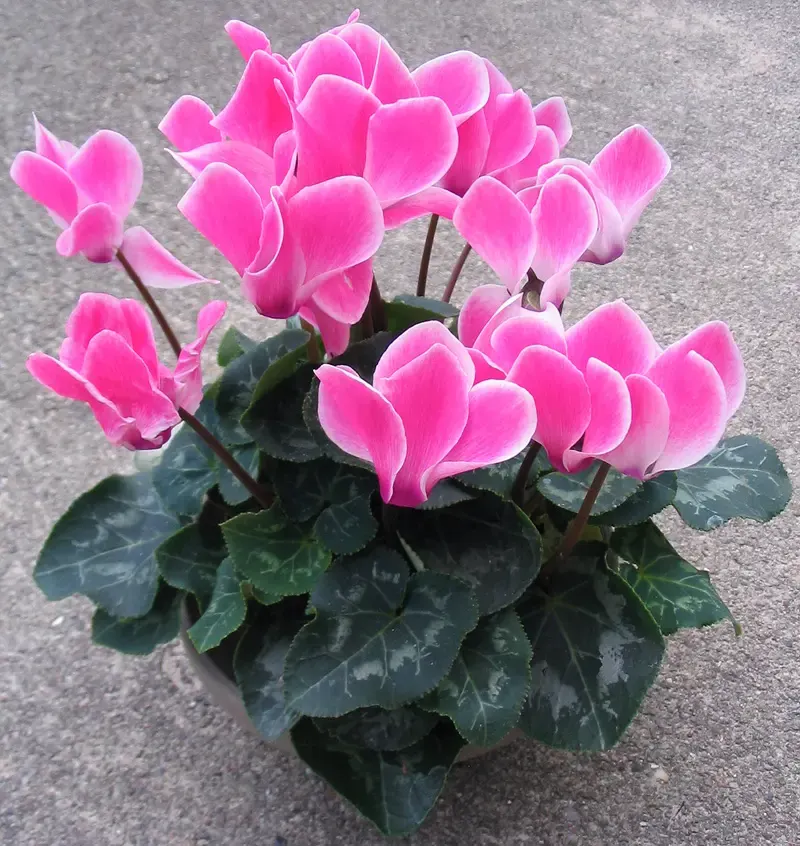
© Darkone, de:22. Oktober 2004 · CC BY-SA 2.0 · Commons
Cyclamen persicum
Toxic🐾Zimmer-Alpenveilchen · (Cyclamen persicum)
Primrose family (Primulaceae)
Description
Cyclamen persicum, the Persian cyclamen, is a species of flowering herbaceous perennial plant growing from a tuber, native to rocky hillsides, shrubland, and woodland up to 1,200 m (3,900 ft) above sea level, from south-central Turkey to the Levant. Cultivars of this species are the commonly seen florist's cyclamen.
External use only!
This plant must NOT be taken internally. Use only as compress, salve, or bath.
CONTRAINDICATED during pregnancy
Cyclamin and related saponins may exert uterine-contracting effects. Internal use during pregnancy is strictly contraindicated; external application also to be avoided.
CONTRAINDICATED during breastfeeding
No safety data available. Due to saponin toxicity, no use during lactation.
CONTRAINDICATED for children
Tuber is highly toxic — young children are at particular risk. Keep plant out of reach of children. No application in children under 18 years.
- RawWhole plantExternalFolk medicine
Cyclamen persicum is cultivated as a winter-flowering potted plant indoors. Its blooming season from October to March fills the decorative gap in many living spaces. Preferring cool temperatures and indirect light (12–16 °C, no direct sun), it is particularly suited to cool stairwells, hallways, and bedrooms.
- Salveuse.plant_part.bulbExternalFolk medicine
Historically in folk medicine, crushed or macerated cyclamen tubers were used externally as a counter-irritant rubefacient for gout, rheumatic joints, and skin rashes. The saponins (cyclamin, hederagenin glycosides) are believed to exert a locally irritant-rubefacient action. This application is documented solely historically and, due to saponin toxicity, is only defensible externally — strict avoidance of mucous membrane and eye contact.
[#src_reznicek_phytochem] [#src_harvala_planta_med] [#src_wiki_cyclamen_en]
- Compressuse.plant_part.bulbExternalFolk medicine
In several European folk medicine traditions, freshly grated cyclamen tubers were applied as compresses to furuncles, stubborn abscesses, and wounds to accelerate maturation. The saponin-rich plant juice is described as antiseptic and mildly skin-irritating. Hildegard of Bingen describes related Cyclamen species (Cyclamen europaeum) in her phytomedicinal writings for similar applications.
- Tinctureuse.plant_part.bulbExternalClinical trial
Saponin-containing extracts from Cyclamen europaeum (closely related to C. persicum) are used in nasal sprays (e.g. CYCLAMED) for acute rhinosinusitis. The hypertonic saponin solution induces secretolysis and mucosal drainage of the paranasal sinuses without systemic absorption. Cochrane Review 2014 (Zalmanovici Trestioreanu & Barua) rates clinical evidence as limited but methodologically permissible. This application applies only to certified finished preparations — NOT to self-made extracts.
Preparation & dosage
- Tinctureuse.plant_part.bulbExternalFolk medicine
Samuel Hahnemann included Cyclamen europaeum in his homeopathic pharmacopoeia (Materia Medica Pura). In a homeopathic context, highly diluted cyclamen preparations (D6–D30) are applied for dizziness, nausea, and menstrual complaints. The folk classification reflects the finding that at homeopathic high dilutions no pharmacologically active constituent remains detectable.
- Rawuse.plant_part.bulbExternalFolk medicine
Traditionally, cyclamen tubers were soaked in water in some Mediterranean regions to produce a mild rinse for skin parasites (scabies, lice). The saponins act as membrane-destabilising agents on small organisms. This practice is historically documented but dangerous: overdosing or swallowing causes severe irritation of the gastrointestinal mucosa.