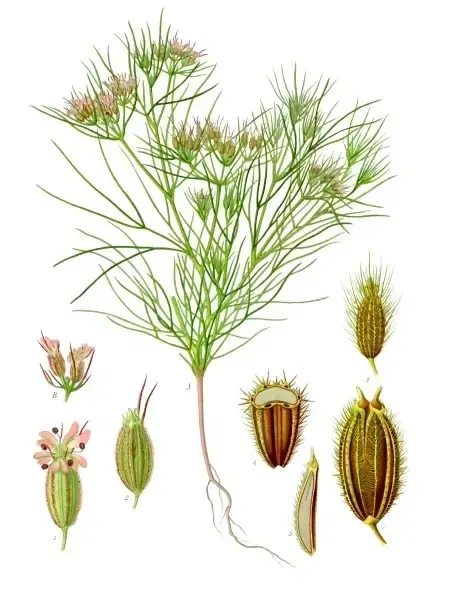
© Franz Eugen Köhler, Köhler's Medizinal-Pflanzen · Public domain · Commons
Cumin
CautionKreuzkümmel · (Cuminum cyminum)
Carrot family (Apiaceae)
Description
Cumin is a flowering plant in the family Apiaceae, native to the Irano-Turanian Region. Its seeds – each one contained within a fruit, which is dried – are used in the cuisines of many cultures in both whole and ground form. Although cumin is used in traditional medicine, there is no high-quality evidence that it is safe or effective as a therapeutic agent.
🌿 Risk of confusion — read before wild-harvesting!
Cumin as a culinary spice is safe in normal amounts. The essential oil can cause skin irritation in sensitive individuals (do not apply undiluted). Do not confuse with caraway (Carum carvi). Cumin seeds may lower blood sugar – monitor for interactions with antidiabetic medication.
- SpiceSeedInternalTraditional use
Dried cumin seeds are one of the oldest culinary spices in the world. The characteristic intense smell comes from cuminaldehyde. Cumin acts carminatively and antispasmodically and is used in Ayurvedic medicine to promote digestion (strengthening Agni). Toasting in a pan intensifies the aroma through formation of pyrazines.
[#src_wp_de_kreuzkuemmel] [#src_wp_en_cumin] [#src_pfaf_cumin]
- TeaSeedInternalFolk medicine
In Ayurvedic and Persian folk medicine, an infusion of crushed cumin seeds (jeera water) is used for flatulence, digestive complaints, nausea and colic. Efficacy is based on the essential oil released when the seeds are crushed.
Preparation & dosage
Lightly crush seeds, pour over 200 ml hot water, steep 10 minutes, strain.
- Dry amount
- 1–2 g
- Doses per day
- 3×
- SpiceSeedInternalFolk medicine
In Ayurvedic tradition and Iranian folk medicine, cumin seeds are used for dysmenorrhoea (painful menstruation). Preclinical data suggest uterine-relaxing and analgesic properties; clinical studies are limited.
- TeaSeedInternalFolk medicine
In various traditional cultures, cumin is regarded as a galactagogue (lactation-promoting plant). A cumin seed infusion is given to nursing mothers. Evidence is limited; a small clinical pilot study found positive effects on breastfeeding indicators.
- Essential oilSeedExternalFolk medicine
The essential oil from cumin seeds shows antibacterial and antifungal activity in vitro. Used externally, well diluted (1–2 % in carrier oil), in folk medicine for skin infections. Do not apply undiluted – irritation potential.
- SpiceSeedInternalFolk medicine
Until the Middle Ages, valued mainly as a medicinal spice in Europe; in the Ayurvedic tradition, cumin seeds are used to support the liver and gallbladder and as a stimulant for the entire digestive tract. In Western Europe the plant was largely replaced by caraway (Carum carvi).