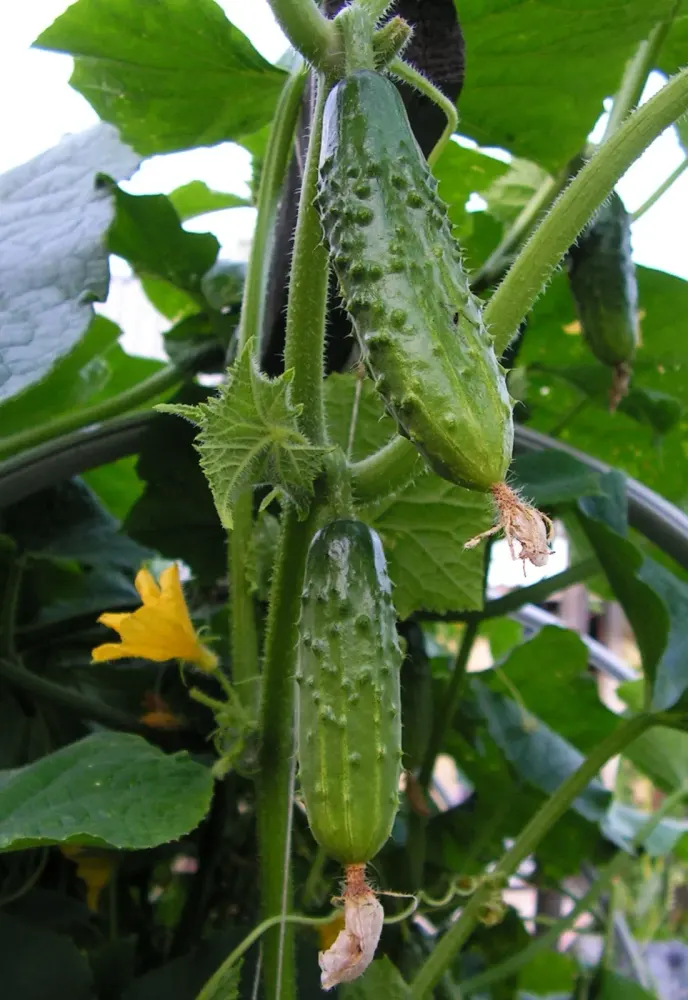
© Bff · CC BY-SA 3.0 · Commons
Cucumber
Gurke · (Cucumis sativus)
Gourd family (Cucurbitaceae)
Description
At around 95 % water, the cucumber is one of the most refreshing vegetables of summer, harvested from July through October. Beyond water it supplies potassium, vitamin K, modest vitamin C, fibre and silica. In the kitchen it is eaten raw, pickled or juiced; folk tradition has long placed cucumber slices on the skin as a cooling compress, for tired eyes or minor irritation, and the seeds have also seen traditional use. Cucumbers are very well tolerated by most people. One important warning sign is bitterness: it points to elevated levels of cucurbitacins, bitter compounds that can build up under growth stress or through crossing with wild relatives, and which may cause nausea and digestive upset. Noticeably bitter fruit should therefore not be eaten.
Fresh cucumber as raw food — salads, snacking, tzatziki. With a water content of approx. 95 %, cucumber is one of the most water-rich foods available and contributes significantly to daily fluid intake. Very low in calories (~15 kcal/100 g), a source of dietary fibre, vitamin K, and potassium. The skin contains more fibre and chlorophyll — eat it when organically grown.
Cucumber infusion water ("detox water"): cucumber slices with fresh mint or lemon steeped in cold water for several hours. Well known in folk tradition as a refreshing summer drink; no clinically proven detoxification effect, but an enjoyable method to increase fluid intake.
Pickled cucumbers (pickles, salt cucumbers, fermented sour cucumbers): cucumbers are preserved in vinegar brine (pickles) or via lactic acid fermentation (mustard pickles, Polish Ogórki kiszone). Fermented varieties provide live lactic acid bacteria (probiotics) and are culturally embedded across Europe, Asia, and North America. Dill, garlic, and horseradish are classic seasoning partners.
Cucumber eye compresses: fresh, chilled cucumber slices placed on closed eyelids (5–15 minutes). Traditionally used for tired, puffy, or irritated eyes. The cooling effect is primarily physical (cold + high water content). Contained flavonoids and vitamin C are described in folk medicine as anti-inflammatory; clinical evidence is lacking.
Cucumber skin masks and compresses: grated or thinly sliced cucumber pulp applied to the skin — used in folk cosmetics for mild sunburn, reddened or sensitive skin, and as a refreshing facial treatment. The high water content and mildly astringent environment are considered soothing and cooling. Not suitable for open wounds or severe burns.
Garden silicon source: cucumbers contain notable amounts of silicon (silicic acid), which in folk medicine and naturopathy is associated with skin, hair, and connective tissue health. Scientifically, silicon is not conclusively recognised as an essential trace element; evidence for dietary effects is limited. Cucumber remains one of the most accessible dietary sources of this mineral.
Pumpkin-seed-like use of cucumber seeds: in some cultures cucumber seeds are dried and used as a light snack or oil source. The seeds contain more fat and protein than the flesh. In folk medicine, cucumber seeds were historically described as a mild anthelmintic (similar to pumpkin seeds) — not clinically substantiated for Cucumis sativus.
Cucumbers are generally very well-tolerated by humans. WARNING regarding bitterness: cucurbitacins are bitter, toxic triterpene compounds that can be significantly elevated in wild cucumbers or occasionally in cultivated varieties (especially pickling cucumbers under stress from heat, drought, or crossing with wild relatives). Do NOT eat strongly bitter fruits — bitterness is a warning signal. Cucurbitacin poisoning can cause nausea, vomiting, diarrhoea, and abdominal cramps. Occasionally cucumbers, especially the skin, may cause mild digestive discomfort (bloating, heartburn) in sensitive individuals. ASPCA classification (accessed 2026-08-10): non-toxic to dogs and cats.
Commercial cucumbers in normal dietary amounts are considered safe in pregnancy. Avoid very bitter fruits (cucurbitacins).
Safe in normal dietary amounts. Avoid very bitter cucumbers.
Well suited for children. Always avoid very bitter fruits. Young children may have the skin peeled for easier digestion.
Contraindications
- Strongly bitter cucumber fruits (elevated cucurbitacin content) — do not consume.
- Known hypersensitivity or allergy to Cucurbitaceae (e.g. cucumbers, melons, courgettes) — cross-reactions possible.
Harvested part: fresh fruits
- Time of day:
- Prefer cool morning or evening hours — the fruits are then firm and juicy. Midday heat stresses the plant and can cause harvested fruits to wilt more quickly.
- Drying:
- HARVEST YOUNG & REGULARLY: cucumbers are harvested at optimal size (slicing cucumbers approx. 20–30 cm, pickling cucumbers 5–10 cm). Overripe fruits turn yellow, become bitter (cucurbitacins increase), and slow further fruit development. Therefore: check and harvest every 1–2 days — the more frequently harvested, the more fruits the plant produces. Cut with a sharp knife, do not pull (causes plant damage). Store freshly harvested cucumbers at refrigerator temperature (approx. 10–12 °C, not colder — cucumbers are cold-sensitive) for up to 1 week.
- Storage:
- 1 months — Store cool (10–12 °C), not below 8 °C (cold damage possible). Do not store next to tomatoes or apples — ethylene gas from these fruits accelerates yellowing. Unwashed in the skin keeps for up to 7 days.
- Time of day:
- Seed harvest from fully ripe, already yellowing fruits deliberately left to ripen fully on the plant. Choose dry weather.
- Drying:
- SEED SAVING: cut open overripe yellow cucumbers, ferment seed pulp in water for approx. 2–3 days (destroys germination-inhibiting gel). Viable seeds sink, empty ones float. Drain, wash seeds, and dry thoroughly on paper at room temperature (at least 1–2 weeks). Store dry, cool, and dark — viability approx. 3–5 years. Only sensible with non-hybrid (open-pollinated, OP) varieties.
- Storage:
- 36 months — Fully dried, airtight sealed, cool and dark — viability 3–5 years.
- Wasser (H₂O)OtherContent: ca. 95 %
The dominant constituent of cucumber — making it one of the most water-rich foods available. Primarily responsible for the cooling effect in external application and for the hydrating effect when eaten.
- Vitamin K (Phylloquinon)VitaminContent: ca. 16 µg/100 g (ca. 13–20 % der RDA)
The most significant micronutrient highlight of cucumber. Phylloquinon (Vitamin K1) is essential for blood coagulation and bone metabolism. Cucumbers are a notable plant-based source of vitamin K.
- Vitamin C (L-Ascorbinsäure)VitaminContent: ca. 2–3 mg/100 g
Present in moderate amounts; contributes to overall vitamin C intake, though not a primary source. Antioxidant, relevant for immune function and collagen synthesis.
- KaliumMineralContent: ca. 150–160 mg/100 g
Notable potassium source, relevant for electrolyte balance, cardiac function, and blood pressure regulation. Cucumbers can contribute to dietary potassium intake.
- Ballaststoffe (Cellulose, Pektin)PolysaccharideContent: ca. 0,5 g/100 g
Primarily cellulose in the skin and pectin in the flesh. Support intestinal motility and promote a healthy gut environment. Fibre content is moderate — higher in unpeeled cucumber.
- Cucurbitacine (Cucurbitacin B, D, E)BitterContent: Spuren bis wenige ppm (in bitteren Früchten deutlich höher)
Bitter triterpene compounds responsible for the plant's evolutionary anti-herbivore defence. Strongly reduced by breeding in modern cultivars; stress conditions (heat, drought, crossing with wild relatives) can cause levels to increase again. High cucurbitacin levels are toxic (gastrointestinal irritation, in extreme cases life-threatening).
- Silicium (Kieselsäure, SiO₂ als ortho-Kieselsäure)MineralContent: ca. 1–2 mg/100 g
Cucumbers are considered one of the better dietary sources of bioavailable silicon, associated in naturopathy with connective tissue, skin, and nail health. The evidence base for silicon's essentiality in humans is not yet conclusive.
- Flavonoide (Quercetin, Kaempferol, Apigenin — Spuren)FlavonoidContent: Spuren
Small amounts of polyphenolic flavonoids, particularly in the skin and seeds. Antioxidant and mildly anti-inflammatory properties described in vitro; the contribution from a normal serving of cucumber is nutritionally modest.
- [1]MonographUSDA FoodData Central — Cucumber, with peel, raw (FDC ID: 168409)(accessed: 2026-05-21)
- [2]MonographPlants For A Future (PFAF) — Cucumis sativus database entry(accessed: 2026-05-21)
- [6]MonographASPCA Animal Poison Control — Cucumber (Cucumis sativus)(accessed: 2026-08-10)
- [3]WikipediaGurke (Wikipedia DE)(accessed: 2026-05-21)
- [4]WikipediaCucumber (Wikipedia EN)(accessed: 2026-05-21)
- [5]WikidataCucumis sativus — Wikidata (Q1419186)(accessed: 2026-05-21)
🤝 Permaculture Partners
In your garden, this plant acts as:
✨ Best symbiotic partners
- 🌿 Onion Onion deters mildew spores from cucumbers.
- 🌿 Dill Classic: dill with pickled cucumbers — also best bed partners.
- 🌿 Calendula officinalis Calendula deters nematodes and attracts beneficials.
- 🌿 Lettuce Classic companion-planting partner.
- 🌿 Phaseolus vulgaris Classic companion-planting partner.
- 🌿 Pea Classic companion-planting partner.
- 🌿 Tropaeolum majus Nasturtium deters cucumber pests.
- 🌿 Maize Maize serves as climbing frame for cucumber (Three Sisters analogue).
⚠️ Better not planted together
- 🥬 Tomato Tomato and cucumber share fungal disease (mildew) — cross-infection.
📦 Part of these planting sets:
Source: Gertrud Franck, Gesunder Garten durch Mischkultur (1980, eigene Kuration) | Helga und Margarete Langerhorst, Mein gesunder Naturgarten (eigene Kuration)