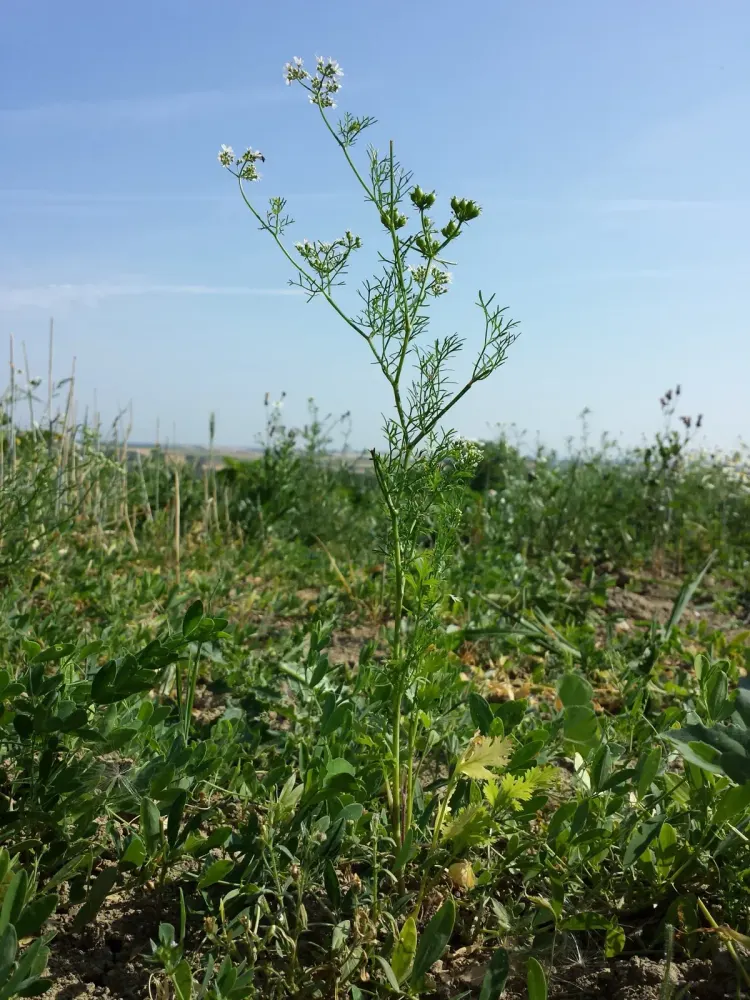
© Stefan.lefnaer · CC BY-SA 4.0 · Commons
Coriander
CautionEchter Koriander · (Coriandrum sativum)
Carrot family (Apiaceae)
Description
Coriander, or Coriandrum sativum, is an annual herb in the family Apiaceae. The leaves are known as cilantro in the US. Most people perceive the leaves as having a fresh, slightly citrus taste.
- SpiceSeedInternalCommission E
Dried coriander seeds (fruits) are a classic culinary and medicinal spice. Commission E approved coriander seeds for dyspeptic complaints and loss of appetite. The carminative and antispasmodic effect is attributed to the essential oil (main constituent linalool).
Preparation & dosage
Lightly crush or crack seeds before infusion. Pour 150 ml hot water over 1.5–3 g fruits, steep 10 minutes, strain. Up to 3 times daily.
- Dry amount
- 1.5–3 g
- Doses per day
- 3×
[#src_pfaf_coriander] [#src_altmeyers_coriander] [#src_wp_de_koriander]
- RawLeafInternalFolk medicine
Fresh coriander leaves (cilantro) are used worldwide as a culinary herb. They are rich in vitamins A, C and K, as well as calcium and iron. The characteristic smell comes from aliphatic aldehydes (2-decenal, 2-dodecenal). Genetically, about 10–15 % of people perceive these aldehydes as soapy.
- TeaSeedInternalTraditional use
In the folk medicine tradition of Europe and the Middle East, crushed coriander seeds are used as tea for flatulence, colic and nervous tension. Coriander as a component of digestive tea blends (with fennel, caraway, anise) is documented since the 19th century.
- Essential oilSeedExternalFolk medicine
The essential oil from coriander seeds (linalool-dominated) shows antibacterial activity against gram-positive and gram-negative bacteria in vitro. A topical lipolotion product (1 % coriander oil) is used for skin care in superinfected eczema. Must be well diluted (1–2 % in carrier oil).
- SpiceSeedInternalFolk medicine
In Ayurvedic and Persian folk medicine, coriander seeds are used for palpitations, anxiety and headaches. Preclinical studies confirm anxiolytic and anticonvulsant properties of linalool; human clinical evidence is lacking.
[#src_pmc_coriander_neuroprotective] [#src_pmc_coriander_ethnobotany]
- CompressAerial partsExternalFolk medicine
Externally, coriander was used in folk medicine as a compress for rheumatic complaints. A decoction of leaves or seeds is applied to cloths and placed on the joints.
Distribution in Europe
🪴 Grow at home
- ☀ Light
- partial shade
- 💧 Water
- every few days
- 🌱 Soil
- Loose, humus-rich
- 🪴 Pot
- 18 cm
- ⭐ Difficulty
- ★★☆ intermediate
- 🐾 Pets
- pet-safe
Tips:
- Bolts quickly in heat — sow new every 2-3 weeks.
- Sow in place — doesn't tolerate transplanting.
- Both leaves (cilantro) AND seeds (coriander spice) usable.
Care tips are general indoor-gardening recommendations, not scientific sources.
🤝 Permaculture Partners
In your garden, this plant acts as:
✨ Best symbiotic partners
⚠️ Better not planted together
Source: Gertrud Franck, Gesunder Garten durch Mischkultur (1980, eigene Kuration) | Helga und Margarete Langerhorst, Mein gesunder Naturgarten (eigene Kuration)