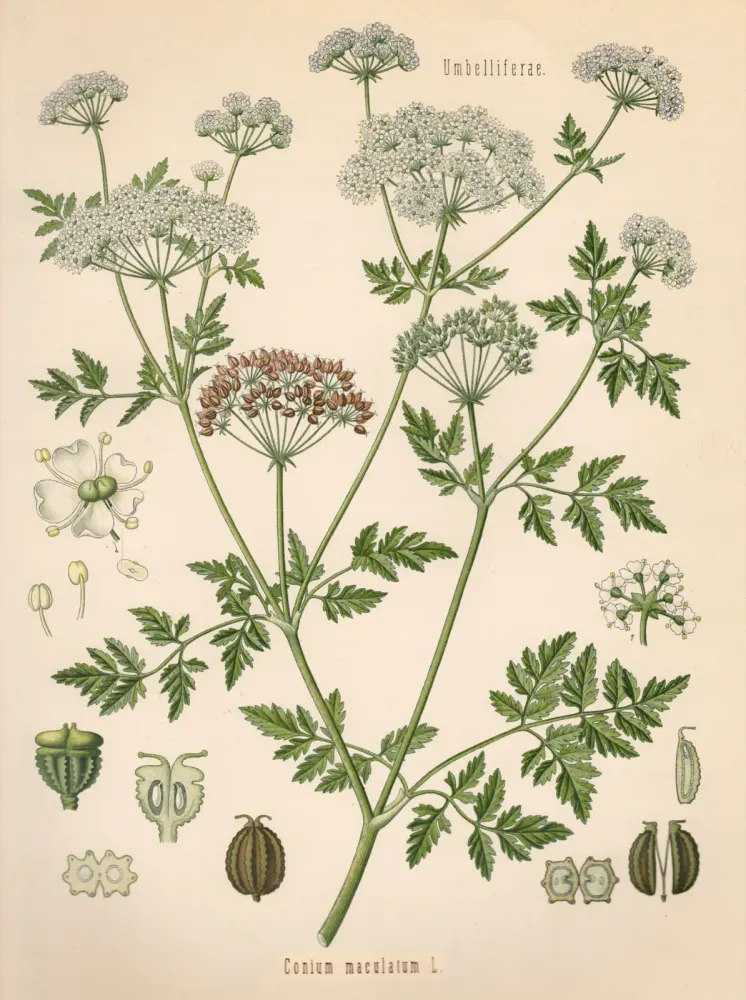
© Köhlers Medizinalpflanzen · Public domain · Commons
Conium maculatum
Toxic🐾Gefleckter Schierling · (Conium maculatum)
Carrot family (Apiaceae)
Description
Conium maculatum, commonly known as hemlock or poison hemlock, is a highly poisonous flowering plant and a nitrophile weed species in the carrot family Apiaceae.
🌿 Risk of confusion — read before wild-harvesting!
FATALLY TOXIC — ENTIRE PLANT, ESPECIALLY UNRIPE FRUITS AND ROOT. RISK OF CONFUSION with parsley, meadow chervil, anise, garden chervil — distinguishing features: red-spotted stem, hairless foliage, intense mouse-urine smell when crushed.
External use only!
This plant must NOT be taken internally. Use only as compress, salve, or bath.
CONTRAINDICATED during pregnancy
Coniine crosses the placenta and is a documented teratogen — use during pregnancy can cause congenital malformations (in particular cleft palate and limb deformities, documented in animal and porcine models) as well as ascending paralysis in the foetus. Any exposure during pregnancy is absolutely contraindicated.
CONTRAINDICATED during breastfeeding
Coniine passes into breast milk and can trigger neuromuscular paralysis in the infant. Breastfeeding: strictly contraindicated.
CONTRAINDICATED for children
Children are extremely sensitive to coniine. Even a few leaves can be fatal. Confusion poisonings with parsley or chervil are especially dangerous. No use in children and adolescents under 18 years.
Critical drug interactions with:
Nicht-depolarisierende neuromuskuläre Blocker (Rocuronium, Vecuronium, Cisatracurium) · Depolarisierende Muskelrelaxantien (Succinylcholin) · Atemdepressiva (Opioide, Benzodiazepine, Barbiturate, GABA-Agonisten)
- SalveLeafExternalTraditional use
Historical external use of hemlock ointments and oil extracts for gout, painful ulcers, tumours and inflamed lymph nodes. Already recommended in medieval herbals (15th–16th centuries) as well as by Nicholas Culpeper (1650s) for external swellings; in the 18th century promoted by the Viennese physician Anton von Störck as a 'resolving and altering' remedy. Officinal in pharmacopoeias 1864–1934. Today abandoned due to toxicity (skin absorption of coniine).
Preparation & dosage
[#src_wp_en_conium_maculatum] [#src_wp_de_conium_maculatum] [#src_pfaf_conium_maculatum]
- CompressLeafExternalFolk medicine
Folk medicinal external use as compress for mastitis, malignant tumours (particularly breast), anal fissures and haemorrhoids. Widely promoted as a cancer remedy in the 18th and 19th centuries. Plants for a Future reports 'ointments and oils' for these indications. Today no longer used due to uncertain efficacy and systemic toxicity.
Preparation & dosage
- TinctureAerial partsExternalFolk medicine
Antique and medieval use as sedative and hypnotic: Dioscorides (Materia Medica, 1st cent.) and Pliny the Elder (Naturalis Historia) describe hemlock (Greek kōneion, Latin cicuta) as external analgesic and, in small amounts, as a sedative. In pharmacopoeias Conii herba was listed as a sedative — dose-dependently highly toxic.
Preparation & dosage
[#src_wp_en_conium_maculatum] [#src_hotti_2017_conium_maculatum]
Historical documentation only — do NOT use
These internal applications are historically documented. This plant is highly toxic — self-treatment can cause severe poisoning or death. For documentation only, explicitly NOT a recommendation.
- TinctureAerial partsInternalTraditional use
Historical pharmaceutical use of hemlock extract (Extractum Conii) as antispasmodic for tetanus, whooping cough and epileptic seizures in the 18th and 19th centuries. Coniine acts on the nicotinic acetylcholine receptor — at excessive dose ascending paralysis. Today replaced by benzodiazepines and modern anticonvulsants; pharmaceutical use obsolete.
Preparation & dosage
[#src_wp_de_conium_maculatum] [#src_hotti_2017_conium_maculatum] [#src_pfaf_conium_maculatum]
- TinctureAerial partsInternalFolk medicine
Homeopathic use of Conium maculatum (D6–C30), typically as constitutional remedy for glandular indurations, vertigo in the elderly, paralytic symptoms and premenstrual complaints. Pure homeopathic dilution levels (from C12) contain no pharmacologically active coniine amounts. Widespread in classical homeopathy.
Preparation & dosage
[#src_pfaf_conium_maculatum] [#src_wikidata_conium_maculatum]
- RawFruitInternalFolk medicine
Historical-juridical use of the hemlock cup in classical Athens (5th/4th cent. BCE) as method of execution — most famous application: the execution of Socrates in 399 BCE, documented in Plato's dialogue Phaedo. Preparation from crushed unripe fruits and roots in water or wine. Plato describes the ascending paralysis from the feet upward with consciousness retained. Pure historical cultural phenomenon — no application recommendation.
Preparation & dosage
[#src_dayan_2024_conium_maculatum] [#src_hotti_2017_conium_maculatum] [#src_wp_de_conium_maculatum]