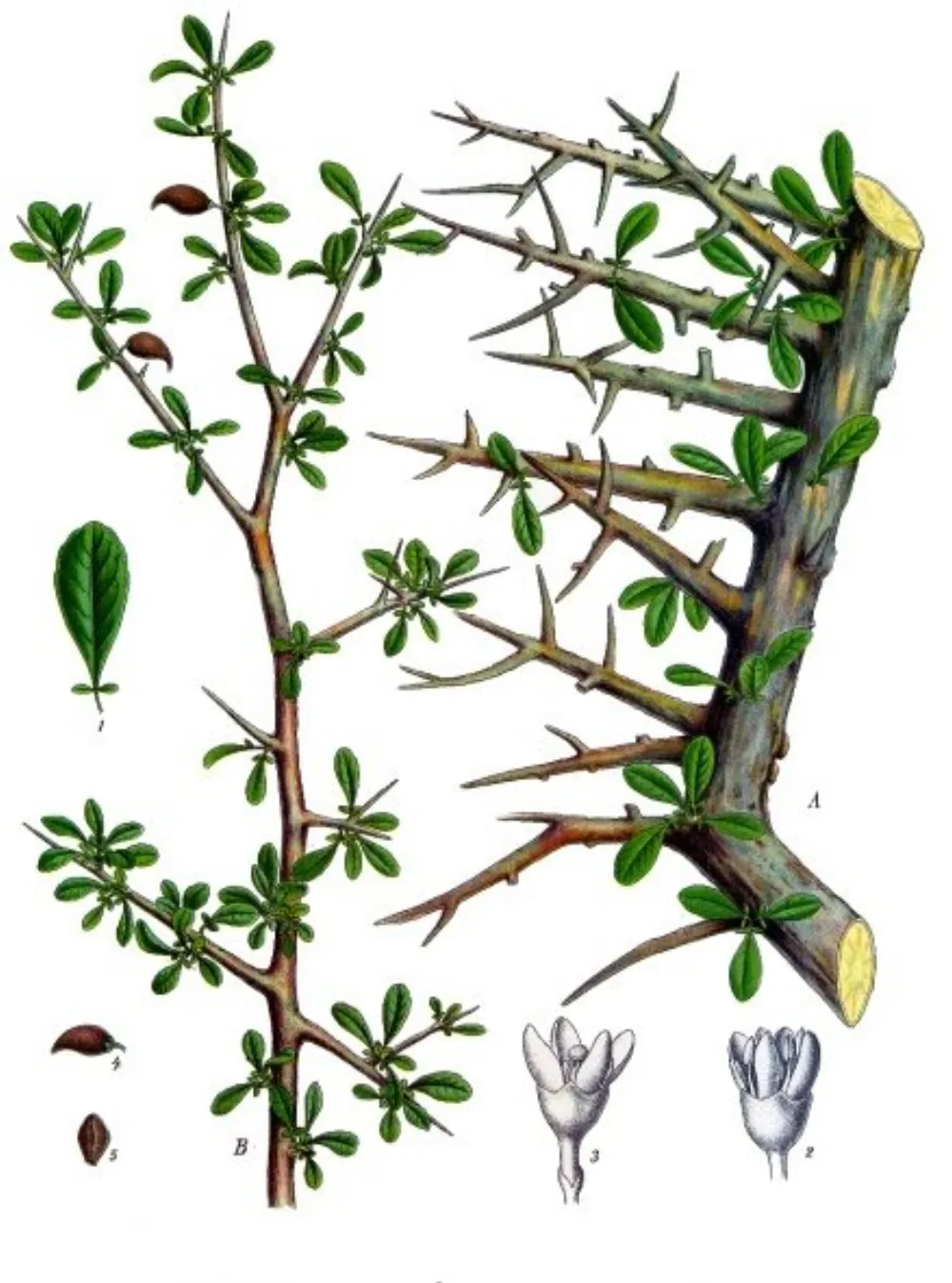
© Franz Eugen Köhler (Köhler's Medizinal-Pflanzen) · Public domain · Commons
Myrrh
CautionMyrrhe (Echte Myrrhe) · (Commiphora myrrha)
Torchwood family (Burseraceae)
Description
Myrrh is a thorny small tree or shrub native to north-eastern Africa and the Arabian Peninsula (Somalia, Ethiopia, Yemen, Oman). When the bark is wounded, a fragrant oleo-gum-resin exudes and hardens in the air into reddish-brown, brittle tears. This resin (Myrrha) has been used since antiquity as incense, for embalming, and as a medicine. The bark is two-layered, with a silvery-grey papery outer layer and a green inner layer.
External use only!
This plant must NOT be taken internally. Use only as compress, salve, or bath.
CONTRAINDICATED during pregnancy
Do not use during pregnancy. Myrrh is traditionally regarded as an emmenagogue and uterine stimulant; safety has not been established.
CONTRAINDICATED for children
Do not use in children under 12 years of age (EMA monograph).
- GargleBarkExternalTraditional use
Traditional use for minor inflammation and small ulcers (sores) of the mouth and throat mucosa.
Preparation & dosage
Dab myrrh tincture (from the bark resin) undiluted onto the affected mouth or throat mucosa 2-3× daily with a cotton swab, or add 5-10 drops to a glass of water and use as a mouthwash/gargle. Do not swallow in larger amounts.
- Doses per day
- 3×
⚠ Age restriction: ≥ 12 years — Per the EMA monograph, use only in adults and adolescents over 12 years of age.
- SalveBarkExternalTraditional use
Traditional topical use for minor wounds and small boils (skin sores).
Preparation & dosage
Apply myrrh tincture or a resin-based salve thinly to minor wounds and small boils. The alcohol in the tincture may cause short-lived stinging on application to the skin.
- Doses per day
- 3×
⚠ Age restriction: ≥ 12 years — Per the EMA monograph, use only in adults and adolescents over 12 years of age.
🤝 Permaculture Partners
In your garden, this plant acts as: