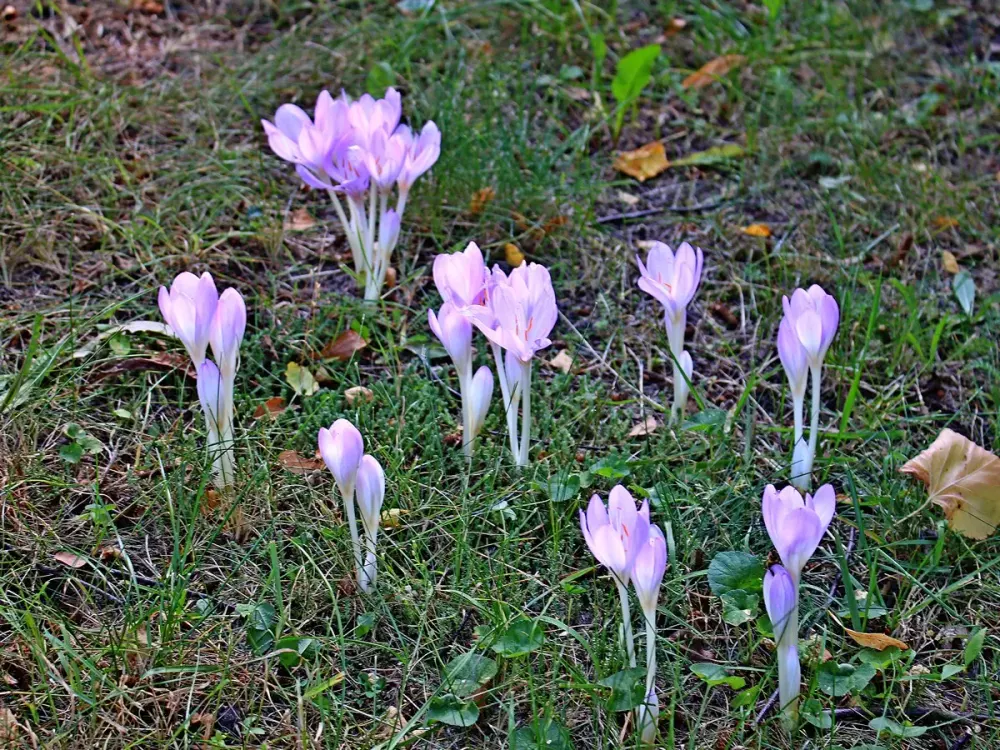
© Frank Liebig · CC BY-SA 3.0 de · Commons
Colchicum autumnale
Toxic🐾Herbstzeitlose · (Colchicum autumnale)
Autumn-crocus family (Colchicaceae)
Description
Colchicum autumnale, commonly known as autumn crocus, meadow saffron, naked boys or naked ladies, is a toxic autumn-blooming flowering plant that resembles the true crocuses, but is a member of the plant family Colchicaceae, unlike the true crocuses, which belong to the family Iridaceae. It is called "naked boys/ladies" because the flowers emerge from the ground long before the leaves appear. Despite the vernacular name of "meadow saffron", this plant is not the source of saffron, which is obtained from the saffron crocus, Crocus sativus – and that plant, too, is sometimes called "autumn cr...
🌿 Risk of confusion — read before wild-harvesting!
Colchicum autumnale (autumn crocus) is one of the most toxic plants in Central Europe. Animal hazard: highly toxic to dogs, cats and horses (ASPCA) — even small amounts can be fatal.
External use only!
This plant must NOT be taken internally. Use only as compress, salve, or bath.
CONTRAINDICATED during pregnancy
Colchicine is teratogenic and embryotoxic in animal studies. Contraindicated even as a pharmaceutical drug in pregnancy. The plant itself is absolutely contraindicated.
CONTRAINDICATED during breastfeeding
Colchicine is excreted into breast milk. Breastfeeding is contraindicated even with pharmaceutical use. The plant is absolutely contraindicated.
CONTRAINDICATED for children
No application of plant preparations from Colchicum autumnale in children and adolescents. Pharmaceutical colchicine may only be used in children under strict medical indication (e.g. FMF).
Critical drug interactions with:
CYP3A4-Inhibitoren (z. B. Clarithromycin, Erythromycin, Itraconazol) · P-Glykoprotein-Inhibitoren (z. B. Ciclosporin, Verapamil)
Historical documentation only — do NOT use
These internal applications are historically documented. This plant is highly toxic — self-treatment can cause severe poisoning or death. For documentation only, explicitly NOT a recommendation.
- Rawuse.plant_part.bulbInternalClinical trial
Colchicine, the active compound isolated from Colchicum autumnale, is an approved pharmaceutical for treating acute gout flares. The placebo-controlled double-blind study by Terkeltaub et al. (2010) showed that low-dose colchicine (1.2 mg + 0.6 mg after 1 hour) is as effective as high-dose protocols, with a significantly better tolerability profile. IMPORTANT: This indication applies exclusively to standardised pharmaceutical colchicine preparations (e.g. Colchicum-Dispert®). The plant itself is NOT suitable for self-administration — no therapeutic window exists; fatalities have been documented.
Preparation & dosage
[#src_terkeltaub_2010_gout] [#src_wiki_colchicum_de] [#src_pfaf_colchicum]
- Rawuse.plant_part.bulbInternalClinical trial
Pharmaceutical colchicine (active compound from Colchicum autumnale) is the first-line therapy for familial Mediterranean fever (FMF). Levy and Eliakim (1977) and Peters et al. (1978) documented in early prospective studies the prevention of fever attacks and prophylaxis of AA amyloidosis with long-term use. Today recognised internationally as the standard therapy. Only as a pharmaceutical, not as a plant product.
Preparation & dosage
- Rawuse.plant_part.bulbInternalClinical trial
In the COLCORONA analysis (Tardif et al., published in Journal of Diabetes and Clinical Research 2021), pharmaceutical colchicine was investigated in outpatient COVID-19 patients. Colchicine inhibited the excessive inflammatory response (inflammasome activation) and, in PCR-confirmed cases, reduced the combined endpoint risk (hospitalisation, ventilation, death). The study pertains to pharmaceutical colchicine, not plant extracts.
Preparation & dosage
- Rawuse.plant_part.bulbInternalClinical trial
Pharmaceutical colchicine (from Colchicum autumnale) is a documented treatment for Behçet's disease. In the randomised double-blind trial by Yurdakul et al. (2001), colchicine significantly reduced the frequency of skin manifestations and joint attacks in Behçet's patients. Only as a prescription pharmaceutical.
Preparation & dosage
- TeaSeedInternalFolk medicine
Historically in folk medicine, Colchicum autumnale was used in European folk medicine and by Arab physicians of the Middle Ages (Ibn Sina / Avicenna, c. 980–1037) for joint pain, gout, and dropsy. Due to the lack of a therapeutic window and documented fatalities from colchicine poisoning, any folk-medicine self-administration of the plant is today STRICTLY CONTRAINDICATED. Historical documentation without any recommendation to follow.
Preparation & dosage
- TinctureSeedInternalFolk medicine
In the 19th and early 20th centuries, a standardised Colchicum seed extract (Colchicinum crudum) was used in phytotherapy before pure colchicine was isolated. Maud Grieve documents its use for gout in 'A Modern Herbal' (1931). The historical tincture had unpredictable active substance content and caused poisonings. Today obsolete and STRICTLY CONTRAINDICATED — listed here for historical documentation only.
Preparation & dosage
- Rawuse.plant_part.bulbInternalFolk medicine
Colchicum autumnale is known homeopathically as the remedy 'Colchicum' and is used for gout, acute joint pain, and digestive complaints, among other indications. Homeopathic potentisation (D4 and above) contains no pharmacologically relevant amounts of colchicine. Homeopathic Colchicum preparations are legally available and considered safe when correctly potentised.
Preparation & dosage