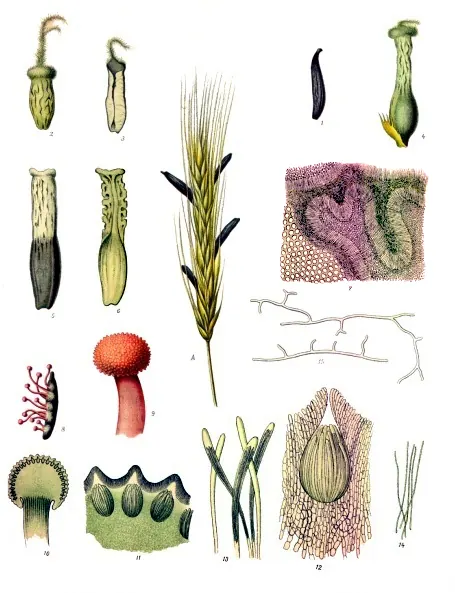
© Franz Eugen Köhler, Köhler's Medizinal-Pflanzen (1887) · Public domain · Commons
Ergot
Toxic🐾Mutterkorn · (Claviceps purpurea)
Clavicipitaceae (Clavicipitaceae)
Description
Claviceps purpurea is an ascomycete fungus of the family Clavicipitaceae that infects the ovaries of grasses and cereals, especially rye. In place of the grain it forms a hard, dark, curved resting structure called the sclerotium or ergot. This contains a complex mixture of ergot alkaloids derived from lysergic acid. The fungus overwinters in the soil and germinates in spring under cool, moist conditions. Flour contaminated with ergot caused mass poisonings for centuries.
🌿 Risk of confusion — read before wild-harvesting!
Eating cereal contaminated with ergot causes ergotism (St. Anthony's fire): a gangrenous form with strong vasoconstriction, burning pain and loss of limbs, and a convulsive form with seizures, hallucinations and nerve damage. Historical epidemics caused many deaths. Ergot and its alkaloids are highly toxic; self-use is life-threatening.
Historical documentation only — do NOT use
These internal applications are historically documented. This plant is highly toxic — self-treatment can cause severe poisoning or death. For documentation only, explicitly NOT a recommendation.
- TinctureInternalClinical trial
Ergot preparations were traditionally used to induce labor and control bleeding after childbirth; ergometrine, isolated in 1935, is used for postpartum hemorrhage because it contracts the uterus. Only as a tested medicine under medical supervision.
- TinctureInternalClinical trial
Ergotamine and dihydroergotamine are used against acute migraine attacks because of their vasoconstrictive action — as prescription medicines.