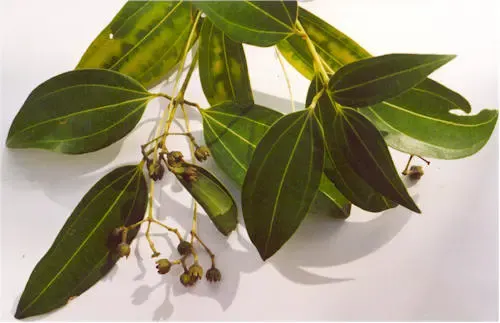
© Unknown · Public domain · Commons
Cinnamomum verum
CautionEchter Zimt · (Cinnamomum verum)
Laurel family (Lauraceae)
Description
True cinnamon, also called Ceylon cinnamon, comes from an evergreen laurel-family tree native to Sri Lanka. The part used is the inner bark of young shoots: peeled off, it curls on drying into thin-walled, multi-layered quills that crumble between the fingers — quite unlike the thick, hard cassia cinnamon from China. The bark's essential oil is 60 to 90 percent cinnamaldehyde, accompanied by eugenol and type-A procyanidins. In 1990 the German Commission E confirmed the use of the dried bark for mild digestive complaints, flatulence and a feeling of fullness; brewed as a tea, its tannins act mildly astringently on the gut lining. Whether cinnamon affects blood sugar is under investigation, and human results so far are inconsistent. One practical point matters most: Ceylon cinnamon contains very little coumarin, which makes it far better suited to regular consumption than cassia. The pure bark oil is strongly irritating and belongs on the skin only heavily diluted.
True cinnamon (Ceylon cinnamon) is traditionally used as a spice for mild dyspeptic complaints, flatulence, and feeling of fullness. The German Commission E confirmed this indication in 1990 for the dried inner bark.
Preparation & dosage
Pour 150 ml hot water over 0.5–1 g ground bark, steep 10 min, strain. Up to 3 times daily.
- Dry amount
- 0.5–1 g
- Doses per day
- 3×
Prepared as a tea, cinnamon bark helps relieve spasmodic gastrointestinal complaints and mild diarrhoea. The tannin content (catechin tannins) acts mildly astringent on the intestinal mucosa.
Preparation & dosage
Pour 200 ml boiling water over 1 teaspoon (approx. 1 g) coarsely ground cinnamon bark, steep 10 min, strain. Drink warm 3 times daily.
- Dry amount
- 0.5–1.5 g
- Doses per day
- 3×
Used as an appetite-stimulating spice: true cinnamon stimulates saliva secretion and gastric juice production. Traditionally recommended for loss of appetite.
Preparation & dosage
Cinnamon bark extract in tincture form is traditionally used for digestive complaints and to support peripheral circulation. Cinnamaldehyde has mild vasodilatory effects.
Preparation & dosage
Cinnamon bark tincture (1:5, 70% ethanol): 20–40 drops in water, 2–3 times daily before meals.
The essential oil of cinnamon bark contains approx. 60–90% cinnamaldehyde and shows antibacterial and antifungal properties in laboratory tests. For external use only, highly diluted (max. 0.5%) in carrier oil — undiluted it is strongly skin-irritating.
Preparation & dosage
In nutritional science, true cinnamon is being studied for its influence on blood glucose metabolism. Polyphenols (type-A procyanidins) show insulin-like activity in cell experiments and inhibit intestinal alpha-glucosidases. Clinical studies in humans have so far yielded inconsistent results.
Preparation & dosage
In Ayurvedic and Arabic medicine, true cinnamon has been used as a warming carminative for nausea and to support digestive function — documented over millennia.
Preparation & dosage
Ceylon cinnamon contains very little coumarin (approx. 0.05–0.5% in essential oil) and is significantly better suited for regular consumption than cassia cinnamon (Chinese cinnamon). Do not apply cinnamon bark essential oil undiluted to skin — strongly irritating. Cinnamaldehyde can cause contact allergies.
Medicinal doses not recommended during pregnancy — insufficient safety data. Culinary use in usual amounts is considered safe.
Insufficient data on use during breastfeeding. Use as culinary spice in small amounts traditionally accepted.
Medicinal use in children under 18 years: insufficient safety data. Keep essential oil away from children.
Drug interactions
Antidiabetika / Insulinpräparate
Polyphenols in cinnamon bark may enhance blood glucose lowering at high doses; theoretically additive effect with antidiabetic drugs.
Antikoagulanzien / Thrombozytenaggregationshemmer
High doses could affect blood coagulation; caution before planned surgery.
Contraindications
- Hypersensitivity to cinnamon, tolu balsam, or Peru balsam
- Gastric and intestinal ulcers
Harvested part: dried inner bark
- Time of day:
- Morning to midday, when moisture makes the bark easier to peel.
- Drying:
- Bark pieces air-dried in shade (25–30°C) until forming the characteristic cinnamon stick roll; then store in a cool, dark place.
- Storage:
- 24 months — Cinnamon sticks or ground form in airtight containers, dark, cool. Ground loses aroma faster — prefer whole sticks.
- Drying:
- Leaves air-dried; leaf oil (rich in eugenol) is obtained by steam distillation from fresh or dried leaves.
- Storage:
- 12 months — Dried leaves in sealed containers; leaf essential oil stored dark and cool in amber glass bottles.
- Cinnamaldehyd (trans-Cinnamaldehyd)Essential oilContent: 60-90 % (im ätherischen Rindenöl)Bark
Primary active compound of the essential oil; responsible for aroma, flavour, and antimicrobial activity.
- EugenolEssential oilContent: 1-10 % (Rindenöl); bis 90 % im BlattölBark
Phenylpropanoid with anti-inflammatory and analgesic properties; dominant in leaf oil, present at low concentration in bark oil.
- CinnamylacetatEssential oilContent: 3-8 %Bark
Contributes to the characteristic cinnamon aroma; milder than cinnamaldehyde.
- Procyanidine (Typ-A-Polymer)Phenolic acidContent: 1-4 % (Wasserextrakt der Rinde)Bark
Polyphenolic compounds showing insulin-like activity in cell experiments and inhibiting intestinal glucosidases.
- CatechintannineTanninContent: 1-3 %Bark
Astringent effect on the intestinal mucosa; contributes to traditional use for mild diarrhoea.
- CumarinOtherContent: 0,05-0,5 % (ätherisches Öl von C. verum); bis 7 % in Cassia-ZimtBark
Hepatotoxic at high doses; present in very low concentration in true cinnamon — key quality difference from cassia cinnamon.
- LinaloolEssential oilContent: 2-7 %Bark
Terpene alcohol with mildly sedating and anxiolytic effects in animal experiments; pleasant floral scent component in cinnamon oil.
- β-CaryophyllenSesquiterpeneContent: 1-4 %Bark
Sesquiterpene with anti-inflammatory activity; present as a minor compound in bark essential oil.
- [1]MonographKommission E Monographie Cinnamomum verum (Zimtrinde) — BAnz. Nr. 223, 30.11.1985 / Nr. 193, 15.10.1987(accessed: 2026-05-22)
- [2]MonographEMA/HMPC Community Herbal Monograph on Cinnamomum verum J.S. Presl, cortex (EMA/HMPC/246774/2009)(accessed: 2026-05-22)
- [3]MonographArzneipflanzenlexikon — Cinnamon (Cinnamomum verum): medicinal use, indications, dosage, safety(accessed: 2026-05-22)
- [4]MonographTherapeutic Potential of Cinnamon Oil: Chemical Composition, Pharmacological Actions, and Applications (PMC11677886)(accessed: 2026-05-22)
- [5]WikipediaCinnamomum verum (Wikipedia EN)(accessed: 2026-05-22)
- [6]WikipediaEchter Zimt (Wikipedia DE)(accessed: 2026-05-22)