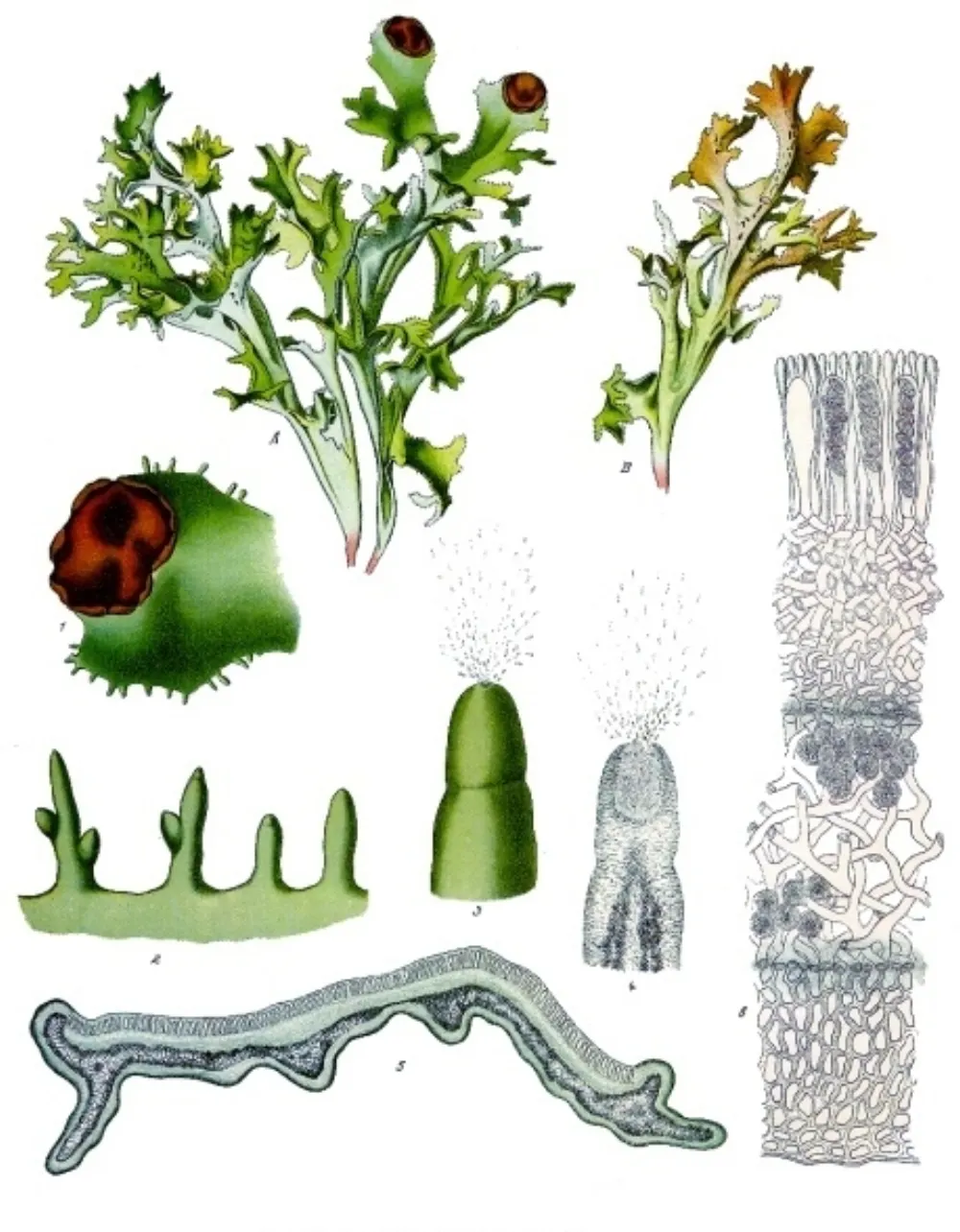
© Franz Eugen Köhler, Köhler's Medizinal-Pflanzen (1897) · Public domain · Commons
Iceland moss
Isländisches Moos · (Cetraria islandica)
Parmeliaceae (a lichen family) (Parmeliaceae)
Description
Iceland moss (Cetraria islandica), also called Iceland lichen, is - despite its name - not a moss but a lichen: a symbiotic dual organism formed by a fungus and an embedded green alga. It develops an erect to semi-erect, shrubby body (thallus) 4 to 12 cm tall, made of channelled, leaf-like, repeatedly forked, leathery bands whose margins are regularly toothed and fringed with short, lash-like projections. Depending on light exposure the colour ranges from greenish-brown through chestnut to dark brown, with a paler, whitish-blotched underside. The species is widespread in the cool-temperate and arctic-alpine regions of the Northern Hemisphere, growing on sandy, acidic soil in heaths, open pine forests, bogs and tundra. As a lichen it accumulates substances from its surroundings and is a sensitive indicator of air quality. The medicinal part is the whole dried thallus (Lichen islandicus or Cetrariae lichen). It is characterised by the combination of abundant water-soluble mucilage polysaccharides (lichenin and isolichenin), which give it its demulcent soothing action, and strongly bitter-tasting lichen acids.
- TeaWhole plantInternalTraditional use
Main use (EMA monograph, 'traditional use'): the water-soluble mucilage polysaccharides lichenin and isolichenin form a protective film over the irritated mucous membranes of the mouth and throat, soothing the feeling of irritation and the associated dry irritating cough. This is a traditional use whose plausibility rests on long-standing experience - not a clinically proven ('well-established') effect.
Preparation & dosage
Demulcent (soothing) use: prepare about 1-2 g of finely cut Iceland moss with 150 ml of water, several times a day. For the purely demulcent mucilage effect the thallus is made as a COLD MACERATE (steep for 10-15 minutes in cold water, then warm briefly) - this preserves the soluble mucilage and reduces the bitter taste. If needed, sip warm 3 times daily. The mucilage extract is also made into pastilles and lozenges that should dissolve slowly in the mouth to coat the mucous membranes of the mouth and throat.
- Dry amount
- 1–2 g
- Doses per day
- 3×
⚠ Age restriction: ≥ 6 years — Demulcent use according to the EMA monograph for adults, adolescents and children from 6 years of age. For younger children only after medical advice.
[#src_ema_monograph] [#src_ema_overview] [#src_wikipedia_de]
- TeaWhole plantInternalTraditional use
Second EMA-recognised traditional use: for temporary loss of appetite. The bitter lichen acids (including cetraric and fumarprotocetraric acid) act as a bitter tonic (amarum) and reflexively stimulate the digestive juices. This too is a 'traditional use' indication, not a clinically established proof of efficacy.
Preparation & dosage
Appetite-stimulating (bitter) use: pour about 1-2 g of Iceland moss with 150 ml of boiling water as a HOT INFUSION, steep for 10-15 minutes, then strain. Unlike the cold macerate, this deliberately extracts the bitter-tasting lichen acids. Drink a cup of the bitter infusion about half an hour before meals, up to 3 times daily. The bitter stimulus promotes the formation of saliva and gastric juice.
- Dry amount
- 1–2 g
- Doses per day
- 3×
⚠ Age restriction: ≥ 18 years — Use for loss of appetite according to the EMA monograph is for adults only (from 18 years), as the basis of experience for this indication is limited to adults.
[#src_ema_monograph] [#src_ema_overview] [#src_wikipedia_de]
🤝 Permaculture Partners
In your garden, this plant acts as: