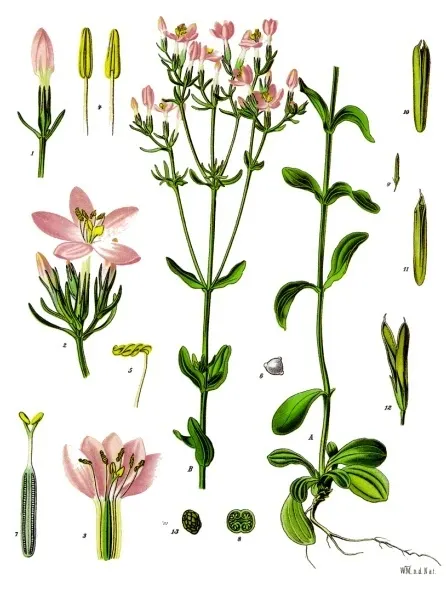
© Walther Otto Müller, Köhler's Medizinal-Pflanzen (1887) · Public domain · Commons
Common centaury
CautionEchtes Tausendgüldenkraut · (Centaurium erythraea)
Gentian family (Gentianaceae)
Description
Common centaury (Centaurium erythraea) is an upright annual-to-biennial herb of the gentian family reaching 20–60 cm. From a basal rosette it sends up a stem with opposite leaves, and from June to September bears clusters of small pink-to-purple star-shaped flowers. The flowering herb is used — one of Europe's most intensely bitter medicinal plants.
CONTRAINDICATED for children
Use in children and adolescents under 18 not recommended.
- TeaAerial partsInternalTraditional use
Classic bitter tea (amarum) for loss of appetite and mild digestive complaints — taken before meals.
Preparation & dosage
INFUSION: Pour 200 ml boiling water over 1–4 g of the comminuted herb, cover and steep about 10 minutes, then strain; up to 4 times daily. For loss of appetite, traditionally taken about half an hour before meals — the bitters stimulate saliva and gastric juice. If complaints last more than 2 weeks, consult a doctor.
- Dry amount
- 1–4 g
- Doses per day
- 4×
- Max duration
- 2 weeks
⚠ Age restriction: ≥ 18 years — Use in children and adolescents under 18 not recommended.
- TinctureAerial partsInternalTraditional use
Concentrated bitter tincture to stimulate appetite and digestion.
Preparation & dosage
TINCTURE: 1.5–5 g (ml) single dose, up to 3 times daily, before meals in a little water. A concentrated bitter form. Due to the alcohol content, not for pregnant or breastfeeding women, children, or people with liver disease.
- Liquid amount
- 1.5–5 ml
- Doses per day
- 3×
- Max duration
- 2 weeks
⚠ Age restriction: ≥ 18 years — Alcohol-containing tinctures only for adults from 18 years.
🤝 Permaculture Partners
In your garden, this plant acts as: