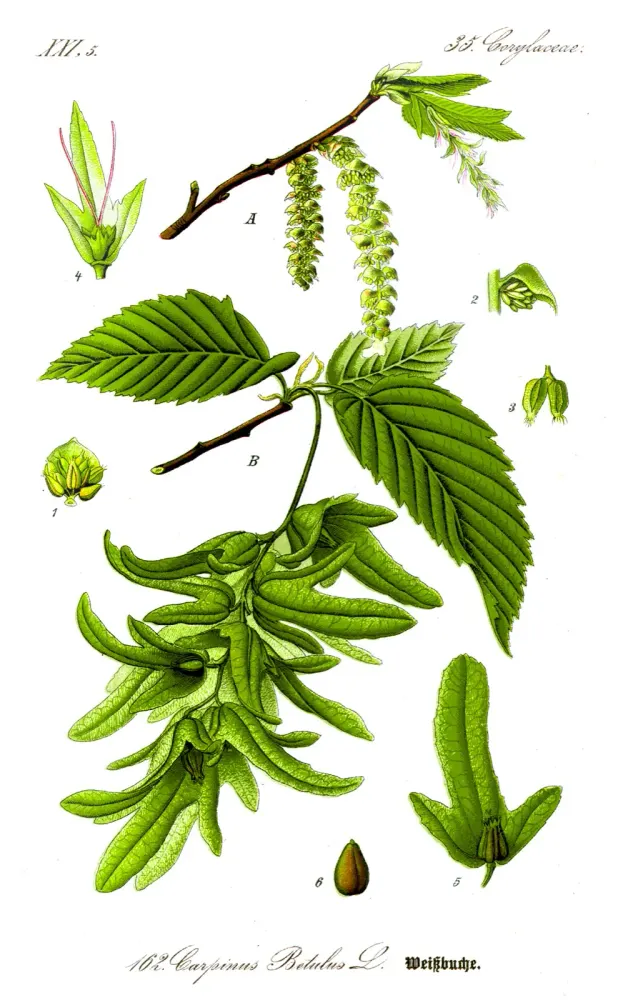
© Unknown · Public domain · Commons
Carpinus betulus
Gemeine Hainbuche · (Carpinus betulus)
Birch family (Betulaceae)
Description
Carpinus betulus, the European or common hornbeam, is a species of tree in the birch family Betulaceae, native to Western Asia and central, eastern, and southern Europe, including southern England. It requires a warm climate for good growth, and occurs only at elevations up to 1,000 metres (3,300 ft). It grows in mixed stands with oak, and in some areas beech, and is also a common tree in scree forests.
- TinctureFlowerInternalFolk medicine
Bach Flower Remedy No. 17 'Hornbeam' — developed by Edward Bach (1936) for the state of mental weariness and the 'Monday morning feeling': tiredness before the day has even begun, the sense of being barely able to cope with daily duties. This application is part of the Bach Flower tradition and is not pharmacologically substantiated. The dilution (highly diluted in alcohol) contains no measurable plant constituents; the effect is considered purely energetic/psychological within Bach therapy.
Preparation & dosage
[#src_bach_1936] [#src_wiki_carpinus_de] [#src_pfaf_carpinus]
- TeaLeafInternalFolk medicine
In European folk medicine, hornbeam leaves were used as a mildly astringent tea for mild fever and sore throat. The tannins (condensed tannins, catechins) act astringently on mucous membranes. No scientific validation exists; the use is transmitted purely through folk tradition.
Preparation & dosage
Pour 200 ml of boiling water over 2–4 g dried hornbeam leaves, steep for 10 minutes, then strain. Up to 3 cups daily.
- Dry amount
- 2–4 g
- Doses per day
- 3×
[#src_pfaf_carpinus] [#src_wiki_carpinus_de] [#src_grieve_carpinus]
- TeaBarkExternalFolk medicine
Hornbeam bark was used in folk medicine as a decoction for compresses and wound washes for poorly healing wounds and skin irritations. The tannin substances in the bark act astringently and have mild antimicrobial properties. Evidence is limited to folk-healing tradition.
Preparation & dosage
Simmer 5–10 g bark in 500 ml water for 15 minutes, allow to cool, then strain. Apply as a compress or wound rinse.
- Dry amount
- 5–10 g
- Doses per day
- 2×
- RawSeedInternalFolk medicine
The nut-like seeds of the hornbeam (small nutlets in the winged fruit husks) are edible and were used as a food source in times of scarcity. Their nutritional value is modest, but they contain some fat and protein. This is a historical emergency folk use with no practical significance today.
Preparation & dosage
- TeaLeafInternalFolk medicine
In traditional folk medicine, hornbeam leaves were occasionally used for mild joint complaints and rheumatic conditions. The tannin fraction and possible flavonoids (quercetin, catechin) may have a mild antioxidant effect. No scientific evidence exists; use documented only in folk medicine.
Preparation & dosage
Steep 2–3 g dried leaves in 200 ml hot water for 10 minutes. 2 cups daily.
- Dry amount
- 2–3 g
- Doses per day
- 2×