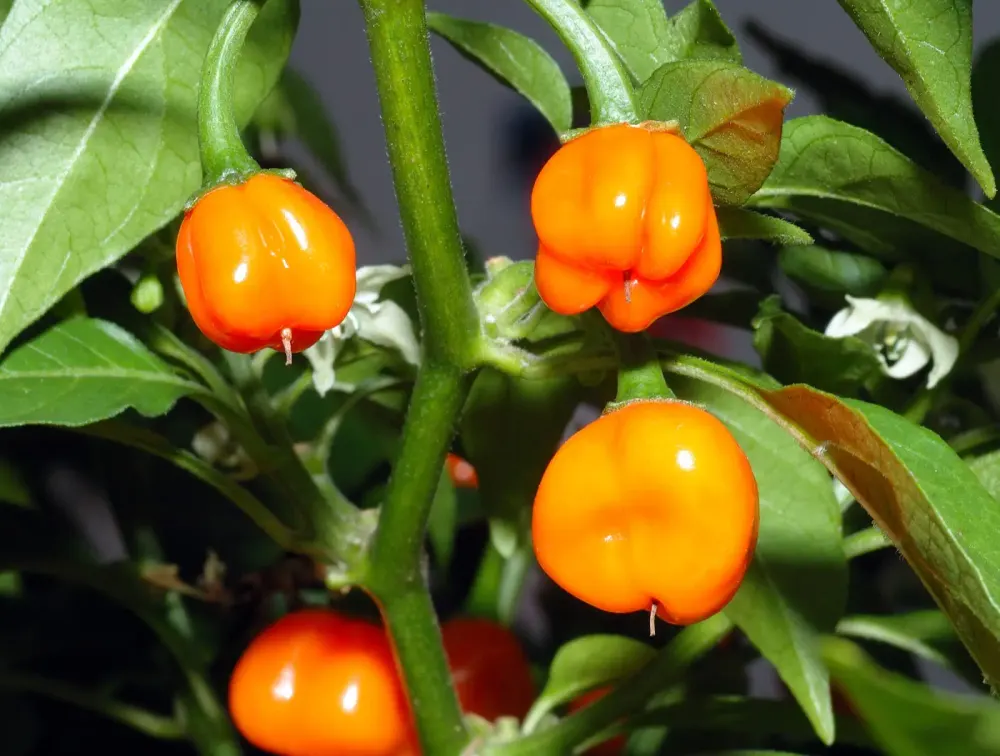
© André Karwath aka Aka · CC BY-SA 2.5 · Commons
Capsicum chinense
Caution🐾Capsicum chinense · (Capsicum chinense)
Nightshade family (Solanaceae)
Description
Capsicum chinense, commonly known as a "habanero-type pepper", is a species of chili pepper native to the Americas. C. chinense varieties are well known for their unique flavors and, in many cases, exceptional heat.
CONTRAINDICATED for children
C. chinense cultivars are unsuitable for infants and young children due to their extreme pungency — risk of severe mucosal irritation, vomiting, burning diarrhoea and rare cases of aspiration. Topical capsaicin creams or patches are not approved in children under 12. Parents should store habanero/reaper hot sauces and dried fruits safely out of reach.
- SpiceFruitInternalTraditional use
Capsicum chinense provides the world's hottest cultivated edible fruits — Habanero (100,000–350,000 SHU), Scotch Bonnet (100,000–350,000 SHU), Bhut Jolokia (~1 million SHU), Carolina Reaper (1.4–2.2 million SHU) and Pepper X (2.69 million SHU, Guinness record 2023). Indispensable in Yucatecan, Caribbean and West African cuisine (salsa, jerk marinades, pepperpot, pikliz, mole). Fruits are used fresh, dried, roasted, pickled or processed into hot sauce. Besides capsaicin, a high content of fruity-floral aroma esters (notably hexyl isobutyrate) gives C. chinense its distinctive profile, setting it apart from C. annuum (paprika, cayenne) and C. frutescens (tabasco).
[#src_wp_de_capsicum_chinense] [#src_wp_en_capsicum_chinense] [#src_pfaf_capsicum_chinense] [#src_crops_habanero_capsaicinoid]
- SalveFruitExternalTraditional use
In folk medicine, capsaicin-rich Habanero or Scotch Bonnet fruits are used similarly to cayenne (C. annuum/frutescens) for warming rubs and salves — for muscle tension, joint pain, lumbago and neuralgia. Mechanism: capsaicin activates the TRPV1 receptor on sensory nerve endings, initially painful, with repeated application leading to substance P depletion and pain desensitisation. IMPORTANT: the EMA-HMPC monograph for Capsici fructus ('well-established use' for muscle pain, especially low back pain) explicitly covers only C. annuum var. minimum and C. frutescens — NOT C. chinense. For medical applications standardised cayenne/frutescens preparations are therefore preferable; folk use of even hotter C. chinense cultivars is equivalent in principle but without official authorisation and with substantially greater irritation potential.
[#src_pfaf_capsicum_chinense] [#src_anand_bley_capsaicin] [#src_ema_capsici_fructus]
- CompressFruitExternalFolk medicine
Fresh or dried C. chinense fruits are macerated in warm oil or high-proof alcohol and applied as an irritant compress or rub for rheumatic complaints, chilblains, sciatica, sports injuries and circulatory problems. The warming sensation is mediated by capsaicin-induced TRPV1 activation and reactive hyperaemia. Apply ONLY on intact skin — never on mucous membranes, eyes, wounds or irritated skin! Because of the very high capsaicin content (up to 30× that of cayenne), C. chinense preparations must be heavily diluted and used in very small amounts; gloves are mandatory and contact with the eyes must be strictly avoided.
[#src_pfaf_capsicum_chinense] [#src_anand_bley_capsaicin] [#src_crops_habanero_capsaicinoid]
- SpiceFruitInternalTraditional use
In traditional folk medicine of Mexico, Yucatán and the Caribbean, small amounts of very hot Capsicum chinense fruits are used as a circulatory stimulant, diaphoretic and 'warming' tonic for early colds, cold limbs and general debility. The intense pungency stimulates peripheral circulation and triggers reflex sweating. In Yucatán, Habanero is also traditionally combined as a digestive and appetite stimulant with fatty, protein-rich foods. The strong irritation of oral and gastric mucosa requires moderation; the scientific evidence base specifically for C. chinense is much thinner than for C. annuum/frutescens.
[#src_pfaf_capsicum_chinense] [#src_wp_en_capsicum_chinense] [#src_wp_de_capsicum_chinense]
- TinctureFruitInternalFolk medicine
Folk cayenne/habanero tinctures (very heavily diluted!) are used in Anglo-American and Caribbean folk medicine as a circulatory stimulant and 'stomach-warming' stomachic for cold digestive complaints and general weakness — usually only drop-wise in water or tea. A safe medical dosage specifically for C. chinense tinctures is not standardised due to lack of clinical data; the strong mucosal irritation limits internal use. Avoid in sensitive stomach, reflux, gastritis or peptic ulcer.
Preparation & dosage
Folk recipe: macerate 1–3 g dried, finely ground habanero or Scotch bonnet fruits in 100 ml ethanol 60 % for 2 weeks, then strain. NEVER take undiluted — 1–3 drops in a large glass of water or warm tea, max. 3× daily after meals. Wear gloves during preparation, strictly avoid eye contact, store well-labelled out of children's reach.
- Dry amount
- 1–3 g
- Doses per day
- 3×
[#src_pfaf_capsicum_chinense] [#src_anand_bley_capsaicin] [#src_wp_en_capsicum_chinense]
- RawFruitInternalTraditional use
Very small amounts of ripe C. chinense fruits (1–2 g fresh corresponds to a grain-of-rice-sized piece of habanero) are sprinkled as a 'micro-spice' onto finished dishes. Ripe fruits contain vitamin C (~70–80 mg/100 g) as well as carotenoids (beta-carotene, capsanthin in red cultivars); the typical orange/yellow/red colour of ripe habaneros comes from capsanthin and beta-carotene. At normal culinary use, intake of these nutrients is not nutritionally relevant due to the very small amounts — the main purpose remains pungency and aroma, not micronutrient supply.
[#src_wp_en_capsicum_chinense] [#src_pfaf_capsicum_chinense] [#src_crops_habanero_capsaicinoid]
🤝 Permaculture Partners
In your garden, this plant acts as:
✨ Best symbiotic partners
- 🌿 Basil Classic companion-planting partner.
- 🌿 Tagetes patula Classic companion-planting partner.
Source: Helga und Margarete Langerhorst, Mein gesunder Naturgarten (eigene Kuration)