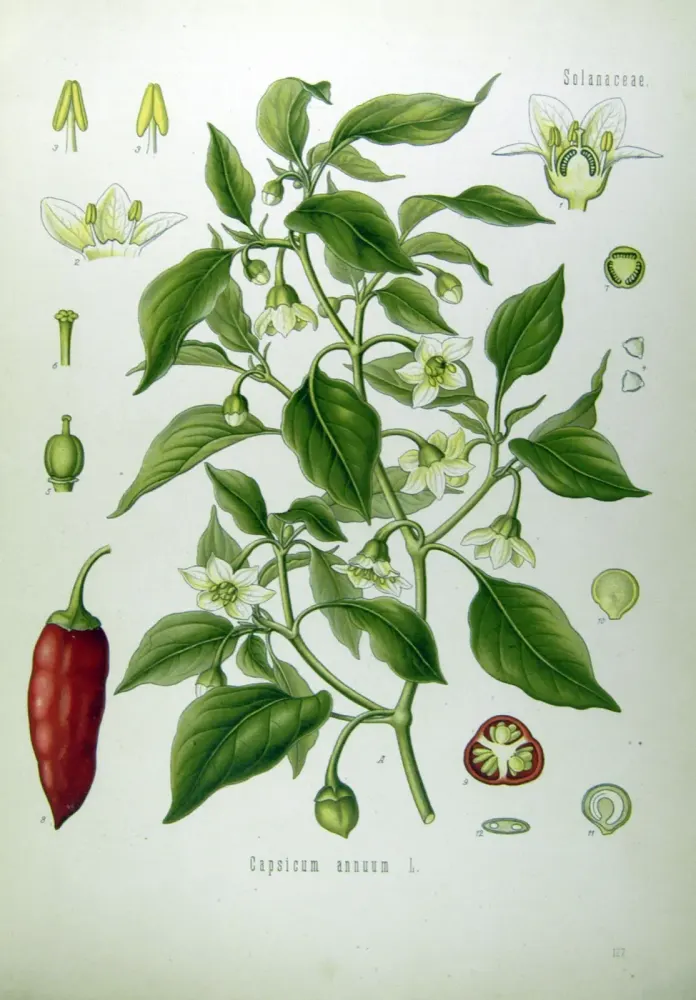
© Franz Eugen Köhler · Public domain · Commons
Capsicum annuum
CautionPaprika · (Capsicum annuum)
Nightshade family (Solanaceae)
Description
Capsicum annuum is a flowering plant in the family Solanaceae (nightshades), native to the northern regions of South America and to southwestern North America. The plant produces berries of many colors including red, green, and yellow, often with pungent taste. It is one of the oldest cultivated crops, with domestication dating back to around 6,000 years ago in regions of Mexico.
- RawFruitInternalClinical trial
Fresh bell pepper (green, yellow, orange, red) contains exceptionally high vitamin C — red fruits up to 200 mg/100 g, about three times more than oranges. Eaten raw they also provide vitamin A (as beta-carotene precursor), vitamin B6 and folate. Red bell peppers in particular are rich in capsanthin, the dominant red carotenoid, plus quercetin and other flavonoids. Raw consumption preserves heat-sensitive vitamins optimally.
[#src_usda_capsicum] [#src_efsa_vitamin_c] [#src_wp_de_paprika] [#src_wp_en_capsicum]
- RawFruitInternalFolk medicine
Bell pepper fruits harvested green and unripe — particularly varieties such as Jalapeño, Serrano or sweet bell peppers — are eaten raw in salads, antipasti or as snacks. Green peppers contain less sugar and fewer carotenoids than the fully ripe fruit, but have a fresh, slightly bitter flavour. Seeds and inner membranes are edible but contain most of the capsaicin in hot cultivars.
[#src_pfaf_capsicum] [#src_wp_de_paprika] [#src_wp_en_capsicum]
- RawFruitInternalTraditional use
Fully ripe, coloured bell pepper fruits — braised, baked, grilled or steamed — are a staple of Mediterranean, Balkan and Central European cuisines. Cooking breaks down cell walls and increases bioavailability of fat-soluble carotenoids (capsanthin, beta-carotene) compared with raw consumption, while heat-sensitive vitamin C is partially lost. Classic dishes include Hungarian goulash (with sweet paprika), ajvar (Balkan peninsula), stuffed peppers (Central Europe) and peperonata (Italy).
[#src_usda_capsicum] [#src_wp_de_paprika] [#src_pfaf_capsicum]
- SpiceFruitInternalTraditional use
From fully ripe, dried and ground pepper fruits, paprika powder (sweet, hot, smoked) is produced. It is an indispensable spice in Hungarian, Spanish (Pimentón de la Vera, smoked) and Moroccan cuisines. Paprika powder contains concentrated amounts of capsanthin (bright-red colour), carotenoids and, depending on cultivar, variable capsaicin levels (minimal in sweet varieties). Industrially, capsanthin (E160c) is used as a natural food colourant.
[#src_wp_de_paprika] [#src_wp_en_capsicum] [#src_usda_capsicum] [#src_efsa_capsanthin]
- SalveFruitExternalTraditional use
Capsaicin-containing preparations from cayenne or other hot Capsicum cultivars have been used in folk medicine for centuries externally for muscle and joint pain and neuralgias. Capsaicin acts as a TRPV1 receptor agonist and causes desensitisation of pain fibres with repeated application (substance P depletion). This mechanism is scientifically established; however, it applies primarily to capsaicin-rich cultivars (cayenne, chilli), not to mild bell pepper. Commercial capsaicin creams (0.025–0.1 % capsaicin) and patches (8 % high-concentration patch, prescription-only) are approved.
[#src_capsaicin_review_doi] [#src_pfaf_capsicum] [#src_wp_en_capsicum]
- CompressFruitExternalFolk medicine
In folk medicine, fresh or dried hot pepper fruits are macerated in warm oil or alcohol and applied as an irritant compress or rub for rheumatic pain, sciatica and muscle soreness. The warming sensation is mediated by capsaicin-induced TRPV1 activation. Apply only on intact skin, never on mucous membranes or wounds. Again: effective only with capsaicin-rich cultivars; bell pepper lacks sufficient capsaicin for this effect.
- RawFruitInternalClinical trial
Bell pepper is one of the vegetables with the highest carotenoid content: capsanthin (unique to Capsicum), capsorubin, beta-carotene, zeaxanthin and lutein have been extensively studied. These carotenoids are antioxidant and are associated with prevention of oxidative cell damage. Beta-carotene is converted to vitamin A (retinol) in the body as needed. Lutein and zeaxanthin are important for retinal health. Carotenoid concentration increases markedly from green (low) through yellow and orange to red (highest levels).
[#src_usda_capsicum] [#src_efsa_vitamin_c] [#src_efsa_capsanthin]
🤝 Permaculture Partners
In your garden, this plant acts as:
✨ Best symbiotic partners
- 🌿 Garlic Garlic deters spider mites and fungi.
- 🌿 Calendula officinalis Classic companion-planting partner.
- 🌿 Basil Basil deters pests and improves pepper aroma.
- 🌿 Tagetes patula Marigold deters nematodes and aphids.
⚠️ Better not planted together
- 🥬 Fennel Classic companion-planting partner.
📦 Part of these planting sets:
Source: Gertrud Franck, Gesunder Garten durch Mischkultur (1980, eigene Kuration) | Helga und Margarete Langerhorst, Mein gesunder Naturgarten (eigene Kuration)