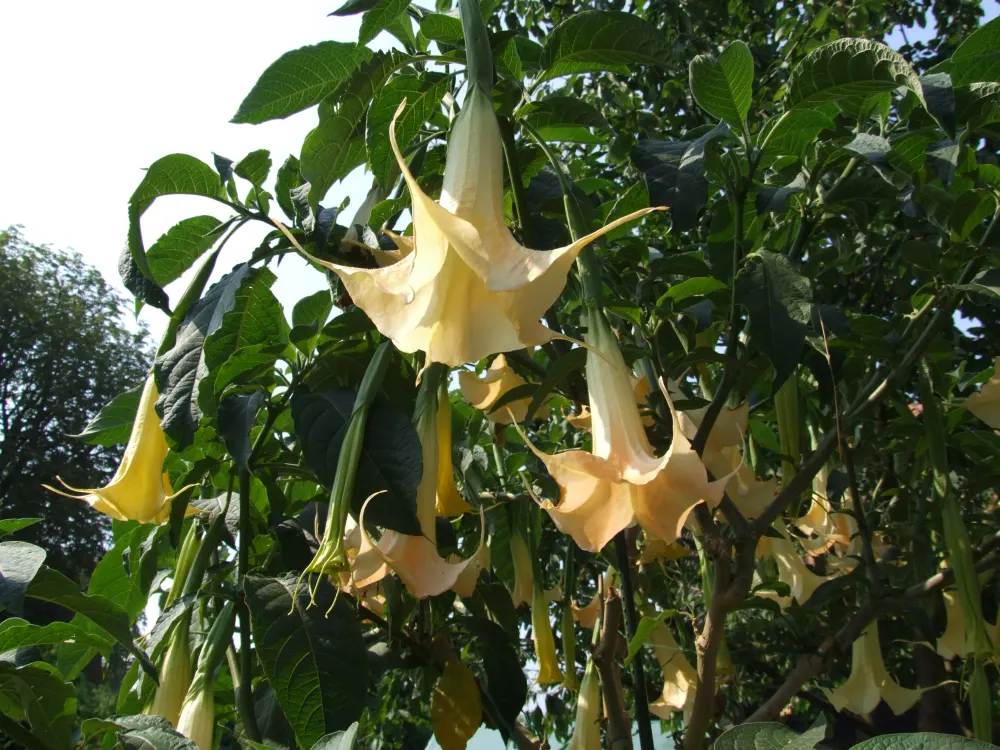
© Claus Ableiter · CC BY-SA 3.0 · Commons
Brugmansia
Toxic🐾Engelstrompeten · (Brugmansia arborea)
Nightshade family (Solanaceae)
Description
Brugmansia is a genus of seven species of flowering plants in the nightshade family Solanaceae. They are woody trees or shrubs, with pendulous flowers, and have no spines on their fruit. Their large, fragrant flowers give them their common name of angel's trumpets, adjacent to the nickname devil's trumpets of the closely related genus Datura.
🌿 Risk of confusion — read before wild-harvesting!
Frequent fatal poisonings among teenagers seeking intoxication (1994 Florida outbreak: 112 hospitalisations).
External use only!
This plant must NOT be taken internally. Use only as compress, salve, or bath.
CONTRAINDICATED during pregnancy
Tropane alkaloids (scopolamine, hyoscyamine, atropine) cross the placental barrier and can cause fetal tachycardia, CNS damage and congenital malformations. Any exposure during pregnancy is strictly contraindicated — including via skin contact and inhalation.
CONTRAINDICATED during breastfeeding
Scopolamine and atropine pass into breast milk and can trigger anticholinergic effects in the infant (tachycardia, dry mouth, fever, sedation, seizures). Breastfeeding: strictly contraindicated.
CONTRAINDICATED for children
Children are extremely sensitive to tropane alkaloids; a few seeds or a piece of flower can be fatal. Angel's trumpets in households with small children or pets are a documented poisoning risk. No use in children and adolescents under 18 years — not even low homeopathic potencies below D6.
Critical drug interactions with:
Anticholinergika (Tiotropium, Ipratropium, Oxybutynin, Darifenacin, Scopolamin-Pflaster) · Trizyklische Antidepressiva (Amitriptylin, Imipramin, Clomipramin) · MAO-Hemmer (Phenelzin, Tranylcypromin, Moclobemid, Selegilin)
- CompressLeafExternalFolk medicine
Traditional external use in South America: crushed or heated angel's trumpet leaves are applied in folk medicine as poultices for rheumatism, arthritis, muscle pain, bruises and skin inflammation. Local anticholinergic action of tropane alkaloids superficially reduces pain and spasm. Important: tropane alkaloids are absorbed through the skin — systemic poisonings have been described. No lay use.
Preparation & dosage
[#src_algradi_2021_brugmansia_arborea] [#src_wp_en_brugmansia_arborea]
Historical documentation only — do NOT use
These internal applications are historically documented. This plant is highly toxic — self-treatment can cause severe poisoning or death. For documentation only, explicitly NOT a recommendation.
- TinctureLeafInternalFolk medicine
Shamanic and divinatory use in the folk medicine of the northern Peruvian Andes (curandero tradition): Brugmansia arborea and related species ('floripondio', 'misha', 'borrachero') have been used since pre-Columbian times for initiation rituals, vision quests and healing ceremonies. De Feo (2004) documents use in combination with Trichocereus pachanoi (San Pedro cactus) in mesa rituals. Mechanism: central anticholinergic delirium triggered by scopolamine. No recommendation for application — poisonings are frequent, hallucinations are described as 'terrifying'.
Preparation & dosage
[#src_defeo_2004_brugmansia_arborea] [#src_algradi_2021_brugmansia_arborea] [#src_wp_en_brugmansia_arborea]
- TinctureFlowerInternalFolk medicine
Historical use of flowers in Colombian and Ecuadorian healing traditions ('borrachero blanco'). Healers dried and crushed flowers for ritual fumigation or administered them as cold infusions to induce trance and vision states — historically tied to legends about theft and witchcraft (Robles myth, Colombia). Modern documented: criminal use of concentrated scopolamine extracts ('Devil's Breath') against tourists in Bogotá — no therapeutic role.
Preparation & dosage
[#src_algradi_2021_brugmansia_arborea] [#src_defeo_2004_brugmansia_arborea] [#src_wp_en_brugmansia_arborea]
- TinctureLeafInternalFolk medicine
Homeopathic use (Brugmansia D6–D12) for night terrors, hallucinatory states, nightmares and sleep disorders with persecution imagery — analogous to the Datura indication in classical homeopathy. From D12 onward no pharmacologically active alkaloid amounts remain. Lower potencies (below D6) are not freely available in Germany.
Preparation & dosage
[#src_wp_de_brugmansia_arborea] [#src_wp_en_brugmansia_arborea]
- RawSeedInternalFolk medicine
Purely ethnobotanical/historical documentation of seed use in pre-Columbian Inca/Chibcha burial rituals: angel's trumpet seeds were mixed with maize beer and tobacco and given to wives and slaves of the deceased before they were buried alive (according to 16th-century Spanish chroniclers). Today no application recommendation — seeds contain the highest scopolamine concentration and are potentially lethal in tiny amounts.
Preparation & dosage
[#src_defeo_2004_brugmansia_arborea] [#src_wp_en_brugmansia_arborea]
- InhalationLeafInternalFolk medicine
Historical asthma fumigations with angel's trumpet leaves: before asthma was recognised as allergic inflammation, Brugmansia leaves (along with Datura and Hyoscyamus leaves) were burned and inhaled as 'anti-asthma powders' or 'stramonium cigarettes' — anticholinergic bronchodilation via atropine/scopolamine. Completely obsolete since the introduction of β2-sympathomimetics and inhaled corticosteroids; rejected due to toxicity and hallucinogenic effects.
Preparation & dosage
[#src_algradi_2021_brugmansia_arborea] [#src_wp_en_brugmansia_arborea]