© Evelyn Gunn · CC BY-SA 3.0 · Commons
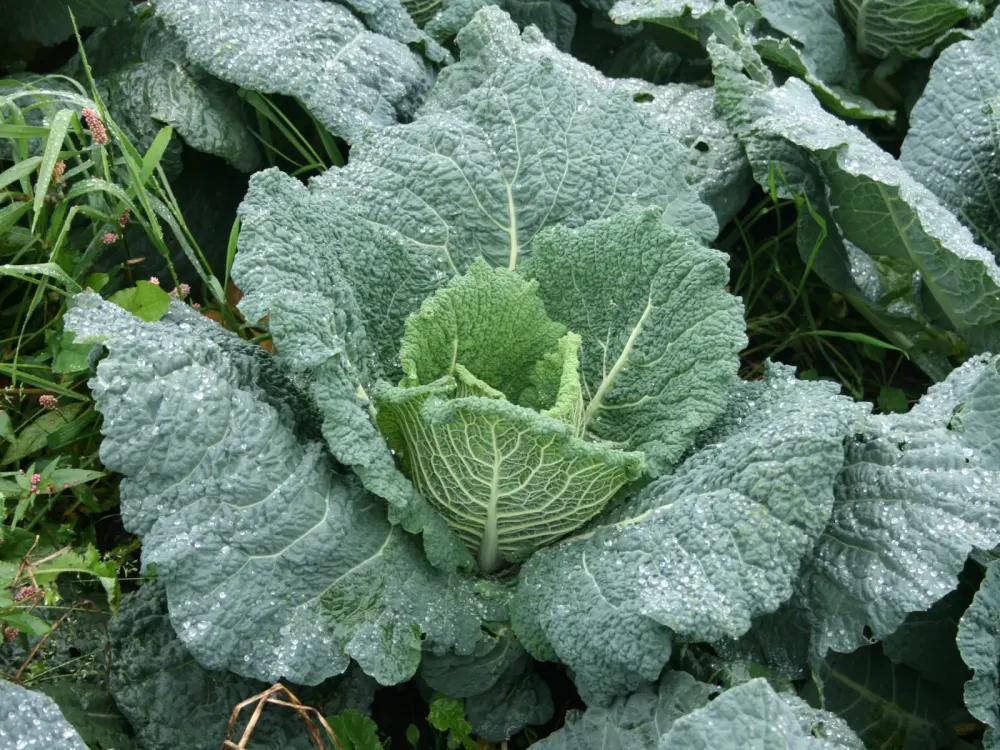
Savoy cabbage
Wirsing · (Brassica oleracea convar. capitata var. sabauda)
Cabbage family (Brassicaceae)
Description
Savoy cabbage is a variety or cultivar group of the plant species Brassica oleracea. Savoy cabbage is a winter vegetable and one of several cabbage varieties. It has crinkled, emerald green leaves, which are crunchy with a slightly elastic consistency on the palate.
- RawLeafInternalTraditional use
Savoy cabbage as a cooked kitchen vegetable — briefly steamed, blanched or braised: the crinkled, wavy leaves break down less than white cabbage and retain a firm texture when cooked. Classical preparations in DACH (Germany, Austria, Switzerland) cuisine include savoy cabbage with bacon and onion, savoy cabbage and potato stew, creamed savoy cabbage and savoy as a side dish to game and braised meats. Nutritionally savoy cabbage delivers abundant vitamin C (approx. 50–60 mg/100 g fresh — slightly higher than white cabbage), vitamin K1, folate, dietary fibre and carotenoids (beta-carotene, lutein, zeaxanthin — responsible for the characteristic yellow-green colour of the inner leaves). Savoy is considered more digestible than white cabbage as the more tender leaves require shorter cooking and cause less flatulence. Best vitamin C retention with brief cooking (5–8 minutes steamed).
[#src_wp_de_wirsing] [#src_wp_en_savoy] [#src_usda_fdc_savoy]
- RawLeafInternalFolk medicine
Savoy cabbage rolls (Krautwickel) — traditional Central European dish from southern Germany, Austria, Poland, Czech Republic, Hungary and the Balkans: large outer savoy leaves are briefly blanched (1–2 min., until pliable), the tough central rib flattened, filled with minced meat, rice or buckwheat, onion and spices, and rolled into parcels. Braised in tomato sauce or broth for approx. 45–60 min. Savoy is traditionally preferred over white cabbage because the crinkled wavy leaves are more pliable, break less when wrapped and bind sauces better via their folds. Regional variants: 'sarma' (Balkans, fermented sour savoy), 'gołąbki' (Poland), 'töltött káposzta' (Hungary). Nutritionally a complete dish: plant fibre plus animal or vegetable protein.
- RawLeafInternalFolk medicine
Savoy cabbage as raw food (finely shredded, savoy salad): the more tender inner leaves are suited finely sliced for winter salads with apple, walnut, carrot and yoghurt or vinaigrette dressing. Compared to white cabbage, raw savoy is milder in flavour and less flatulence-inducing. Raw savoy fully preserves the high vitamin C content and contains intact myrosinase enzyme, which on chewing converts glucosinolates (glucobrassicin, sinigrin) into bioactive isothiocyanates (incl. sulforaphane precursors). In DACH folk practice raw savoy was recommended to stimulate digestion — a staple of winter vitamin C supply before the greenhouse era.
[#src_wp_de_wirsing] [#src_pfaf_brassica_oleracea] [#src_usda_fdc_savoy]
- CompressLeafExternalTraditional use
Cabbage leaf compress with savoy leaves for breast engorgement and lactation mastitis: fresh, cool savoy leaves (outer robust leaves preferred, washed, hard central rib flattened) are applied to the swollen or painful breast for 20–30 minutes or until warmed, 2–3 times daily between feeds. Savoy is traditionally preferred over white cabbage because the crinkled wavy leaves conform better to the breast shape and wilt less quickly. Several systematic reviews (Cochrane 2020 — Mangesi & Zakarija-Grkovic) could not demonstrate superiority over other measures but found a favourable safety profile and subjective pain relief. Mechanism unclear — hypotheses: cooling effect, pressure relief, anti-inflammatory isothiocyanates and sinapic acid.
[#src_cochrane_mastitis_2020] [#src_wp_en_savoy] [#src_pfaf_brassica_oleracea]
- CompressLeafExternalFolk medicine
Savoy cabbage leaf compress for joint pain, osteoarthritis, rheumatism and bruises: traditional DACH folk medicine — fresh savoy leaves are stripped of the hard rib, beaten flat with a rolling pin or glass bottle until plant juice is released, then (cold or gently warmed) applied directly to the painful joint (knee, ankle, wrist) or bruise, secured with a cloth or gauze and left for several hours or overnight. Also used in folk practice for varicose veins, phlebitis and leg ulcers. Clinical evidence for the joint indication is weaker than for mastitis; one randomised trial (Lauche et al. 2016, University of Duisburg-Essen) showed pain relief in knee osteoarthritis comparable to topical diclofenac gel. Low-risk complementary measure; does not replace rheumatological treatment.
- RawLeafInternalFolk medicine
Fresh savoy cabbage juice (approx. 100–250 ml daily) — folk use for stomach complaints, heartburn and as an adjunct in gastritis: raw savoy is processed in a juicer or high-power blender (then strained) and the green juice drunk fresh. Like other Brassica cultivars it contains traces of S-methylmethionine (formerly called 'vitamin U'), to which mucosa-protective properties were attributed in early studies (Cheney, Stanford 1940s). Modern evidence is limited; folk tradition particularly in Eastern Europe and the Alpine region. Not recommended as a substitute for medically prescribed ulcer therapy (proton pump inhibitors, H. pylori eradication) — only as a complementary measure after medical clarification.
🤝 Permaculture Partners
In your garden, this plant acts as:
✨ Best symbiotic partners
- 🌿 Leek Classic companion-planting partner.
- 🌿 Apium graveolens Classic companion-planting partner.
Source: Helga und Margarete Langerhorst, Mein gesunder Naturgarten (eigene Kuration)