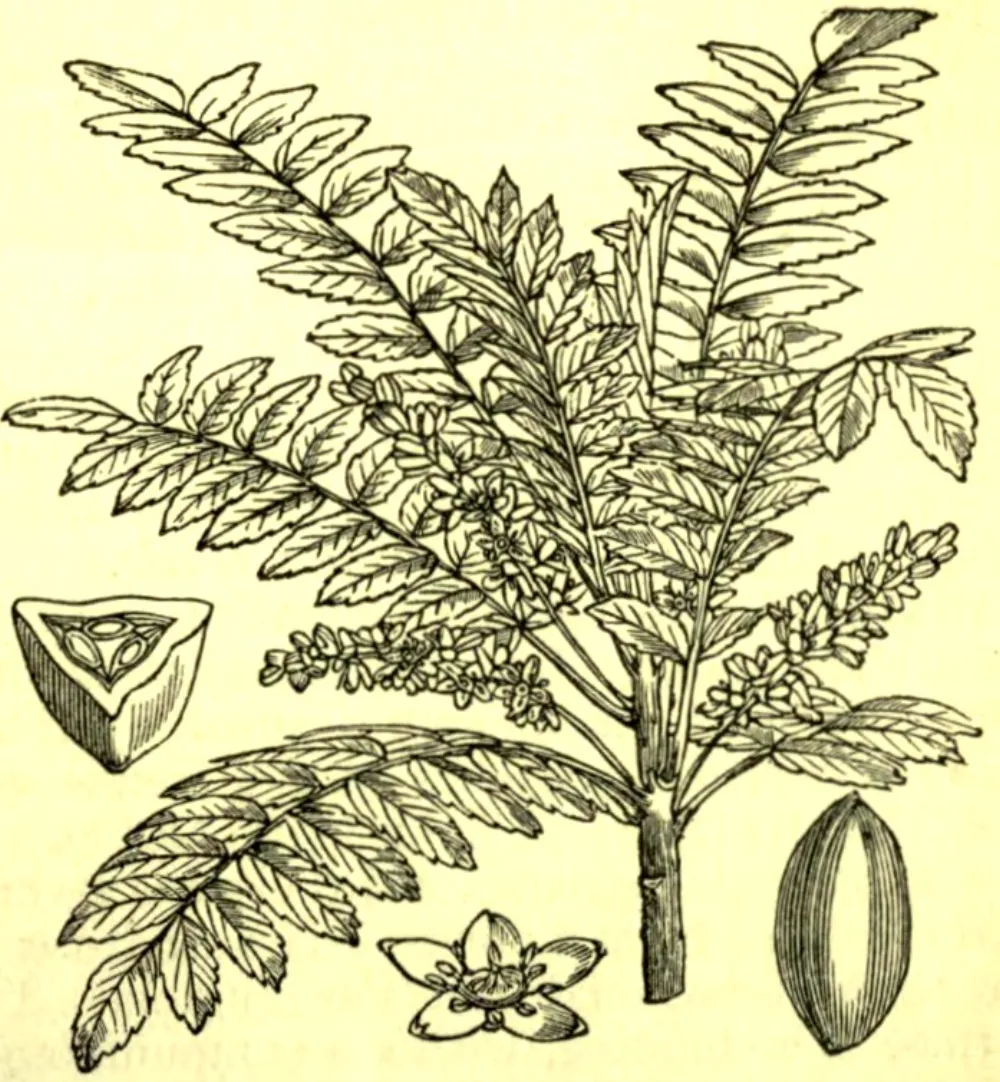
© Unknown author (The American Cyclopædia, 1891) · Public domain · Commons
Indian frankincense
Indischer Weihrauch · (Boswellia serrata)
Torchwood family (Burseraceae)
Description
Indian frankincense (Boswellia serrata), also called the salai tree, is a small to medium-sized deciduous tree of the torchwood family (Burseraceae). It grows in the dry, rocky hill and mountain forests of India and neighbouring Pakistan. When the bark is tapped, an aromatic gum-resin exudes and hardens in the air into brownish-yellow tears - Indian frankincense (olibanum). This resin is closely related to the frankincense prized in antiquity, which became widely known as incense in temples and, through the biblical account of the gifts of the wise men from the East, in the Christian world. Its medicinally important compounds are the boswellic acids, pentacyclic triterpene acids; the lead substance 3-O-acetyl-11-keto-β-boswellic acid (AKBA) inhibits the enzyme 5-lipoxygenase and thereby intervenes in inflammatory processes.
CONTRAINDICATED during pregnancy
There are insufficient data on the safety of concentrated, standardised frankincense extracts in pregnancy; isolated indications of possible effects on the uterus make a safe assessment impossible. Use of the extract in pregnancy is therefore not advised.
- TinctureBarkInternalClinical trial
Best-studied use: standardised Boswellia serrata extracts for osteoarthritis (especially knee osteoarthritis) and inflammatory joint pain. A systematic review with meta-analysis (Yu et al. 2020, 7 randomised trials, 545 patients) found an improvement in pain, stiffness and joint function (including WOMAC and VAS scores) for frankincense preparations compared with controls. Important caveat: the included trials were mostly small, of medium to low methodological quality, highly heterogeneous (different extracts and doses) and partly manufacturer-funded - so the evidence is promising but not yet conclusive. Mechanistically the anti-inflammatory effect is attributed mainly to inhibition of 5-lipoxygenase by AKBA.
Preparation & dosage
Standardised frankincense dry extract (obtained from the bark resin, adjusted to a defined content of boswellic acids or AKBA): usually about 300 mg two to three times daily, mostly with meals. Standardised capsules/preparations are used - the raw resin is not a suitable substitute. The effect builds up slowly over several weeks; a meaningful assessment is usually only possible after about four weeks. Seek medical advice for persistent or severe joint complaints; it does not replace a doctor-prescribed osteoarthritis therapy.
- Doses per day
- 3×
- Max duration
- 12 weeks
⚠ Age restriction: ≥ 18 years — Standardised frankincense extracts have been studied mainly in adults; there are insufficient data for children and adolescents. Use only in adults or only after medical advice.
[#src_review_yu2020] [#src_wikipedia_en] [#src_wikipedia_de]
- TinctureBarkInternalTraditional use
Traditional (folk) use: Indian frankincense is one of the classic remedies of Ayurveda, where it has long been used for joint inflammation, rheumatism and sciatica. This use rests on experiential knowledge rather than controlled trials and is therefore classified as traditional.
Preparation & dosage
In Ayurvedic medicine the resin of the salai tree (Sanskrit: 'shallaki') has been used traditionally for centuries for rheumatic and arthritic joint complaints, usually as prepared resin powder or in compound formulations. No universally valid modern dose can be derived from the traditional use; for defined complaints standardised extracts should be preferred.
🤝 Permaculture Partners
In your garden, this plant acts as: