© Holger Krisp (Wikimedia Commons) · CC BY 3.0 · Commons
Porcini
Steinpilz · (Boletus edulis)
Bolete family (Boletaceae)
Description
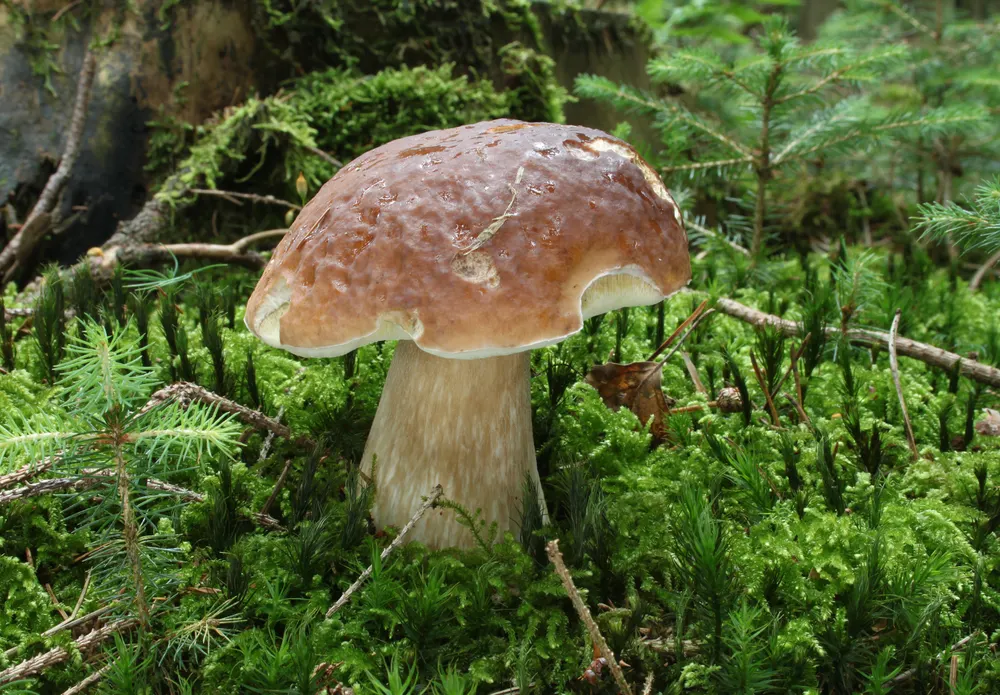
The porcini is regarded as one of Europe's most prized edible mushrooms. Its firm, richly nutty fruiting body carries a brown cap — bun-coloured when older — and a bulbous stem with a fine pale net on a pale ground; that netting is the most reliable identifying feature. Instead of gills, a layer of tubes sits under the cap, white when young and turning yellow to olive with age; it does not bruise blue. The porcini lives in partnership with trees — spruce, pine, beech and oak — which is why it cannot be farmed and every specimen on the market has been gathered. It is sought from summer to late autumn and valued both fresh and dried. It provides protein, beta-glucans, the antioxidant ergothioneine and ergosterol, a vitamin D precursor. It should always be cooked through before eating. When foraging it can be confused with the non-toxic but bitter bitter bolete, which ruins an entire dish.
🌿 Risk of confusion — read before wild-harvesting!
Foraging confusion possible with the bitter bolete (Tylopilus felleus – pink pores when mature, dark stem netting, bitter taste).
Young, firm fruiting bodies are sautéed, stewed or braised and make a protein-rich ingredient in risotto, pasta and soups. Always cook thoroughly before eating. Do not wash them — clean with a brush and knife, or the mushroom soaks up water and will no longer fry.
Dried and ground porcini yield an intensely aromatic seasoning powder for sauces, stocks and stews; the flavour intensifies on drying. Do not throw away the soaking water — much of the flavour is in it; just leave the sediment behind.
Mushrooms contain ergosterol, which converts to vitamin D2 under UV light. Dried mushrooms that have lain in the sun therefore contain more of it than fresh ones from the dark forest. How much of this reaches the human body is not fully settled — the mushroom is no substitute for a proper vitamin D source.
Sources: [1]
Good edible; cook before eating. Foraging confusion possible with the bitter bolete (Tylopilus felleus – pink pores when mature, dark stem netting, bitter taste). Raw or over-mature specimens can cause stomach upset. Mushrooms can bioaccumulate heavy metals and radioactive caesium from the soil. Germany's Federal Office for Radiation Protection still measures values above the commercial limit of 600 becquerel caesium-137 per kilogram in some species in parts of southern Germany — the Bavarian Forest, Donaumoos, Mittenwald and Berchtesgaden; that limit does not apply to self-collected mushrooms. The porcini is not among the most heavily affected species but is not free of it either. Moderate consumption is considered harmless according to the BfS.
Harmless as a thoroughly cooked edible mushroom. Do not eat raw — which matters especially in pregnancy.
Harmless as an edible mushroom.
Mushroom dishes are hard for small children to digest; small amounts and well cooked. Foraging only under supervision — telling lookalikes apart is not a job for children.
Contraindications
- Eating them raw — even edible boletes can cause stomach upset uncooked.
- Foraging along roadsides, on industrial land and in known caesium-affected areas.
Harvested part: fruiting body
- Time of day:
- In the early morning, one to two weeks after a good rain while the ground is still warm. Twist the mushroom out or cut it at the base and cover the hole. Take only young, firm specimens — old ones are often maggoty and the cap falls apart in the pan.
- Drying:
- Cut into evenly thin slices and dry at 40–50 °C until they snap rather than bend. Do not wash them. Higher temperatures make them tough and take the aroma.
- Storage:
- 12 months — Store dried mushrooms airtight and dark; a screw-top jar keeps out moisture and moths. Fresh mushrooms belong in a basket or paper bag, never in plastic — in which they spoil within a day.
- ErgothioneinOther
Sulphur-containing amino acid with antioxidant activity, especially abundant in Boletus species.
- Beta-GlucanePolysaccharide
Cell-wall polysaccharides that contribute to dietary fibre and are studied for immune-modulating effects.
- Eiweiß / AminosäurenOther
High-quality protein with one of the highest amino-acid contents among wild mushrooms (around 7 g per 100 g fresh).
- Ergosterol (Provitamin D2)Other
Fungal sterol (provitamin D2) that can be converted into vitamin D2 under UV light.
- ChitinOther
The building material of the cell walls; indigestible for humans and the reason mushrooms should be chewed well and cooked through.
- Mineralstoffe (Kalium, Selen, Phosphor)Mineral
- [4]MonographBundesamt für Strahlenschutz — Radioaktives Cäsium in Wildpilzen: maßvoller Verzehr unbedenklich (Pressemitteilung)(accessed: 2026-08-20)
- [1]WikipediaBoletus edulis – Wikipedia(accessed: 2026-06-24)
- [2]WikipediaGemeiner Steinpilz – Wikipedia(accessed: 2026-06-24)
- [3]WikidataBoletus edulis (Q165356) – Wikidata(accessed: 2026-06-24)