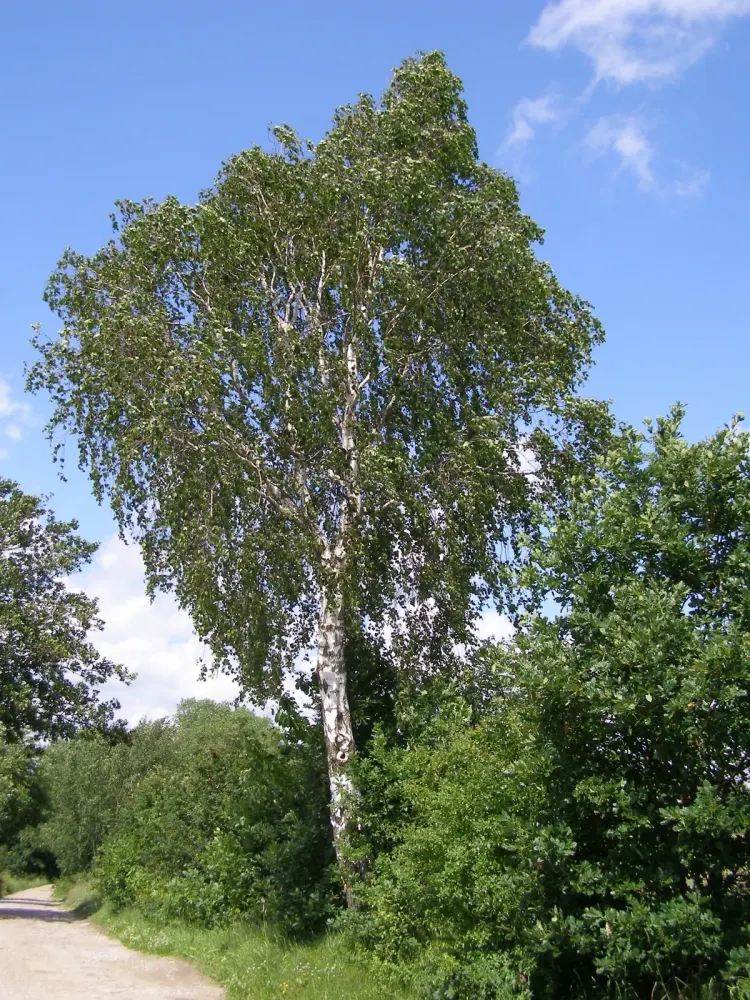
© Andrzej Otrębski · CC BY-SA 3.0 · Commons
Betula pendula
CautionHänge-Birke · (Betula pendula)
Birch family (Betulaceae)
Description
Betula pendula, commonly known as silver birch, warty birch, European white birch, or East Asian white birch, is a species of tree in the family Betulaceae, native to Europe and parts of Asia, though in southern Europe, it is only found at higher altitudes. Its range extends into Siberia, China, and southwest Asia in the mountains of northern Turkey, the Caucasus, and northern Iran. It has been introduced into North America, where it is known as the European white birch or weeping birch and is considered invasive in some states in the United States and parts of Canada.
- TeaLeafInternalTraditional use
Traditional use as an aquaretic (irrigation therapy) for supportive treatment of mild urinary complaints — EMA HMPC monograph (traditional use).
Preparation & dosage
INFUSION (aquaretic): 2–3 g (approx. 1–1.5 tsp) dried, coarsely cut birch leaves in 200 ml boiling water, covered, steep 10–15 min, strain. 3× daily fresh, between meals. Daily dose 6–9 g. Ensure adequate fluid intake (at least 1.5–2 L/day) as the effect depends on urinary irrigation. Duration per EMA HMPC up to 2–4 weeks; fever, blood in urine or persisting complaints require prompt medical attention. CONTRAINDICATED in oedema due to cardiac or renal insufficiency — irrigation therapy must not be used in these cases.
- Dry amount
- 2–3 g
- Doses per day
- 3×
- Max duration
- 4 weeks
⚠ Age restriction: ≥ 18 years — Per EMA HMPC traditional use monograph: adults only — insufficient data for children/adolescents under 18.
[#src_ema_betulae_folium] [#src_escop_betulae_folium] [#src_kommission_e_birke] [#src_wichtl_birke]
- TinctureLeafInternalTraditional use
Traditional birch leaf tincture as aquaretic; folk use also for joint complaints — adjunctive, no clinical proof for joint indication.
Preparation & dosage
TINCTURE (DER 1:5 in 25–40 % ethanol): 1–2 ml (~20–40 drops) 3× daily diluted in water. Ensure adequate fluid intake (min. 1.5 L/day) — irrigation remains the key principle. Onset of action after ~1–2 weeks. No longer than 4 weeks without medical supervision. Contraindicated in oedema from heart or kidney insufficiency. Folk use also for joint complaints (gout, rheumatoid arthritis) as an adjunct — no clinical evidence for this indication.
- Liquid amount
- 1–2 ml
- Doses per day
- 3×
- Max duration
- 4 weeks
⚠ Age restriction: ≥ 18 years — Adults only. Due to ethanol content, not for alcohol dependence, liver disease, or epilepsy.
[#src_ema_betulae_folium] [#src_escop_betulae_folium] [#src_pfaf_betula_pendula]
- RawLeafInternalFolk medicine
Fresh spring leaves as wild salad green and historical folk-medicine practice ('blood-cleansing') — folk custom without modern evidence.
Preparation & dosage
FRESH LEAVES (spring): Very young, pale-green birch leaves (April–May flush) may be eaten fresh as a wild salad green — mildly herbaceous, slightly resinous flavour. Folk tradition used freshly pressed birch juice (leaves + birch sap) as a spring 'blood-cleansing' drink. Pharmacological evidence is lacking; the educational value lies in the historical folk practice.
[#src_madaus_birke] [#src_pfaf_betula_pendula] [#src_wp_de_birke]
- RawFruitInternalFolk medicine
Birch sap — traditional spring drink tapped from drilled trunks, rich in minerals and sugars, folk use as a tonic and aquaretic.
Preparation & dosage
BIRCH SAP ('birch water'): In early spring (Feb–Mar, before leaf burst) the trunk is drilled or a thin branch cut, and the clear flowing sap is collected (max 1–2 L/day per tree; seal the hole immediately to protect the tree). Fresh birch sap contains sugars (mainly fructose), amino acids, vitamins (C, B-group), minerals (potassium, calcium, magnesium) and small amounts of betuloids and saponins. Folk medicine use for urinary complaints, spring fatigue and skin conditions. Fresh sap lasts only 2–3 days refrigerated — consume quickly or ferment.
[#src_madaus_birke] [#src_pfaf_betula_pendula] [#src_wp_en_birke] [#src_wp_de_birke]
- BathLeafExternalFolk medicine
Folk birch-leaf full bath for skin conditions and joint complaints — mildly astringent, traditional use without clinical study evidence.
Preparation & dosage
FULL BATH / PARTIAL BATH: 50–100 g dried birch leaves in 2 L boiling water, steep 20 min, strain and add to bath water (36–38 °C, 15–20 min). Traditionally used for skin conditions (psoriasis, eczema, acne), dry or scaly skin, and joint / muscle complaints. The tannin-rich decoction has mild astringent and anti-inflammatory effects on skin. Evidence based on folk tradition and in-vitro data; controlled clinical trials are lacking. Use with caution in known birch pollen allergy — possible cross-reaction.
- Dry amount
- 50–100 g
[#src_madaus_birke] [#src_pfaf_betula_pendula] [#src_wichtl_birke]
- TinctureBarkExternalFolk medicine
Betulin-containing birch bark topical for psoriasis and seborrhoeic dermatitis — betulin and betulinic acid are clinically investigated lead compounds of the bark.
Preparation & dosage
BIRCH BARK EXTRACT / BETULIN PREPARATION (topical): Extracts from birch outer bark (rich in betulin, betulinic acid, lupeol) are used externally for psoriasis, seborrhoeic dermatitis and wound care. Betulin is the key constituent of commercial creams (e.g. Birken-CORS®). Apply thinly 2× daily to affected skin areas. Caution in concurrent birch pollen allergy. Do not apply to open, infected wounds. Clinical data on betulin exist for specific formulations (e.g. Eucerin® with Betulae cortex extract in psoriasis patients).
- Liquid amount
- 5–10 ml
- Doses per day
- 2×
- TeaLeafInternalCommission E
Kommission E positive: birch leaf tea as adjunct for rheumatism, gout and skin conditions — diuretic, anti-inflammatory, saluretic.
Preparation & dosage
SUPPORTIVE USE for joint diseases (gout, rheumatoid arthritis) and skin conditions: 2–3 g birch leaves in 200 ml boiling water, steep 10–15 min, strain. 3× daily. Kommission E rated birch leaves positively for supportive treatment of rheumatic conditions and gout as an adjunct (not monotherapy). The diuretic, anti-inflammatory and saluretic effect is primary. Drink plenty of fluids. CONTRAINDICATED in renal or cardiac oedema. Not a substitute for specific antirheumatic therapy.
- Dry amount
- 2–3 g
- Doses per day
- 3×
- Max duration
- 4 weeks
[#src_kommission_e_birke] [#src_escop_betulae_folium] [#src_wichtl_birke]
- SalveBarkExternalFolk medicine
Historical birch tar ointment from bark distillate for psoriasis and eczema — folk and historical-dermatological; modern equivalent is PAH-free betulin cream.
Preparation & dosage
BIRCH TAR OINTMENT / BIRCH TAR (Pix betulina): Dark oil produced by dry distillation of birch bark (birch tar, Oleum Betulinae empyreumaticum). Historically used in folk and dermatological medicine for chronic psoriasis, eczema and seborrhoeic dermatitis as an ointment (5–10 % in petrolatum or lanolin). Birch tar contains polycyclic aromatic hydrocarbons (PAHs) — prolonged use on large areas not recommended (carcinogenic PAH potential). Modern equivalent: betulin extract creams (PAH-free). Now only historical and very limited niche medical use.
[#src_madaus_birke] [#src_wp_de_birke] [#src_pfaf_betula_pendula]