© User:Kilom691 · Public domain · Commons
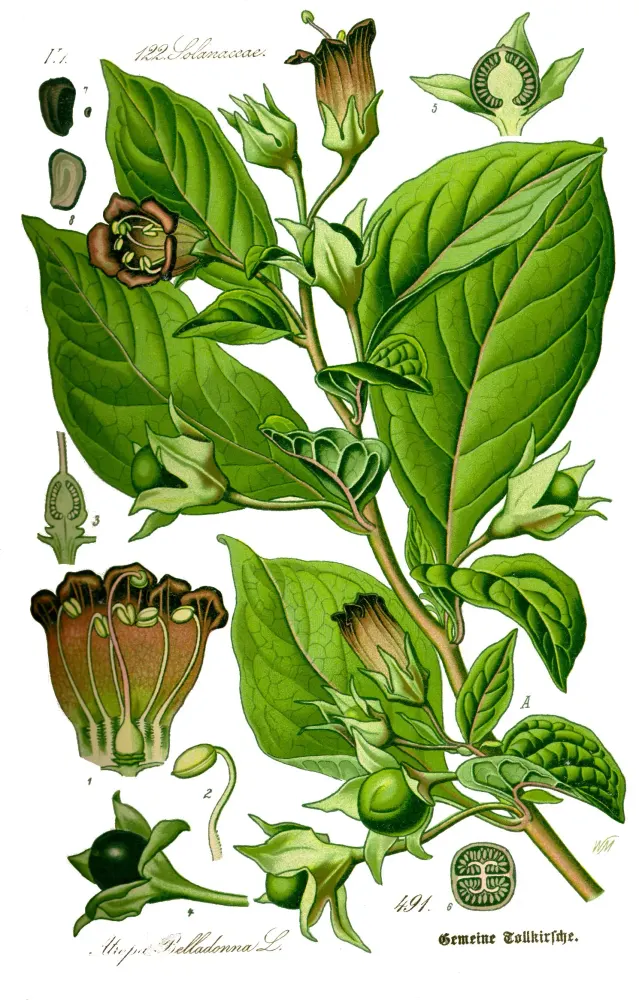
Atropa bella-donna
Toxic🐾Schwarze Tollkirsche · (Atropa belladonna)
Nightshade family (Solanaceae)
Description
Atropa bella-donna, commonly known as deadly nightshade or belladonna, is a toxic perennial herbaceous plant in the nightshade family Solanaceae, which also includes tomatoes, potatoes and eggplant. It is native to Europe and Western Asia, including Turkey, its distribution extending from England in the west to western Ukraine and the Iranian province of Gilan in the east. It is also naturalised or introduced in some parts of Canada, North Africa and the United States.
External use only!
This plant must NOT be taken internally. Use only as compress, salve, or bath.
CONTRAINDICATED during pregnancy
Belladonna alkaloids (atropine, scopolamine) cross the placental barrier and can cause fetal tachycardia and CNS damage. Any application during pregnancy is contraindicated.
CONTRAINDICATED during breastfeeding
Atropine passes into breast milk and can trigger anticholinergic effects (tachycardia, dry mouth, fever) in the infant. Breastfeeding: strictly contraindicated.
CONTRAINDICATED for children
Children are extremely sensitive to belladonna alkaloids. Even a few berries can be fatal. No use in children and adolescents under 18 years. Poisoning risk through attractive black berries is particularly high.
Critical drug interactions with:
Anticholinergika (Tiotropium, Ipratropium, Oxybutynin)
Historical documentation only — do NOT use
These internal applications are historically documented. This plant is highly toxic — self-treatment can cause severe poisoning or death. For documentation only, explicitly NOT a recommendation.
- TinctureLeafInternalTraditional use
Historical pharmaceutical use of atropine-containing belladonna tincture as antispasmodic for gastrointestinal colic and biliary spasms. Applied under medical supervision only — largely replaced today by synthetic anticholinergics.
Preparation & dosage
[#src_wp_en_atropa_belladonna] [#src_pfaf_atropa_belladonna]
- TinctureLeafInternalTraditional use
Use of belladonna extracts in early Parkinson's therapy to alleviate tremor and muscle rigidity through anticholinergic action. Historically common before the introduction of L-dopa.
Preparation & dosage
[#src_wp_en_atropa_belladonna] [#src_wp_atropine_atropa_belladonna]
- TinctureRootInternalTraditional use
Atropine from belladonna as antidote for organophosphate and carbamate poisoning (pesticides, nerve agents). This life-saving application is now standardized and exclusively medically indicated.
Preparation & dosage
[#src_wp_atropine_atropa_belladonna] [#src_wp_en_atropa_belladonna]
- TinctureLeafInternalTraditional use
Historical premedication before surgery: belladonna alkaloids (atropine, scopolamine) reduced salivation and bronchial secretion and prevented vagally-induced bradycardia. Today replaced by pure atropine or glycopyrrolate injections.
Preparation & dosage
[#src_wp_atropine_atropa_belladonna] [#src_wp_scopolamine_atropa_belladonna]
- TinctureLeafInternalFolk medicine
Folk medicinal use of belladonna leaves as smoking herb for bronchial asthma (stramonium cigarettes). Historically widespread, now obsolete due to toxicity and lack of evidence.
Preparation & dosage
[#src_pfaf_atropa_belladonna] [#src_wp_en_atropa_belladonna]
- TinctureLeafInternalFolk medicine
Homeopathic use of Belladonna (D6–D30) for febrile inflammations with redness, heat and delirium. Pure homeopathic dilution levels contain no pharmacologically active alkaloid amounts.
Preparation & dosage
[#src_wp_en_atropa_belladonna] [#src_wikidata_atropa_belladonna]
- TinctureLeafInternalFolk medicine
Historical use of belladonna extract in ophthalmology for pupil dilation (mydriasis) for eye examinations and cosmetic purposes (Renaissance beauty care). Today replaced by synthetic mydriatics.
Preparation & dosage
[#src_wp_en_atropa_belladonna] [#src_pfaf_atropa_belladonna]