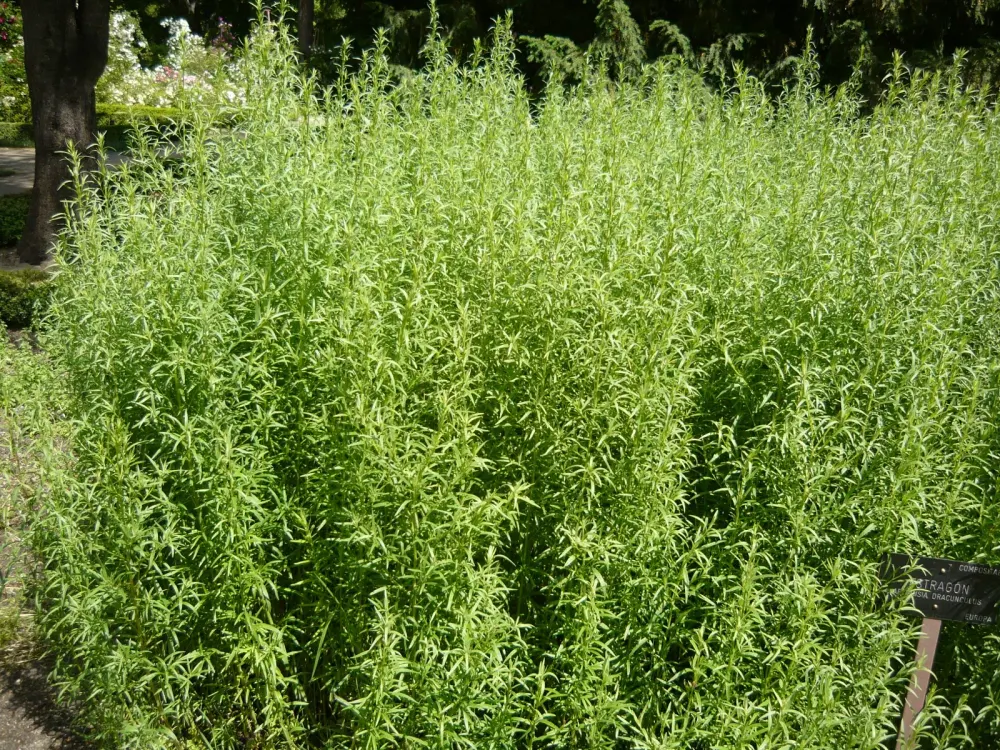
© Cillas · CC BY-SA 4.0 · Commons
Tarragon
CautionEstragon · (Artemisia dracunculus)
Daisy family (Asteraceae)
Description
Tarragon, also known as estragon, is a species of perennial herb in the family Asteraceae. It is widespread in the wild across much of Eurasia and North America and is cultivated for culinary and medicinal purposes.
CONTRAINDICATED during pregnancy
Do not use as a herbal preparation (tea, extract, oil) during pregnancy — emmenagogue effect possible. Small culinary amounts are considered safe.
- SpiceAerial partsInternalFolk medicine
Fresh or dried leaves and shoot tips are used as an aromatic culinary herb. Tarragon is one of the four classic 'fines herbes' in French cuisine and the defining flavour of Béarnaise sauce. The leaves have a mild anise aroma and pair well with poultry, fish, egg dishes and vinegar preparations.
Preparation & dosage
- TeaAerial partsInternalFolk medicine
An infusion of the dried leaves is traditionally used for digestive complaints, flatulence, nausea and hiccups. The bitter principles and essential oils are thought to stimulate bile secretion and gastric activity.
Preparation & dosage
Pour 150 ml hot water over 1–2 g dried leaves, steep 10 minutes, strain.
- Dry amount
- 1–2 g
- Doses per day
- 3×
- TinctureAerial partsInternalFolk medicine
In the folk medicine of Central Asia and the Middle East, extracts of tarragon were used as antipyretics and digestive aids, as well as for loss of appetite and weak digestion.
Preparation & dosage
- CompressAerial partsExternalFolk medicine
Poultices of fresh leaves have been applied externally in folk medicine for rheumatism, gout and joint pain.
Preparation & dosage
- RawLeafInternalFolk medicine
In folk medicine, fresh leaves were chewed for toothache, as essential oils such as estragole exhibit mild local anaesthetic effects. In parts of Iran and Armenia, fresh leaves are eaten daily as part of the traditional herb platter (sabzi khordan).
- Essential oilAerial partsExternalFolk medicine
Tarragon essential oil shows antibacterial and antifungal activity in laboratory studies, due to high levels of estragole and methyl eugenol. External use (highly diluted) is described in aromatherapy. Concentrated ingestion is not recommended due to genotoxic potential.
Distribution in Europe
🤝 Permaculture Partners
In your garden, this plant acts as:
✨ Best symbiotic partners
- 🌿 Parsley Classic companion-planting partner.
🌟 Neutral neighbours
Source: Helga und Margarete Langerhorst, Mein gesunder Naturgarten (eigene Kuration)