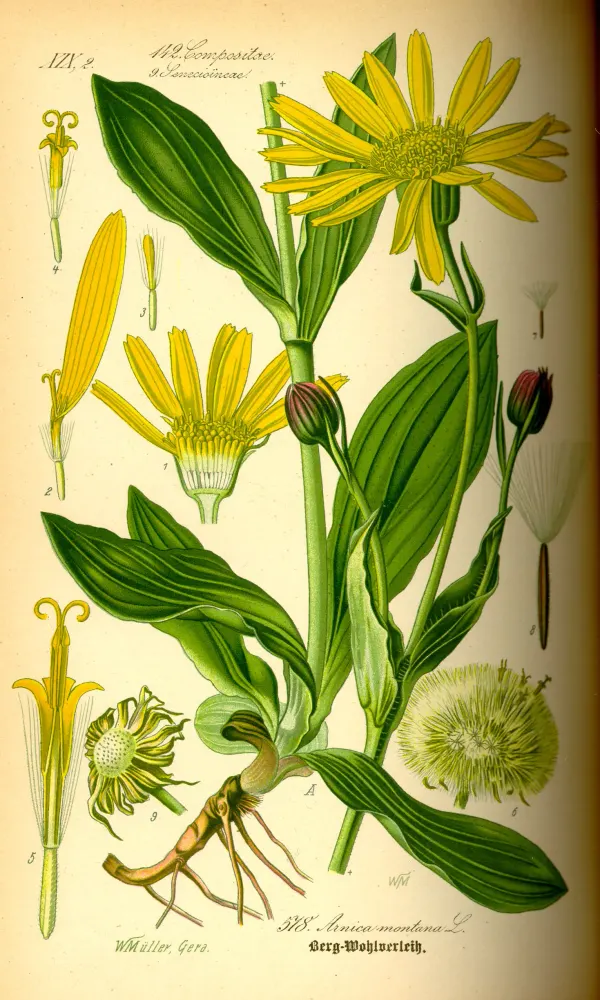
© Otto Wilhelm Thomé, Flora von Deutschland (1885) · Public domain · Commons
Arnica
CautionArnika · (Arnica montana)
Daisy family (Asteraceae)
Description
Arnica is a perennial mountain plant with brilliant yellow-orange ray flowers that grows on nutrient-poor meadows in low mountain ranges and the Alps. It is protected by nature conservation law in Germany and must not be collected in the wild. Its flower extracts are one of the best-known traditional remedies for bruises and contusions — exclusively for external use.
External use only!
This plant must NOT be taken internally. Use only as compress, salve, or bath.
CONTRAINDICATED during pregnancy
Arnica montana must not be used during pregnancy. Helenalin and related sesquiterpene lactones may have uterotonic activity. Per the EMA monograph, sufficient safety data are lacking; given the known toxicity of constituents, all external use during pregnancy should be avoided.
CONTRAINDICATED during breastfeeding
No adequate safety data in lactation. Due to the toxicity of helenalin and potential transfer into breast milk, use during lactation is not recommended. The EMA monograph excludes breastfeeding from the indicated population.
- CompressFlowerExternalCommission E
Arnica tincture (1:10 in 70 % ethanol), diluted 1:3 to 1:10 with water, applied as a moist compress to bruises, contusions, sprains and blunt injuries. External use on intact, unbroken skin only. Apply compress 2-3 times daily for 20-30 minutes, covered with a cloth. Kommission E positively assessed arnica for blunt injuries, haematomas, and muscle and joint complaints.
[#src_kommission_e_arnica] [#src_ema_arnicae_flos] [#src_escop_arnica]
- TinctureFlowerExternalCommission E
Undiluted or lightly diluted arnica tincture (DAB: Tinctura Arnicae 1:10, ethanol 70 %) rubbed in for muscle soreness, strains and joint pain after physical exertion. Apply to intact skin only; do not cover with occlusive dressings. German Commission E positively assessed arnica for topical use on blunt trauma; the EMA classifies the use as traditional.
[#src_ema_arnicae_flos] [#src_kommission_e_arnica] [#src_escop_arnica]
- SalveFlowerExternalCommission E
Arnica ointment or gel (standardised on sesquiterpene lactones, typically 0.5-1 % helenalin derivatives or equivalent to 15 % tincture in ointment base) for external use on blunt injuries, muscle pain, joint complaints, bruises and sprains. Apply thinly 2-3 times daily; do not use on open wounds. German Commission E positively assessed arnica preparations for external use; the EMA monograph lists arnica as traditional use.
[#src_ema_arnicae_flos] [#src_escop_arnica] [#src_kommission_e_arnica]
- BathFlowerExternalTraditional use
Arnica sitz bath or partial/foot bath for tired, aching muscles and mild joint complaints after physical work: 2-3 tbsp dried arnica flowers (approx. 5-10 g) infused in 1 litre boiling water, steeped 10 minutes, strained and added to bath water (temperature 36-38 °C, bathing time 15-20 minutes). Traditional folk application, well documented in German-language herbal literature (Wichtl, Hänsel/Sticher). Do not use on damaged skin, open wounds, or in known Asteraceae allergy.
- CompressFlowerExternalCommission E
Arnica tincture diluted with water (1:5 to 1:10), applied as a compress for insect bites and superficial skin irritations (not on open wounds). Apply compress with a clean cloth to the affected area, leave for 15-20 minutes. Kommission E explicitly lists insect bites as an indication for external arnica preparations. Only on intact skin — use on open wounds is contraindicated (local mucosal irritation, contact dermatitis risk).
- SalveFlowerExternalClinical trial
Standardised arnica gel (50 g arnica flower tincture per 100 g, equivalent to ~15 % mother tincture) clinically studied for osteoarthritis of finger joints and knee: In randomised controlled trials (e.g. Knuesel et al. 2002, Wiesenauer 2004), arnica gel showed comparable efficacy to ibuprofen gel in pain reduction and improvement of joint function. Apply 3 times daily to affected joints for at least 3-6 weeks to assess benefit. Use only as adjunct, not as replacement for physician-prescribed osteoarthritis therapy.
[#src_knuesel_2002] [#src_ema_arnicae_flos] [#src_escop_arnica]
- TinctureFlowerExternalFolk medicine
Folk medicine application of arnica tincture (heavily diluted 1:10 in water) for chilblains (perniones) and cold-induced skin damage: as compress or gentle rub to promote local circulation. Long-standing tradition in German folk medicine (Kneipp tradition) and Swiss herbal medicine (Künzle). Clinical evidence lacking — purely traditional use. Only on intact, unbroken skin.
[#src_kuenzle_1911] [#src_wp_de_arnica] [#src_haensel_sticher]
Classical quotes
"Arnica is a true wonder plant for contusions and sprains — but only when applied externally."