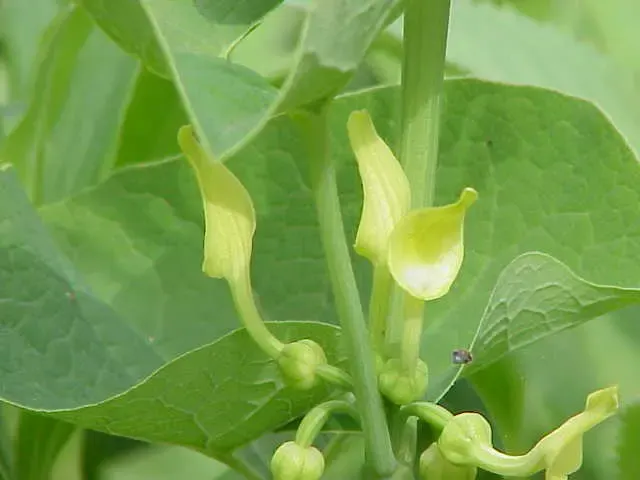
© Kurt Stüber [1] · CC BY-SA 3.0 · Commons
Aristolochia clematitis
Toxic🐾Gewöhnliche Osterluzei · (Aristolochia clematitis)
Birthwort family (Aristolochiaceae)
Description
Aristolochia clematitis, or European birthwort, is a twining herbaceous plant in the family Aristolochiaceae, which is native to most of central and southern Europe and parts of western Asia, and naturalised further north in Europe.
CONTRAINDICATED during pregnancy
ABSOLUTELY CONTRAINDICATED. Aristolochic acid crosses the placenta, is embryotoxic, teratogenic and genotoxic; animal studies document abortions and malformations. The historical name 'birthwort' rests on labour-inducing action combined with severe fetal harm — a supposed 'midwife's aid' that gravely damaged pregnant women and their children. ANY use during pregnancy is prohibited.
CONTRAINDICATED during breastfeeding
CONTRAINDICATED. Aristolochic acid is nephrotoxic and carcinogenic; passage into breast milk is assumed. Infants with immature tubular function are particularly sensitive. NO use during breastfeeding, neither internal nor external.
CONTRAINDICATED for children
STRICTLY CONTRAINDICATED. Children are particularly endangered due to low body weight and developing kidneys. Confusion risk with other medicinal or kitchen plants (peppermint, sage) must be absolutely excluded in school gardens and family households. NO use under 18 years, NO 'child-friendly' infusions, NO homeopathic dilutions below D6 without pharmaceutical supervision.
Critical drug interactions with:
Nichtsteroidale Antirheumatika (NSAR: Ibuprofen, Diclofenac, Naproxen) · Aminoglykosid-Antibiotika (Gentamicin, Tobramycin, Amikacin) · Calcineurin-Inhibitoren (Ciclosporin, Tacrolimus) · Jodhaltige Kontrastmittel (radiologische Diagnostik) · Chemotherapeutika mit renaler Elimination (Cisplatin, Methotrexat-Hochdosis)
- CompressAerial partsExternalFolk medicine
HISTORICALLY OBSOLETE — Antique and medieval wound treatment: Pliny the Elder (Naturalis Historia), Dioscorides (De Materia Medica) and medieval herbals recommended compresses of crushed Aristolochia leaves for purulent wounds, ulcers and snakebite — hence the generic name from Greek áristos (best) + locheía (birth/cleansing). Percutaneous uptake of aristolochic acid may also contribute to renal damage; external use is now likewise rejected. Pure ethnobotanical note, NOT a use recommendation.
[#src_wp_en_aristolochia_clematitis] [#src_pfaf_aristolochia_clematitis] [#src_ema_statement_aristolochia_clematitis]
- RawFlowerExternalFolk medicine
Biological phenomenon — The flower of birthwort is an 'Aristolochia trap' (pitfall flower): the curved perianth tube is lined internally with downward-pointing trichomes and attracts small Diptera (especially fungus gnats) via a carrion-like scent. Insects fall into the kettle chamber and are detained until pollination; after pollen release the trichomes wither and free the exit. Classical textbook example of temporary kettle-trap flowers in botany; NO medicinal relevance, purely pollination ecology.
[#src_wp_de_aristolochia_clematitis] [#src_wp_en_aristolochia_clematitis] [#src_pfaf_aristolochia_clematitis]
- RawWhole plantExternalFolk medicine
OBSOLETE / RARE — Historically Aristolochia clematitis was cultivated as a monastery garden plant and apothecary 'hortus medicus' species (Hildegard tradition, Abbey of St. Gall, monastic pharmacies). Extremely rare in modern gardens, since toxic and banned in the EU as a medicinal plant; occasionally still seen in botanical collections and ethnobotanical demonstration gardens. Naturalized stands persist in vineyards and ruderal sites of Central and Southern Europe. Cultivation in domestic gardens is discouraged due to confusion risk (see poisoning warning).
[#src_wp_de_aristolochia_clematitis] [#src_floraweb_aristolochia_clematitis] [#src_pfaf_aristolochia_clematitis]
Historical documentation only — do NOT use
These internal applications are historically documented. This plant is highly toxic — self-treatment can cause severe poisoning or death. For documentation only, explicitly NOT a recommendation.
- TeaRootInternalFolk medicine
HISTORICALLY OBSOLETE AND DANGEROUS — Medieval and early modern folk medicine: infusions or decoctions of the root were considered a 'midwife' and labour-inducing remedy; the German name 'Osterluzei' and the English 'Birthwort' refer directly to this supposed obstetric use. Hildegard of Bingen mentions the plant (Physica) as a circulation-stimulating agent. The application followed the Doctrine of Signatures, since the curved perianth tube resembles a birth canal. Today NO application is permitted: aristolochic acid is nephrotoxic and a proven carcinogen (IARC Group 1); fully banned from medicinal products in the EU since 2001. Documentation purely ethnobotanical.
[#src_wp_de_aristolochia_clematitis] [#src_wp_en_aristolochia_clematitis] [#src_iarc_aristolochia_clematitis]
- TeaAerial partsInternalFolk medicine
HISTORICALLY OBSOLETE AND HIGHLY DANGEROUS — In traditional Chinese medicine (TCM), Aristolochia species (Mu Tong, Guang Fang Ji) were prescribed as 'diuretic' and 'heat-clearing' drugs until the 1990s. From 1992 to 1994, accidental substitution of Stephania tetrandra by Aristolochia fangchi in a Brussels slimming clinic caused 'Chinese Herbs Nephropathy' (CHN, today Aristolochic Acid Nephropathy/AAN): over 105 mostly young women developed severe interstitial renal fibrosis; many required dialysis or transplantation, and urothelial carcinomas (ureter/bladder) emerged. This catastrophe led to the EU-wide ban. Documented purely as a warning — NO use.
[#src_iarc_aristolochia_clematitis] [#src_ema_statement_aristolochia_clematitis] [#src_wp_aan_aristolochia_clematitis]
- TeaRhizomeInternalFolk medicine
HISTORICALLY OBSOLETE — Antique medicine (Hippocrates, Galen, Dioscorides) used root and rhizome decoctions of birthwort against intermittent fever, as a 'cleansing' postpartum agent (lochia-promoter) and against snakebite. Medieval pharmacopoeias (Macer Floridus, Salernitan Antidotarium) list it as 'Aristolochia rotunda/longa' for internal applications. We now know: such infusions contain free aristolochic acids I and II, which form DNA adducts (aristolactam-dA) on adenine residues and induce A:T → T:A transversions in TP53 — molecular signature of AA-induced carcinogenesis. NO use.
[#src_iarc_aristolochia_clematitis] [#src_wp_en_aristolochia_clematitis] [#src_grollman_pmc_aristolochia_clematitis]