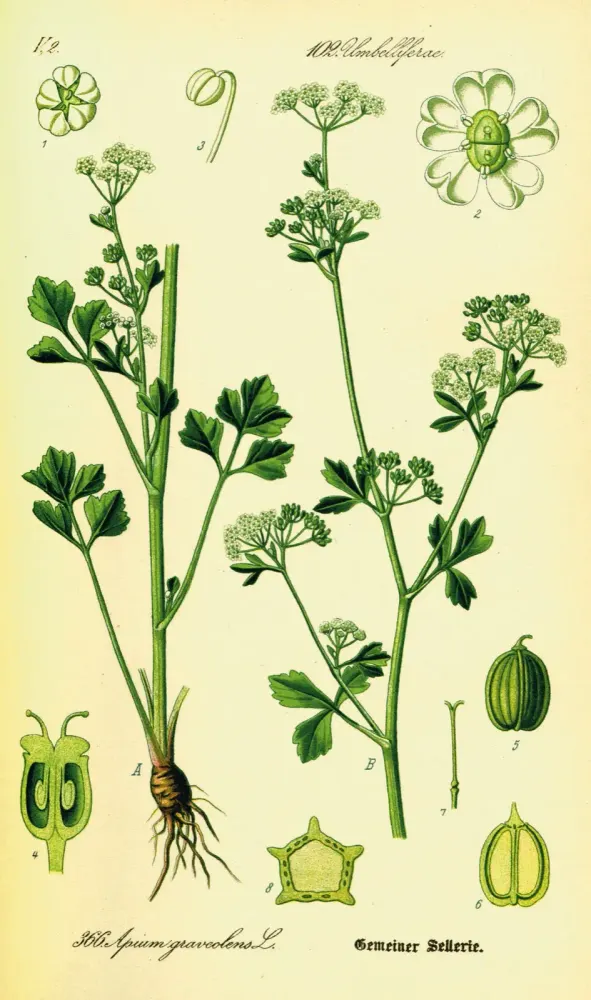
© Unknown · Public domain · Commons
Celeriac
CautionEchter Sellerie · (Apium graveolens var. rapaceum)
Carrot family (Apiaceae)
Description
The knobby, round root of this celery cultivar from the carrot family is harvested in autumn and differs clearly from the stalk-forming celery variety of the same species. Grated raw as crudités, in salads or as the classic céleri rémoulade, the tuber supplies notable amounts of vitamin K, folate and dietary fibre; cooked or pureed it serves as a vegetable or soup base, with the phthalides 3-n-butylphthalide and sedanenolide providing the characteristic aroma. Folk medicine describes an infusion of grated tuber as a mildly diuretic remedy for water retention, though clinical evidence is lacking. WARNING: celeriac is one of the most common food allergens in Central Europe and requires mandatory labelling in the EU; cross-reactions with birch and mugwort pollen are clinically relevant. Because of its furanocoumarin content, phototoxic skin reactions are theoretically possible with large fresh amounts followed by sun exposure.
Raw celeriac as crudités, in salads or as rémoulade. Rich in vitamin K, vitamin C, folate, and dietary fibre. Promotes digestion and gut health through inulin-like fructooligosaccharides.
Cooked, braised, or pureed tuber used as a vegetable or soup base. Contains 3-n-butylphthalide and sedanenolide responsible for the characteristic celery aroma, with mild carminative (antiflatulent) effects.
Preparation & dosage
Infusion of grated or dried celeriac tuber used in folk medicine as a mildly diuretic remedy for water retention and to support kidney function. No specific clinical evidence for the tuber; effect is based on traditional use.
Preparation & dosage
Pour 250 ml of hot water over 2–4 g of dried grated tuber, steep 10 minutes, strain.
- Dry amount
- 2–4 g
- Doses per day
- 2×
Regular celeriac consumption described in folk medicine as supporting healthy blood pressure. Phthalides may relax smooth vascular muscle. Note: Evidence for the root (rapaceum) is weak; phthalide studies refer primarily to celery seeds and celery seed extract.
In folk medicine, celeriac is considered liver-strengthening and bile-flow-promoting (cholagogue). Polyphenols (chlorogenic acid, caffeic acid) and antioxidants contribute to hepatoprotective effects documented in vitro for Apium graveolens.
Celeriac is one of the most common food allergens in Central Europe (celery allergy). Cross-reactions with birch and mugwort pollen (celery-birch-mugwort syndrome) are clinically relevant. Mandatory labelling in the EU as one of the 14 major allergens. Due to furanocoumarin (psoralen) content in the tuber, phototoxic reactions are theoretically possible with large fresh quantities and UV exposure.
Celeriac as food in usual culinary amounts is safe in pregnancy. Avoid as a high-concentration extract or medicinal preparation.
Culinary use is considered safe. Avoid highly concentrated extracts as a precaution.
Celeriac as a vegetable is suitable from complementary feeding age onwards; monitor for allergy symptoms, as celery is one of the most common food allergens in children in Europe.
Drug interactions
Antikoagulantien / Vitamin-K-Antagonisten
Celeriac contains vitamin K1; large regular increase in consumption may affect INR in warfarin/acenocoumarol patients.
Schilddrüsenmedikamente / Thyreostatika
Apiaceae vegetables in very large amounts may theoretically affect iodine utilisation; advise moderation for thyroid disorder patients.
Contraindications
- Known celery allergy or confirmed cross-allergy (celery-birch-mugwort syndrome).
- Severe renal insufficiency (advanced CKD): elevated potassium content may be critical.
Harvested part: tuber (autumn)
- Time of day:
- Can be harvested after the first light frost — frost improves the flavour by converting starch to sugars.
- Drying:
- The tuber is not dried but stored fresh in a cool place or frozen.
- Storage:
- 6 months — Store tubers in moist sand or a cool cellar at 0–4 °C for up to 6 months.
- Time of day:
- Harvest young leaves and stems fresh in summer for soup flavouring. Best in the morning when turgor pressure is highest.
- Drying:
- Dry leaves at 35 °C or freeze-dry; aroma is significantly lost with standard drying.
- Storage:
- 4 months — Store dried leaves airtight and light-protected; quality loss after 4 months.
- 3-n-ButylphthalidOtherRoot
Main contributor to characteristic celery aroma; associated with blood pressure-lowering and mild sedative effects in studies (primarily celery seed extract studies).
- SedanenolidOtherRoot
Volatile phthalide lactone; important aroma compound alongside 3-n-butylphthalide; contributes to carminative effect.
- Apigenin-7-glucosidFlavonoidRoot
Key flavonoid in Apium graveolens; antioxidant and mildly anti-inflammatory.
- ChlorogensäurePhenolic acidRoot
Phenolic acid ester; one of the main polyphenols in the tuber; antioxidant and hepatoprotective.
- Vitamin K1 (Phylloquinon)VitaminContent: 0.004-0.006 %Root
Important for blood coagulation and bone health; clinically relevant for patients on anticoagulation therapy.
- KaliumMineralRoot
Approx. 300 mg/100 g fresh weight; supports blood pressure and electrolyte balance; relevant for patients with renal insufficiency.
- Furanocumarine (Psoralen, Bergapten)OtherRoot
Present in trace amounts; phototoxic in sensitive individuals with UV exposure (contact dermatitis). Clinically barely relevant in normal culinary use.
- Folsäure (Vitamin B9)VitaminRoot
Approx. 24–28 µg/100 g fresh weight; relevant for cell growth and during pregnancy.
- [1]MonographApium graveolens var. rapaceum (celeriac)(accessed: 2026-05-24)
- [2]MonographIsolation of 3-n-Butyl Phthalide & Sedanenolide from Apium graveolens Linn.(accessed: 2026-05-24)
- [3]MonographIn vitro and in vivo antioxidant activities of a flavonoid isolated from celery (Apium graveolens L. var. dulce)(accessed: 2026-05-24)
- [4]MonographAntinociceptive and anti-inflammatory effects of isolated fractions from Apium graveolens seeds in mice(accessed: 2026-05-24)
- [5]WikipediaCeleriac — Wikipedia(accessed: 2026-05-24)
🤝 Permaculture Partners
In your garden, this plant acts as:
✨ Best symbiotic partners
- 🌿 Leek Classic companion-planting partner.
- 🌿 Cabbage Classic companion-planting partner.
- 🌿 Phaseolus vulgaris Classic companion-planting partner.
Source: Helga und Margarete Langerhorst, Mein gesunder Naturgarten (eigene Kuration)