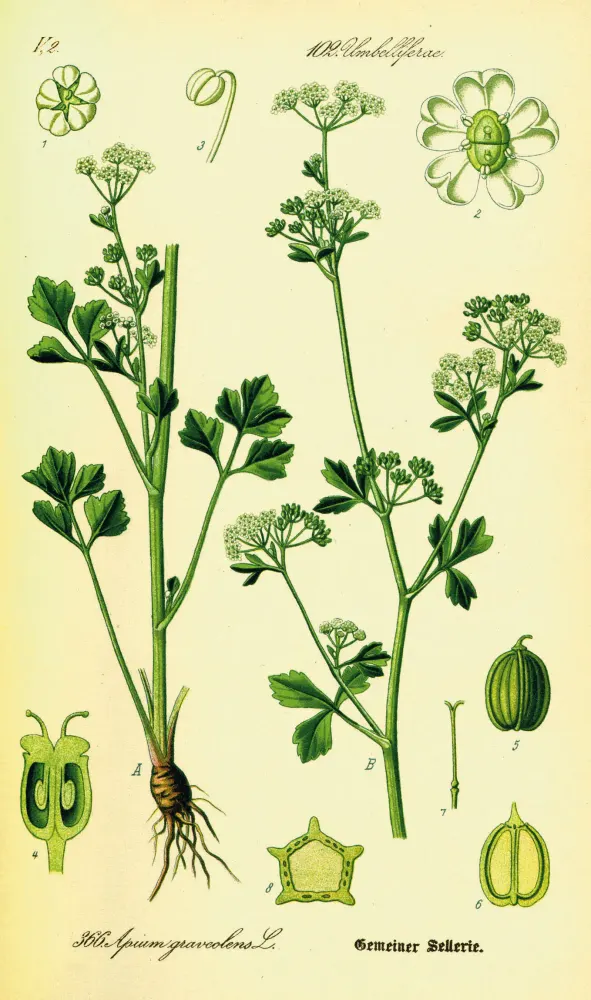
© Unknown (see Commons) · Public domain · Commons
Apium graveolens
CautionEchter Sellerie · (Apium graveolens)
Carrot family (Apiaceae)
Description
Apium graveolens, known in English as celery, is an Old World species of flowering plant in the family Apiaceae. It was first described by Carl Linnaeus in 1753.
- RawAerial partsInternalFolk medicine
Raw celery stalks as vegetable or snack: low calorie (14 kcal/100 g), 95 % water, rich in vitamin K (29 µg/100 g = 24 % DV), folate (36 µg = 9 % DV), and potassium (263 mg = 9 % DV). The characteristic phthalides butylphthalide and sedanolide provide the typical aroma and mildly relax smooth muscle of the digestive tract.
Preparation & dosage
- TeaSeedInternalFolk medicine
Seed infusion: 1 tsp crushed celery seeds in 250 ml hot water, steep 10–15 min. Traditionally used in European folk medicine as a diuretic for mild urinary tract infections and to support kidney function. Commission E monograph notes insufficient efficacy evidence; traditional use in central Europe is nonetheless well documented.
Preparation & dosage
- Dry amount
- 2–4 g
- Doses per day
- 2×
- SpiceSeedInternalFolk medicine
Celery seeds as spice in soups, stews, breads, and vegetable dishes — more intense flavour than the stalks. The seed essential oil contains R-(+)-limonene (~60 %), β-selinene (~13 %), and phthalides (20–30 %). Widely used in traditional cuisine of Europe, the Middle East, and South Asia.
Preparation & dosage
- RawAerial partsInternalFolk medicine
In European folk medicine, celery (stalks, seeds, root) is traditionally used for gout, rheumatism, and arthritis. The diuretic effect is said to promote uric acid excretion. Use for rheumatic complaints is well documented in folk tradition across central Europe and the Middle East; clinical studies on efficacy are lacking.
- RawAerial partsInternalFolk medicine
In traditional Chinese and Persian medicine, celery is used to support blood pressure. Phthalides (especially butylphthalide) relax vascular smooth muscle and lower blood pressure in animal models. No controlled clinical trials on celery as monoextract in humans exist; phthalides have however been isolated and studied as potential active compounds.
- SpiceLeafInternalFolk medicine
Celery leaves as a culinary herb (leaf celery): bitter compounds and essential oils stimulate digestion. Used as a spice and medicinal plant in ancient medicine (Egypt, Greece, Rome). Raw leaves have an intense, slightly bitter flavour; as a cooking herb they are used in soups and broths.
Preparation & dosage
Distribution in Europe
🤝 Permaculture Partners
In your garden, this plant acts as:
✨ Best symbiotic partners
- 🌿 Leek Leek and celery complement each other nutritionally.
- 🌿 Garlic Classic companion-planting partner.
- 🌿 Cauliflower Classic companion-planting partner.
- 🌿 Cabbage Celery deters cabbage white butterfly (classic DACH rule).
- 🌿 Red cabbage Classic companion-planting partner.
- 🌿 Brussels sprout Classic companion-planting partner.
- 🌿 Broccoli Classic companion-planting partner.
- 🌿 Savoy cabbage Classic companion-planting partner.
- 🌿 Cucurbita pepo Classic companion-planting partner.
- 🌿 Lovage Classic companion-planting partner.
- 🌿 Phaseolus vulgaris Classic companions: bean fertilises, celery uses the nitrogen.
- 🌿 Tomato Celery scent masks tomato from pests.
- 🌿 Tropaeolum majus Classic companion-planting partner.
⚠️ Better not planted together
📦 Part of these planting sets:
Source: Gertrud Franck, Gesunder Garten durch Mischkultur (1980, eigene Kuration) | Helga und Margarete Langerhorst, Mein gesunder Naturgarten (eigene Kuration)