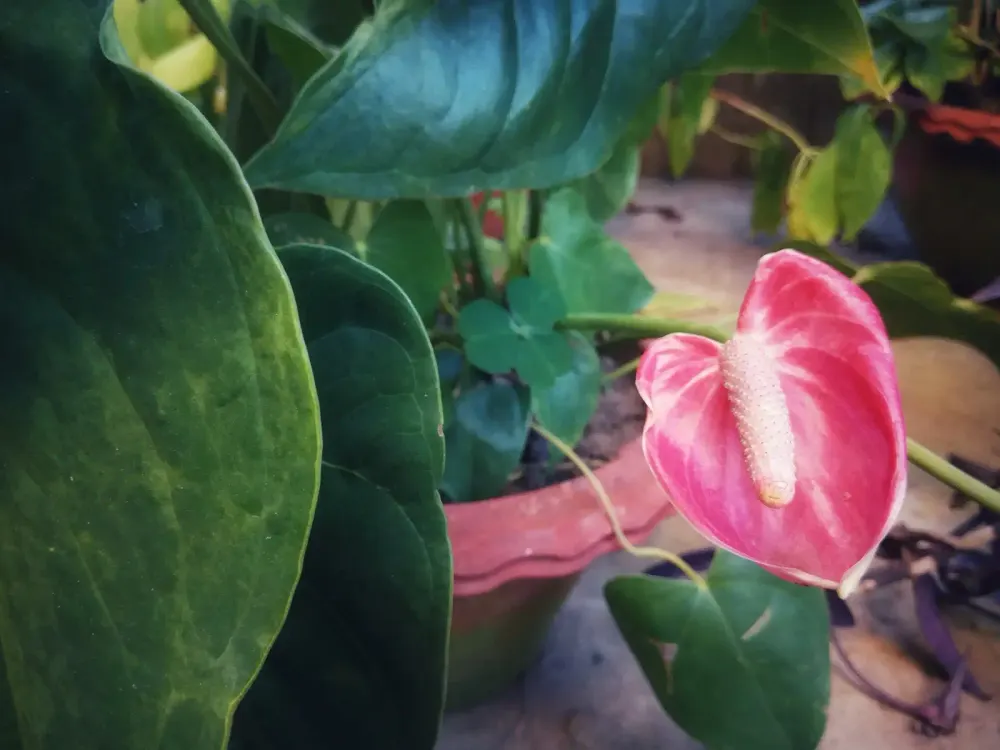
© Das Mousumi · CC BY-SA 4.0 · Commons
Flamingo flower
Caution🐾Flamingoblume · (Anthurium andraeanum)
Arum family (Araceae)
Description
Anthurium andraeanum, commonly known as the flamingo flower, is a species in the arum family Araceae, native to the tropical forests of Colombia and Ecuador. It is renowned for its brightly coloured, waxy-shiny spathes in red, pink, white or salmon, which surround a prominent spadix. Because Anthurium andraeanum is not frost-hardy and cannot survive outdoor temperatures in Central Europe or Bulgaria, it can only be cultivated as a houseplant in these regions.
External use only!
This plant must NOT be taken internally. Use only as compress, salve, or bath.
- RawFlowerExternalFolk medicine
The flamingo flower is cultivated worldwide as a popular houseplant and cut flower. Its glossy red — occasionally pink, white or green — modified leaf (spathe) with the columnar inflorescence (spadix) brings a tropical accent to interiors and is regarded in indoor plant psychology as a mood-enhancing element of urban living spaces.
[#src_wiki_en_anthurium_andraeanum] [#src_wiki_de_anthurium_andraeanum] [#src_kew_pow]
- RawWhole plantExternalFolk medicine
As a low-maintenance houseplant, Anthurium andraeanum tolerates medium light, steady room temperatures above 18 degrees Celsius and moderate watering. Its blooms last six to eight weeks on the plant, making it a long-lasting decoration for living rooms and offices.
- RawFlowerExternalTraditional use
In the international cut-flower industry, the flamingo flower ranks among the most important tropical cut flowers. Hawaii, Mauritius and the Netherlands are leading producers; in the vase the bloom lasts four to six weeks, outlasting nearly every other standard cut flower.
[#src_wiki_en_anthurium] [#src_kew_pow] [#src_rhs_anthurium]
- RawWhole plantExternalTraditional use
Anthurium species were studied by NASA for their ability to absorb volatile organic compounds such as ammonia, formaldehyde, toluene and xylene from indoor air. The contribution of individual plants under real living conditions is modest, but they support a pleasant indoor climate through increased humidity.
- RawWhole plantExternalFolk medicine
Caution note: the plant sap contains calcium oxalate raphides and can cause skin irritation, redness and itching rashes on contact. When handling cut flowers, gloves should be worn — an ethnobotanical caution note, not a therapeutic indication.
- RawFlowerExternalFolk medicine
In its native range of Colombia and Ecuador (the western flank of the Andes, Choco region), the flamingo flower is part of indigenous floristic traditions. It was introduced into Western horticulture by the Belgian botanist Édouard André in 1876 and named after him — the species epithet 'andraeanum' honours its collector.
🪴 Grow at home
- ☀ Light
- bright, indirect
- 💧 Water
- weekly
- 🌱 Soil
- Orchid or aroid mix with a high proportion of coarse structural materials (perlite, bark compost)
- 🪴 Pot
- 15 cm
- ⭐ Difficulty
- ★★☆ intermediate
- 🐾 Pets
- toxic to pets
Tips:
- Flamingo flower is not frost-hardy and can only be kept as a houseplant in Central Europe and Bulgaria — temperatures below 15 °C inhibit growth and damage the plant.
- High humidity (60–80 %) promotes flowering and growth — regular misting or a nearby humidifier is recommended.
- Water only with low-lime water; waterlogging quickly leads to root rot.
- Indirect, bright light is ideal — direct sunlight scorches the spathes.
- Fertilise every 6–8 weeks during the growing season with liquid fertiliser for flowering plants.
Care tips are general indoor-gardening recommendations, not scientific sources.