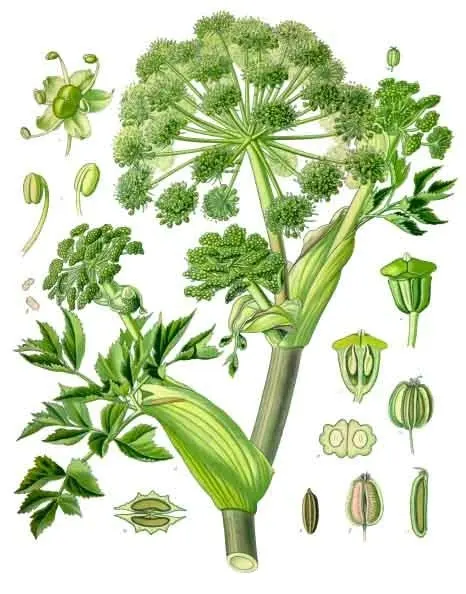
© Franz Eugen Köhler, Köhler's Medizinal-Pflanzen (1897) · Public domain · Commons
Garden angelica
CautionEchte Engelwurz · (Angelica archangelica)
Carrot family (Apiaceae)
Description
Garden angelica (Angelica archangelica) is a tall biennial-to-short-lived herb of the carrot family, with a hollow fluted stem reaching up to about 2.5 m in its flowering year. It bears large globular umbels of greenish-yellow flowers in summer and is cultivated for its sweetly aromatic root and stems. The bitter-aromatic root is the part used medicinally for digestive complaints.
🌿 Risk of confusion — read before wild-harvesting!
The root contains furanocoumarins (bergapten, imperatorin, xanthotoxin) that can make the skin photosensitive — avoid intense sun, tanning beds and UV radiation during and shortly after use, otherwise phototoxic skin reactions are possible (cf. EMA reflection paper EMEA/HMPC/317913/2006). No finalised EU monograph exists for Angelica archangelica; use rests on traditional experience (ESCOP). Do not use during pregnancy and lactation or in children and adolescents under 18. Avoid in case of peptic ulcer. If complaints persist for more than 2 weeks or worsen, consult a doctor. Do not confuse with similar-looking toxic umbellifers — only use plants identified with certainty.
CONTRAINDICATED during pregnancy
Due to lacking safety data and its traditional classification as a labour-stimulating bitter, do not use during pregnancy.
CONTRAINDICATED for children
Not for children and adolescents under 18 due to lack of data.
Critical drug interactions with:
Phototoxische / lichtsensibilisierende Arzneimittel (Psoralene, bestimmte Antibiotika, Retinoide)
Classic aromatic-bitter tea for loss of appetite, fullness, flatulence and sluggish digestion.
Preparation & dosage
INFUSION: Pour 150 ml boiling water over about 1.5 g of finely sliced or coarsely powdered angelica root, cover, steep for 10–15 minutes, then strain. Drink one cup 2–3 times a day (mean daily dose about 4.5 g of dried root), preferably before meals. The bitter aromatic compounds stimulate appetite and digestive secretions.
- Dry amount
- 1.5–1.5 g
- Doses per day
- 3×
- Max duration
- 2 weeks
⚠ Age restriction: ≥ 18 years — Not recommended for children and adolescents under 18 due to insufficient data.
Sources: [1]
Concentrated bitter tincture to stimulate appetite and digestion.
Preparation & dosage
TINCTURE (1:5): 2–5 ml single dose, up to 3 times daily in a little water, shortly before meals. A practical concentrated form when fresh tea is not possible. Due to the alcohol content, not for pregnant or breastfeeding women, children, or people with liver disease.
- Liquid amount
- 2–5 ml
- Doses per day
- 3×
- Max duration
- 2 weeks
⚠ Age restriction: ≥ 18 years — Alcohol-containing tinctures only for adults from 18 years.
Sources: [1]
The root contains furanocoumarins (bergapten, imperatorin, xanthotoxin) that can make the skin photosensitive — avoid intense sun, tanning beds and UV radiation during and shortly after use, otherwise phototoxic skin reactions are possible (cf. EMA reflection paper EMEA/HMPC/317913/2006). No finalised EU monograph exists for Angelica archangelica; use rests on traditional experience (ESCOP). Do not use during pregnancy and lactation or in children and adolescents under 18. Avoid in case of peptic ulcer. If complaints persist for more than 2 weeks or worsen, consult a doctor. Do not confuse with similar-looking toxic umbellifers — only use plants identified with certainty.
⏱ Max continuous use: 2 weeks
Due to lacking safety data and its traditional classification as a labour-stimulating bitter, do not use during pregnancy.
Insufficient data on safety during breastfeeding — not recommended.
Not for children and adolescents under 18 due to lack of data.
Drug interactions
Gerinnungshemmer (Cumarin-/Warfarin-Typ)
The natural coumarin content of the root may theoretically potentiate anticoagulant medicines. Consult a doctor and monitor coagulation when used concurrently.
Phototoxische / lichtsensibilisierende Arzneimittel (Psoralene, bestimmte Antibiotika, Retinoide)
The furanocoumarins of angelica act additively with other photosensitising agents — avoid combining them with UV exposure.
Contraindications
- Pregnancy and lactation.
- Children and adolescents under 18 years.
- Peptic ulcer and known skin photosensitivity.
Harvested part: root (autumn of the 2nd year)
- Time of day:
- On a dry day, after the foliage has died back in the second year.
- Drying:
- Wash the root, slice lengthwise and dry slowly, airy and shaded. The essential oil is volatile — do not dry too hot.
- Storage:
- 12 months — Store in airtight, dark containers and use within a year — once the aroma fades, the drug has lost its strength.
- Ätherisches Öl (α-Pinen, β- und α-Phellandren, 15-Pentadecanolid)Essential oilContent: 0,35–1,3 %Root
Carries the spicy-aromatic profile; α-pinene and phellandrene dominate, with the macrolactone 15-pentadecanolide giving a musky note.
- Furanocumarine (Bergapten, Imperatorin, Xanthotoxin)OtherRoot
Around 20 furanocoumarins — pharmacologically active but phototoxic: they sensitise the skin to UV light. Reason for the sun-exposure warning.
- Cumarine (Angelicin, Osthol)OtherRoot
Accompanying coumarins; may theoretically affect anticoagulant medicines.
- BitterstoffeBitterRoot
Account for the appetite-stimulating and digestive action of the root.
- PhenolcarbonsäurenPhenolic acidRoot
Antioxidant accompanying compounds.
- [1]MonographESCOP Monograph „Angelicae radix" (Angelica Root) — European Scientific Cooperative on Phytotherapy(accessed: 2026-06-03)
- [3]MonographCliniTox Giftpflanzen — Angelica archangelica L.: giftig + (Institut für Veterinärpharmakologie und -toxikologie, Universität Zürich)(accessed: 2026-08-10)
- [2]WikipediaArznei-Engelwurz — Wikipedia (DE)(accessed: 2026-06-03)
🤝 Permaculture Partners
In your garden, this plant acts as: