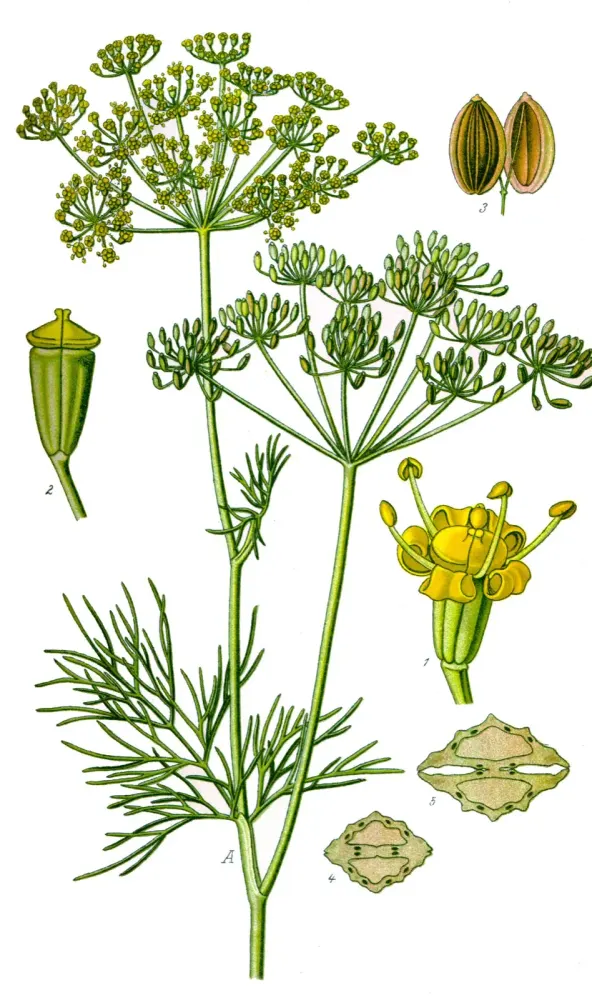
© Illustration_Anethum_graveolens0.jpg: Prof. Dr. Otto Wilhelm Thomé derivative work: Aroche (talk) · Public domain · Commons
Dill
CautionDill · (Anethum graveolens)
Carrot family (Apiaceae)
Description
Dill is an annual herb in the celery family Apiaceae. Native to North Africa and West Asia, dill is grown widely in Eurasia, where its leaves and seeds are used as a herb or spice for flavouring food.
🌿 Risk of confusion — read before wild-harvesting!
Confusion risk: dill (Anethum graveolens) resembles poisonous hemlock (Conium maculatum) and fool's parsley (Aethusa cynapium) — identify safely before wild-harvesting (smell: characteristic dill aroma, no unpleasant mousy or musty odour).
- TeaSeedInternalCommission E
Traditional infusion of dill fruits for dyspeptic complaints, flatulence and bloating — Kommission E positive verdict (1990).
Preparation & dosage
INFUSION (fruit infusion): 2–3 g (approx. 1 tsp) freshly bruised dill fruits in 200 ml boiling water, covered, steep 10 min, strain. 3 cups daily, preferably after meals or when symptoms arise. Kommission E positive verdict (1990) for dill fruits in dyspeptic complaints and flatulence. Crush fruits lightly before brewing (mortar or back of spoon) to release essential oils. Use freshly prepared — do not steep for hours as volatile compounds escape.
- Dry amount
- 2–3 g
- Doses per day
- 3×
- Max duration
- 4 weeks
[#src_kommission_e_anethi_fructus] [#src_escop_anethi_fructus] [#src_wichtl_2009]
- TeaSeedInternalTraditional use
Mild dill-fruit infusion for infant colic and flatulence — traditional European home remedy.
Preparation & dosage
MILD INFANT DILL TEA: 1–2 g lightly bruised dill fruits in 200 ml boiling water, covered 5 min only (shorter than adult tea to keep oil content lower), cool to drinking temperature, strain. Infants (> 6 months): 1–2 teaspoons lukewarm, up to 3× daily. Traditional European folk use for infant colic and flatulence (belly pain). Note: persistent colic or excessive crying always warrants paediatric consultation. No concentrated essential oils for infants.
- Dry amount
- 1–2 g
- Doses per day
- 3×
- Max duration
- 2 weeks
[#src_pfaf_anethum_graveolens] [#src_wichtl_2009] [#src_wp_de_dill]
- TeaAerial partsInternalFolk medicine
Folk dill herb tea as stomachic and mild appetite stimulant — ESCOP mentions traditional stomachic use.
Preparation & dosage
DILL HERB TEA: 2–4 g dried dill herb (stems and leaves) or a large bunch of fresh dill in 250 ml hot (not boiling) water, steep 5–8 min, strain. 2× daily, preferably before meals to stimulate appetite. Folk use for loss of appetite, mild liver stimulation and cholagogue effects. Herb (leaf/stem) tea contains considerably less essential oil than fruit infusion — milder. ESCOP notes traditional use of the herb as a stomachic.
- Dry amount
- 2–4 g
- Doses per day
- 2×
- Max duration
- 3 weeks
[#src_escop_anethi_fructus] [#src_pfaf_anethum_graveolens] [#src_wp_en_dill]
- TinctureSeedInternalTraditional use
Traditional dill-fruit tincture for dyspeptic complaints and flatulence — higher-potency alternative to tea.
Preparation & dosage
TINCTURE from dill fruits (DER 1:5 in 40–60 % ethanol): 1–2 ml (~20–40 drops) 3× daily in water, preferably after meals. Home preparation: 10 g coarsely bruised dill fruits in 50 ml 45 % ethanol, macerate 2–3 weeks at room temperature in the dark, shake occasionally, strain, store in dark bottle. Traditional alternative to tea — concentrated extract; not for infants, children under 6, or persons avoiding alcohol.
- Liquid amount
- 1–2 ml
- Doses per day
- 3×
- Max duration
- 4 weeks
[#src_kommission_e_anethi_fructus] [#src_escop_anethi_fructus]
- SpiceSeedInternalFolk medicine
Dill fruits as everyday spice — mildly carminative, digestive, classic in pickle brine and bread.
Preparation & dosage
KITCHEN AND PREVENTION: Dill fruits (often mislabelled 'dill seeds') used as a spice in bread dough, pickle brine, fish marinades, sauerkraut and cheese. Simple use: lightly toast fruits in a dry pan (more aromatic), bruise coarsely and add as seasoning. Daily culinary doses act as a mild carminative, digestive aid and appetite stimulant — without dosing concerns. Classic use in Scandinavian, Eastern European and Arab cuisine. Dill pickle brine also contains active constituents (carvone) and is a traditional folk remedy for flatulence.
[#src_wp_en_dill] [#src_wp_de_dill] [#src_pfaf_anethum_graveolens]
- SpiceAerial partsInternalFolk medicine
Fresh dill herb in cooking — mildly carminative and known in folk medicine as a gentle nervine with mild sleep-promoting properties.
Preparation & dosage
FRESH HERB (kitchen): Freshly harvested dill herb, finely chopped and added to fish, potatoes, quark, cucumber salad or cold sauces. Never cook (aromas volatile) — add just before serving. Alternatively freeze into herb butter (dill butter) or infuse into oil (dill oil). Drying causes significant aroma loss — prefer fresh or frozen. In folk medicine, fresh dill herb is mildly sleep- and calm-promoting (carvone), hence 'good-night tea' with fresh dill is known in some regions.
[#src_wp_de_dill] [#src_wp_en_dill] [#src_pfaf_anethum_graveolens]
- Essential oilSeedInternalTraditional use
Dill essential oil (fruit oil) — carminative, diluted only; externally useful as abdominal massage oil for flatulence.
Preparation & dosage
DILL ESSENTIAL OIL (use diluted only — NEVER neat internally or on mucous membranes): Food-grade dill essential oil (Anethum graveolens — fruit oil, not the milder herb oil) can be used in very small amounts (1–2 drops dissolved in a teaspoon of honey or neutral carrier oil) to support digestion. Commercially approved as a flavouring agent in foods (GRAS status USA / EFSA EU). Oral therapeutic use without medical supervision not recommended — dosing difficult to control, irritation possible. External: 1–2 drops dill oil in 10 ml carrier oil (e.g. jojoba) for a relaxing abdominal massage for flatulence.
[#src_escop_anethi_fructus] [#src_kommission_e_anethi_fructus] [#src_wichtl_2009]
Distribution in Europe
🪴 Grow at home
- ☀ Light
- full sun
- 💧 Water
- every few days
- 🌱 Soil
- Loose herb compost
- 🪴 Pot
- 18 cm
- ⭐ Difficulty
- ★☆☆ beginner
- 🐾 Pets
- pet-safe
Tips:
- Sow directly — doesn't transplant well.
- Tall plant — needs deep pot.
- Fresh leaves for salads, seeds as spice.
Care tips are general indoor-gardening recommendations, not scientific sources.
🤝 Permaculture Partners
In your garden, this plant acts as:
✨ Best symbiotic partners
- 🌿 Garlic Classic companion-planting partner.
- 🌿 Cucumber Classic: dill with pickled cucumbers — also best bed partners.
- 🌿 Cucurbita pepo Classic companion-planting partner.
⚠️ Better not planted together
- 🥬 Apium graveolens Classic companion-planting partner.
- 🥬 Coriander Classic companion-planting partner.
- 🥬 Carrot Classic companion-planting partner.
- 🥬 Fennel Fennel and dill cross-pollinate and compete.
📦 Part of these planting sets:
Source: Gertrud Franck, Gesunder Garten durch Mischkultur (1980, eigene Kuration) | Helga und Margarete Langerhorst, Mein gesunder Naturgarten (eigene Kuration)