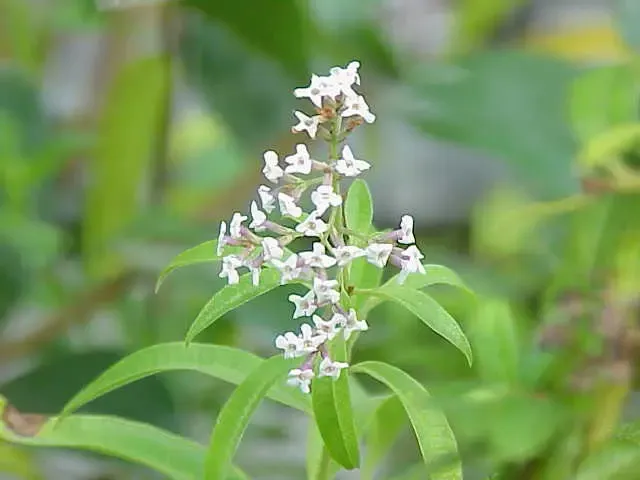
© Kurt Stüber [1] · CC BY-SA 3.0 · Commons
Aloysia citrodora
Zitronenstrauch · (Aloysia citrodora)
Verbena family (Verbenaceae)
Description
Aloysia citrodora, lemon verbena, is a species of flowering plant in the verbena family Verbenaceae, native to South America. Other common names include lemon beebrush. It was brought to Europe by the Spanish and the Portuguese in the 17th century and cultivated for its oil.
- TeaLeafInternalTraditional use
Infusion of dried leaves (1–2 tbsp per 250 ml boiling water, steep 10 min) for relief of mild symptoms of mental stress, sleep difficulties, and mild digestive complaints such as bloating and flatulence. Traditional use as per EMA/HMPC monograph (EMA/HMPC/376770/2019).
Preparation & dosage
Pour 250 ml boiling water over 3–6 g dried leaves, steep 10 minutes, strain. Up to 3 cups daily.
- Dry amount
- 3–6 g
- Doses per day
- 3×
[#src_ema_aloysia] [#src_wp_de_aloysia] [#src_wp_en_aloysia]
- TeaLeafInternalTraditional use
As an evening tea to promote sleep, particularly for mild difficulty falling asleep caused by everyday stress. Verbascoside and flavones such as luteolin contribute to the calming effect.
Preparation & dosage
4–6 g leaves with 250 ml boiling water, drink 10 minutes before bedtime.
- Dry amount
- 4–6 g
- Doses per day
- 1×
- Essential oilLeafExternalFolk medicine
The essential oil (main components: geranial 18–21 %, neral 15–16 %) is used in aromatherapy for relaxation. Dilute strongly for direct skin contact (max. 0.2 %) due to known phototoxic and sensitising properties. Prohibited as a fragrance ingredient in the EU (Regulation No. 1223/2009, Annex II).
- TeaLeafInternalTraditional use
Leaf tea for functional gastric complaints, flatulence, and cramps. The bitter-aromatic constituents stimulate digestive secretions.
Preparation & dosage
3–5 g leaves with 200 ml boiling water, steep 8 minutes. Drink after meals.
- Dry amount
- 3–5 g
- Doses per day
- 2×
- SpiceLeafInternalFolk medicine
Fresh leaves as a culinary herb for desserts, beverages (lemonade, cocktails), dressings, and poultry dishes. Intense lemon aroma from citral (geranial + neral).
- TinctureLeafInternalTraditional use
Tincture extract of leaves (ratio 1:5, 40–60 % ethanol) as a convenient alternative to infusion, particularly for precise dosing of verbascoside-rich extract.
Distribution in Europe
🪴 Grow at home
- ☀ Light
- full sun
- 💧 Water
- every few days
- 🌱 Soil
- Herb compost with good drainage
- 🪴 Pot
- 25 cm
- ⭐ Difficulty
- ★★☆ intermediate
- 🐾 Pets
- pet-safe
Tips:
- Drops all leaves in winter — don't panic, that's normal.
- Winter: bright and cool (5-10 °C), barely water — otherwise root rot.
- Cut back hard in spring for bushy growth.
Care tips are general indoor-gardening recommendations, not scientific sources.