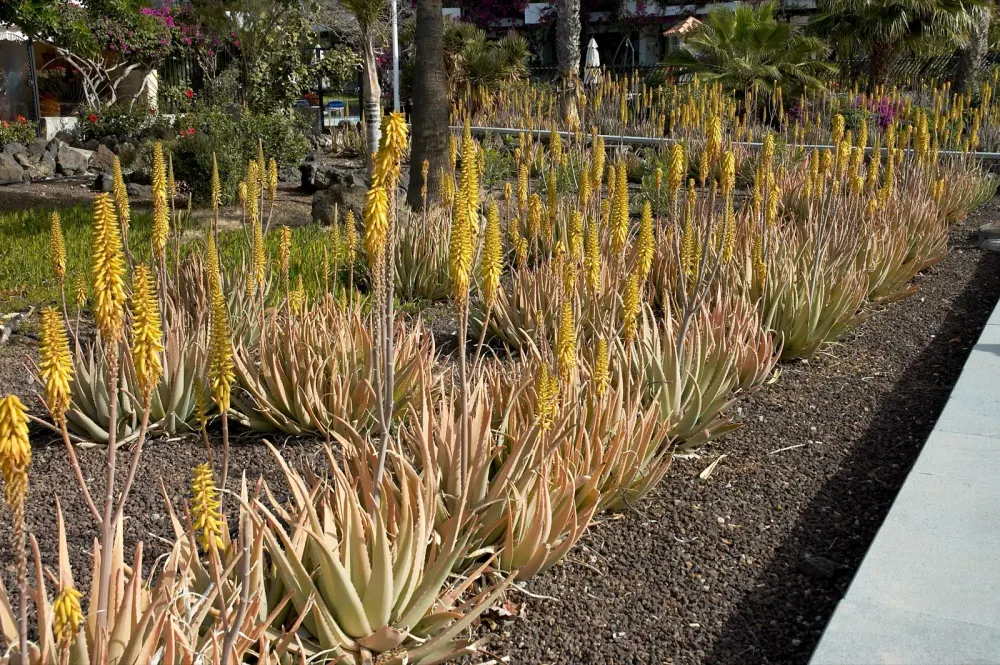
© Wouter Hagens · Public domain · Commons
Aloe vera
Caution🐾Echte Aloe · (Aloe vera)
Asphodel family (Asphodelaceae)
Description
Aloe vera is a succulent plant species of the genus Aloe. It is widely distributed, and is considered an invasive species in many world regions.
CONTRAINDICATED during pregnancy
Internal use of aloin-containing preparations (aloe juice, whole-leaf extracts) is contraindicated in pregnancy — anthraquinones can trigger uterine contractions and are potentially genotoxic. External use of the pure gel is considered safe.
CONTRAINDICATED during breastfeeding
Avoid aloin-containing preparations internally during lactation — anthraquinones pass into breast milk and can cause diarrhea in the infant. External use of the gel is possible.
CONTRAINDICATED for children
Internal use of aloin-containing aloe preparations is contraindicated in children under 12 years according to EMA HMPC. External gel for skin irritations is harmless.
Critical drug interactions with:
Herzglykoside (z. B. Digoxin)
- SalveLeafExternalCommission E
Pure leaf gel or ointment containing Aloe vera gel applied externally to cool and moisturize minor burns, sunburn, small skin irritations, and dry skin. The gel forms a protective moisturizing film and contains polysaccharides (mainly acemannan) that may support wound healing.
Preparation & dosage
[#src_ema_hmpc_aloe_aloe_vera] [#src_commission_e_aloe_gel_aloe_vera] [#src_escop_aloe_gel_aloe_vera]
- RawLeafInternalTraditional use
Pure, freshly peeled inner leaf gel (without the yellow aloin layer) added to smoothies or juices. Traditionally used to support digestion and the immune system. Important: use only the transparent inner gel; carefully remove every trace of the yellow latex from the leaf rind, as it contains aloin.
Preparation & dosage
- TinctureLeafInternalCommission E
Aloe juice (Aloe drug, thickened latex from the leaf rind) contains anthraquinones (aloin, aloe-emodin) and is strongly laxative. Traditionally used as a short-term laxative for acute constipation. To be used cautiously today: EFSA classifies whole-leaf extracts containing hydroxyanthracene derivatives as potentially genotoxic and carcinogenic (Scientific Opinion 2017).
Preparation & dosage
[#src_ema_hmpc_aloe_aloe_vera] [#src_commission_e_aloe_saft_aloe_vera] [#src_efsa_2017_hydroxyanthracene_aloe_vera]
- CompressLeafExternalTraditional use
Cool compress with Aloe vera gel for superficial wounds, insect bites, or irritated skin. The gel soothes, cools, and may support wound healing through its polysaccharides.
Preparation & dosage
- BathLeafExternalFolk medicine
Aloe gel as a bath additive for a nourishing, moisturizing bath for dry or irritated skin. Valued in folk medicine and skincare.
Preparation & dosage
Distribution in Europe
🪴 Grow at home
- ☀ Light
- full sun
- 💧 Water
- sparse
- 🌱 Soil
- Cactus/succulent soil, sandy
- 🪴 Pot
- 18 cm
- ⭐ Difficulty
- ★☆☆ beginner
- 🐾 Pets
- toxic to pets
Tips:
- Under-water rather than over-water — waterlogging kills aloe quickly.
- In winter: bright spot, water only every 4-6 weeks.
- Harvest oldest leaves first — cut at an angle, the wound heals on its own.
Care tips are general indoor-gardening recommendations, not scientific sources.