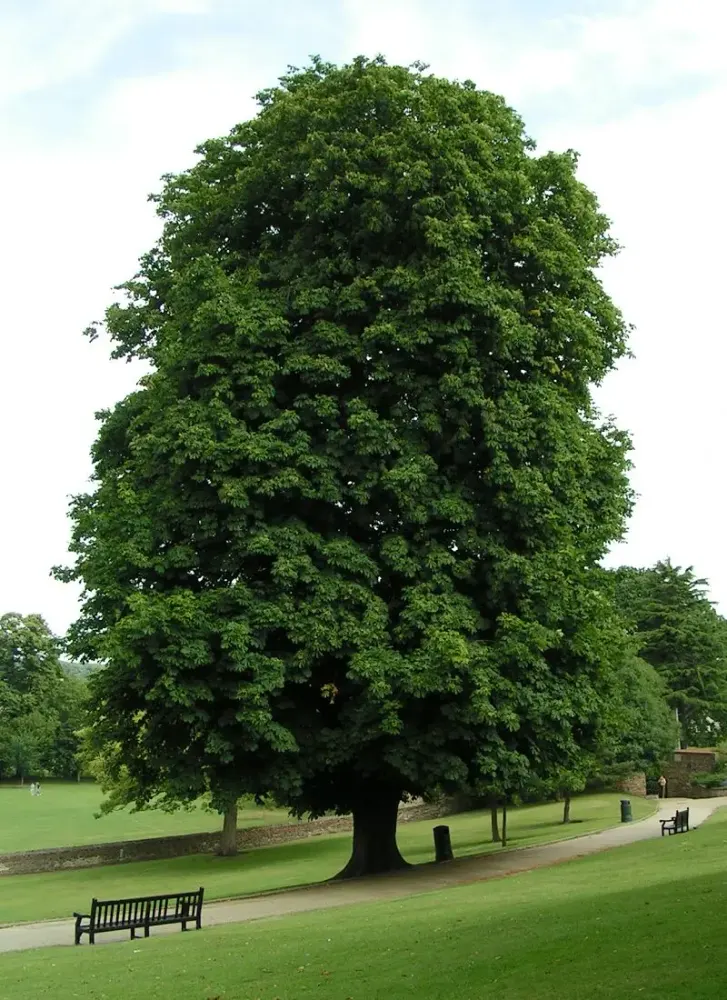
© Sannse at English Wikipedia · CC BY-SA 3.0 · Commons
Aesculus hippocastanum
Toxic🐾Gewöhnliche Rosskastanie · (Aesculus hippocastanum)
Soapberry family (Sapindaceae)
Description
Aesculus hippocastanum, the horse chestnut, is a species of flowering plant in the maple, soapberry and lychee family Sapindaceae. It is a large, deciduous, synoecious (hermaphroditic-flowered) tree. It is also called horse-chestnut, European horsechestnut, buckeye, and conker tree.
External use only!
This plant must NOT be taken internally. Use only as compress, salve, or bath.
CONTRAINDICATED during pregnancy
Contraindicated in pregnancy per EMA HMPC due to insufficient safety data. Aescin has shown embryotoxic properties in animal studies. No internal use during pregnancy. Topical use (gel) to be discussed with physician.
CONTRAINDICATED during breastfeeding
Contraindicated during lactation per EMA HMPC — it is unknown whether aescin passes into breast milk. Internal use not recommended. Topical application (gel on legs) only after consulting a physician.
CONTRAINDICATED for children
Standardised preparations (oral) not for children/adolescents under 18 per EMA — no safety data. Raw chestnuts are a serious poisoning risk for children (conkers in mouths). With aescin gels: avoid contact with mucous membranes and eyes, store out of reach of children.
- TinctureSeedInternalEMA well-established
Standardised horse chestnut seed extract (EMA well-established use) for symptomatic treatment of chronic venous insufficiency — lead compound aescin.
Preparation & dosage
STANDARDISED SEED EXTRACT (EMA well-established use): Standardised dry extracts of horse chestnut seed, calculated as 16–20 % triterpene glycosides (aescin) (e.g. AESCORIN forte, Venostasin retard, horse chestnut extract capsules), DER 4–7:1. Daily dose 100 mg aescin, split into 2 doses (morning and evening), preferably with meals and sufficient fluid. Sustained-release formulations preferred over immediate-release (better tolerability). Indication: symptomatic treatment of chronic venous insufficiency (CVI) — leg oedema, heaviness, pain, pruritus, nocturnal calf cramps. Effect onset after 4–8 weeks of regular use. CAUTION: Raw seeds are toxic — use only standardised finished preparations, NEVER self-extract.
- Liquid amount
- 1–3 ml
- Doses per day
- 2×
- Max duration
- 12 weeks
⚠ Age restriction: ≥ 18 years — Per EMA, adults only — insufficient safety data for children/adolescents under 18.
[#src_ema_aesculus_semen] [#src_escop_aesculus] [#src_kommission_e_aesculus]
- CompressSeedExternalTraditional use
Topical aescin gel or bark compress for venous insufficiency, leg oedema and tired, heavy legs.
Preparation & dosage
TOPICAL APPLICATION (standardised gel/cream): Finished vein gels or creams with 2 % aescin applied 2–3× daily to affected leg areas (lower leg, ankle), massaged gently towards the heart. Do not apply to open wounds or mucous membranes. Traditionally also as a compress with boiled, cooled bark decoction (1:20, simmer 10 min) on swollen, tired legs — soak cloth in liquid, apply for 15–20 min. Regular use over several weeks is recommended.
[#src_ema_aesculus_semen] [#src_escop_aesculus] [#src_wichtl_aesculus]
- TinctureBarkExternalFolk medicine
Folk bark tincture for topical application to swollen legs and varicosities; internal use not recommended.
Preparation & dosage
BARK TINCTURE (folk, external only): Young branch bark strips (spring, before leaves fully open) macerated 1:5 in 40–60 % ethanol for 2–4 weeks, filtered. Apply undiluted to tired, swollen legs 2× daily as a rub. Traditionally used for haemorrhoids as salve or suppository base. Internal use of bark tincture NOT recommended — insufficient standardisation, no safety data, potentially toxic.
- Liquid amount
- 2–5 ml
- Doses per day
- 2×
- Max duration
- 4 weeks
[#src_madaus_1938_aesculus] [#src_pfaf_aesculus] [#src_wp_de_aesculus]
- BathSeedExternalTraditional use
Traditional foot or full bath from chestnut decoction for varicose veins, venous congestion and tired, swollen legs.
Preparation & dosage
FOOT BATH / FULL BATH (traditional): For a footbath, simmer 4–6 crushed raw or dried horse chestnuts (shells removed) in 1 L water for 20 minutes (decoction), strain, add to footbath tub and fill to ~10 L with warm water (38–40 °C). Foot soak for 15–20 min. For a full bath, scale decoction from 20–30 chestnuts. Traditionally for varicose veins, tired legs, haemorrhoids (sitz bath). Traditional use — not a substitute for standardised extract. Discard chestnuts after bathing, do not process or eat them.
[#src_wichtl_aesculus] [#src_madaus_1938_aesculus] [#src_pfaf_aesculus]
- SalveSeedExternalCommission E
Aescin-containing vein creams and gels (Kommission E, positive) for topical treatment of CVI, haemorrhoids and bruising.
Preparation & dosage
AESCIN SALVE / VEIN OIL (Kommission E): Finished preparations containing 2 % aescin (gel, cream, lotion) applied 2–3× daily to the affected skin area. Massage gently — direction from distal to proximal (ankle → knee → thigh) to support lymph and venous return. Use adjunctively with compression stockings (additive effect on oedema reduction). Own preparation: 1–2 % aescin dry extract in shea butter/beeswax base — only with PHARMACEUTICAL-GRADE aescin, never self-extract from raw chestnuts.
[#src_kommission_e_aesculus] [#src_ema_aesculus_semen] [#src_escop_aesculus]
- CompressFlowerExternalFolk medicine
Folk flower compress for swollen joints, bruising and overexerted muscles.
Preparation & dosage
FLOWER COMPRESS (folk): 2–3 tbsp fresh or dried horse chestnut flowers in 500 ml hot water, steep 15 min, strain, cool to skin temperature. Soak a clean cloth and apply as a wet compress on swollen joints or bruises (20–30 min). Folk use also for muscle soreness after physical exertion. Evidence purely empirical — no clinical studies on flower compresses.
Historical documentation only — do NOT use
These internal applications are historically documented. This plant is highly toxic — self-treatment can cause severe poisoning or death. For documentation only, explicitly NOT a recommendation.
- TeaLeafInternalFolk medicine
Folk leaf tea for cold complaints, fever and as spring tonic — no standardised medical application.
Preparation & dosage
LEAF TEA (folk): 1–2 tsp dried finely cut horse chestnut leaves in 250 ml boiling water, steep covered 10 min, strain. Up to 2 cups daily. Folk use for fever, catarrh, cold complaints and as 'blood-purifying' spring tea. NO adequate scientific evidence — adjunctive folk use only. Leaves contain coumarins and flavonoids but are not standardised for therapeutic purposes. For persistent complaints beyond 2 weeks: medical evaluation.
- Dry amount
- 1–2 g
- Doses per day
- 2×
- Max duration
- 2 weeks
[#src_madaus_1938_aesculus] [#src_pfaf_aesculus] [#src_wp_de_aesculus]
- TinctureSeedInternalTraditional use
Phytotherapeutic seed liquid extracts as finished preparation for CVI — standardised products only, no self-extraction.
Preparation & dosage
PHYTOTHERAPEUTIC TINCTURE (finished preparation only!): Liquid extracts and tinctures of horse chestnut seed (e.g. Aesculuforce, Arkocaps) as finished products with defined aescin content (typically 1.5–3 mg aescin/ml). 1–2 ml 3× daily with water. Self-made seed tinctures are NOT safe — aescin content and toxicity uncontrollable. Use in adults only, after exclusion of deep vein thrombosis. No continuous use beyond 8 weeks without medical supervision.
- Liquid amount
- 1–2 ml
- Doses per day
- 3×
- Max duration
- 8 weeks
⚠ Age restriction: ≥ 18 years — Adults only. Not recommended for children under 18 per EMA.
[#src_ema_aesculus_semen] [#src_escop_aesculus] [#src_wichtl_aesculus]