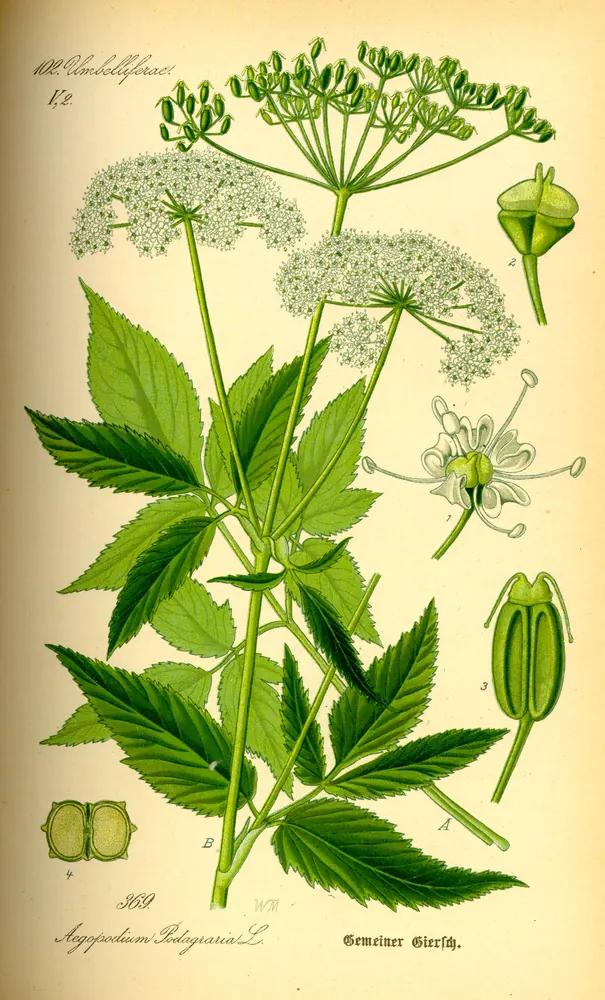
© Walther Otto Müller (in: O. W. Thomé, Flora von Deutschland, Österreich und der Schweiz, 1885) · Public domain · Commons
Ground elder
Giersch · (Aegopodium podagraria)
Carrot family (Apiaceae)
Description
Ground elder (Aegopodium podagraria) is a perennial herbaceous plant of the carrot family (Apiaceae) that forms dense stands via creeping white rhizomes and reaches 30 to 100 cm in height. Its diagnostic features are the three-angled (triangular in cross-section) leaf stalk and the doubly ternate-pinnate leaves; small white flowers appear in compound umbels from June to July. The young leaves, smelling and tasting of parsley and carrot, are the main part used. Traditionally the leaves, stems and roots were used against gout and rheumatism, reflected in the epithet 'podagraria' (from podagra, gout of the foot). As a wild vegetable it is rich in vitamin C, minerals and polyacetylenes.
- RawLeafInternalTraditional use
The young leaves are a classic spring wild vegetable with a high vitamin C content (about 200 mg/100 g) and a savoury parsley-and-carrot flavour.
Preparation & dosage
Use young, still glossy leaves before flowering (March to May) raw in salads, herb quark or pesto; reliably distinguish from poisonous umbellifers before harvesting.
- RawLeafInternalTraditional use
Cooked, ground elder has been used as a spinach substitute since antiquity; leaves harvested before flowering are the mildest.
Preparation & dosage
Briefly steam older leaves like spinach or prepare them as soup or a vegetable dish; after flowering the leaves become more pungent and mildly laxative.
- TeaAerial partsInternalFolk medicine
A herb infusion is traditionally drunk against gout and rheumatic complaints; the species epithet points to this traditional use.
Preparation & dosage
Pour 250 ml of boiling water over 1 to 2 g of dried herb, steep for 10 minutes and strain; up to three times daily.
- Dry amount
- 1–2 g
- Doses per day
- 3×
- Max duration
- 4 weeks
- TeaAerial partsInternalFolk medicine
In folk medicine the herb is credited with a mild diuretic action for bladder and kidney complaints.
Preparation & dosage
Infusion of 1 to 2 g herb per 250 ml water, steeped 10 minutes; up to three times daily, ensuring adequate fluid intake.
- Dry amount
- 1–2 g
- Doses per day
- 3×
- Max duration
- 4 weeks
- CompressLeafExternalFolk medicine
Externally, crushed leaves were applied as a poultice for joint pain, insect stings and minor injuries.
Preparation & dosage
Crush fresh leaves or apply them as a warm poultice (compress) to aching joints, stings or minor wounds.
- RawFlowerInternalFolk medicine
The flowers are also edible and serve as a decorative, mildly aromatic garnish.
Preparation & dosage
Sprinkle the young white umbel flowers (June to August) raw as an edible garnish over salads and dishes.
🤝 Permaculture Partners
In your garden, this plant acts as: