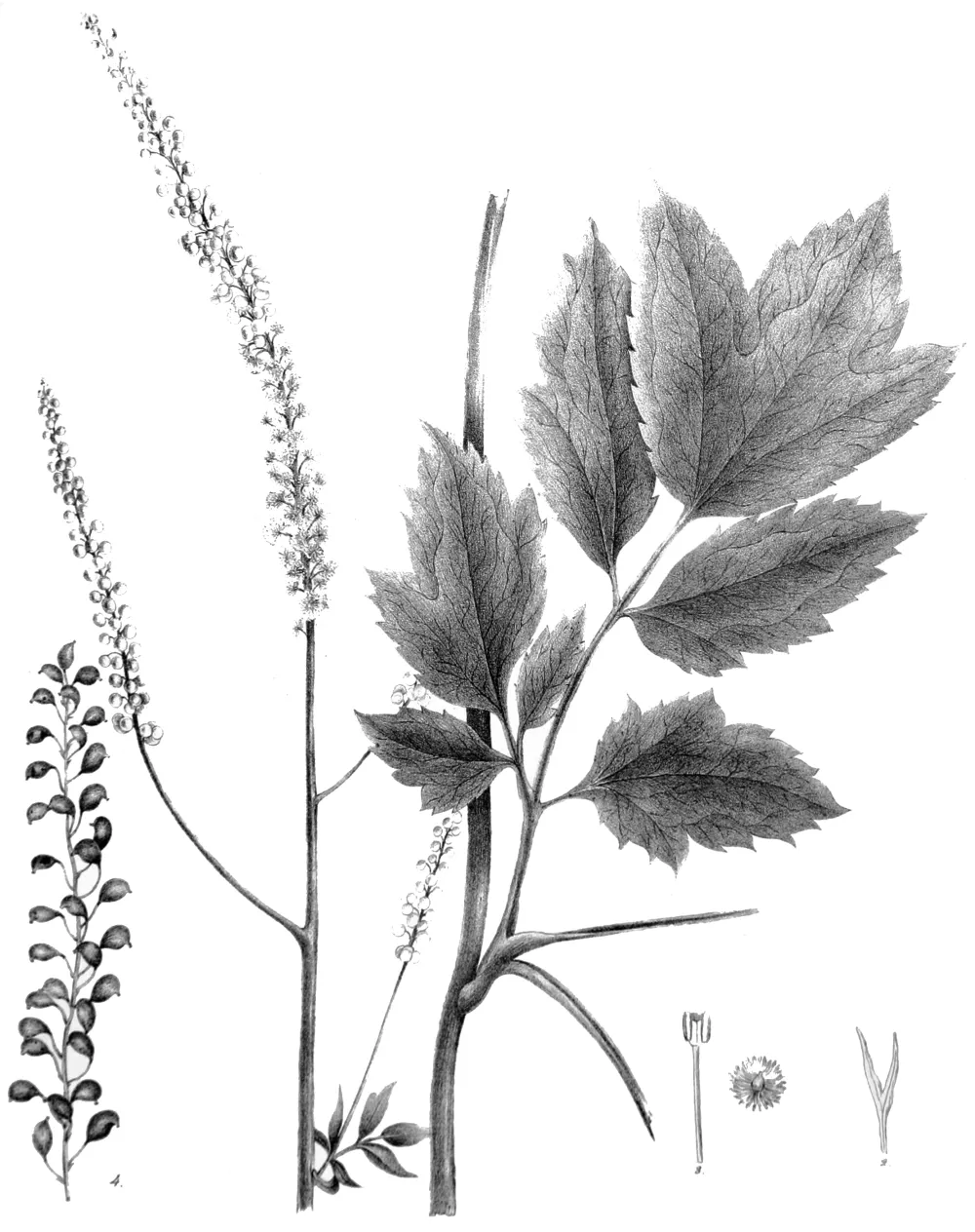
© John Torrey, M.D., F.L.S. (A Flora of the State of New-York, Vol. 1, 1843) · Public domain · Commons
Black cohosh
CautionTraubensilberkerze · (Actaea racemosa)
Buttercup family (Ranunculaceae)
Description
From dense rosettes of leaves, black cohosh sends up slender flower spikes in high summer, reaching two metres and crowded with countless creamy-white stamens — a striking sight in the deciduous woodlands of eastern North America where it originates. It is not the flower that is used but the dark rhizome, dug in autumn. It contains triterpene glycosides such as actein and 23-epi-26-deoxyactein along with phenolic acids including fukinolic acid. For the dry extract of the rhizome, the European Medicines Agency lists use for hot flushes and excessive sweating in the menopause as well established; traditionally it also served for sleep disturbance and nervous irritability. One point matters: in rare cases severe liver damage has been reported in connection with such preparations. A causal link is not proven, but at the first signs — fatigue, loss of appetite, yellowing of the skin — the preparation should be stopped and medical advice sought.
CONTRAINDICATED during pregnancy
Do not use during pregnancy. Safety has not been sufficiently established, and the indication (menopausal complaints) does not apply to pregnant women.
CONTRAINDICATED during breastfeeding
Do not use while breastfeeding, as there are insufficient data on safety for the breastfed infant.
CONTRAINDICATED for children
Not for children and adolescents under 18 years. Use is restricted to adult women with menopausal complaints; there are insufficient data for younger people.
Main use: relief of menopausal complaints such as hot flushes, increased sweating, sleep disorders and nervous irritability. The EMA (HMPC) lists the rhizome dry extract for hot flushes and sweating under 'well-established use'; the broader traditional / empirical-medicine use (including sleep disorders and nervous irritability, as in the ESCOP monograph) is classified here as traditional use. The mechanism of action is not fully clarified; a central-nervous (not primarily oestrogen-like) action of the whole extract is discussed.
Preparation & dosage
What is used are mostly finished, standardised dry extracts of the rhizome (e.g. a dry ethanolic extract, drug-to-extract ratio about 5-10:1, or an isopropanolic extract), not a home-made tea or fresh preparation. The usual daily dose corresponds to roughly 40 mg of dried rhizome and, depending on the product, delivers about 5-6.5 mg of native extract per day; the exact dose follows the particular finished medicine and its package leaflet. The millilitre figures given here refer to liquid ethanolic preparations and are only a rough guide. The effect is not immediate but often sets in only after several weeks. If symptoms persist or worsen, medical advice should be sought; without consulting a doctor, use should not exceed 6 months.
- Liquid amount
- 1–2 ml
- Doses per day
- 2×
- Max duration
- 26 weeks
⚠ Age restriction: ≥ 18 years — For adult women only. Use in children and adolescents under 18 years is not recommended, as there are insufficient data and the indication (menopausal complaints) applies to adults.
In rare cases serious liver damage (up to liver failure) has been reported in connection with rhizome preparations; a causal link is not firmly established and the frequency is unknown. At the first signs of liver damage - such as tiredness, loss of appetite, yellowing of the skin or eyes (jaundice), dark urine, or severe upper-abdominal pain with nausea and vomiting - stop taking it immediately and consult a doctor. People with a history of liver disorder should use black cohosh preparations only with caution and medical supervision. Not in pregnancy or breastfeeding. With a history of breast cancer or other hormone-dependent (oestrogen-dependent) conditions, use only after medical advice. Not for those under 18 years. Do not use if hypersensitive. If symptoms worsen, seek medical advice.
Do not use during pregnancy. Safety has not been sufficiently established, and the indication (menopausal complaints) does not apply to pregnant women.
Do not use while breastfeeding, as there are insufficient data on safety for the breastfed infant.
Not for children and adolescents under 18 years. Use is restricted to adult women with menopausal complaints; there are insufficient data for younger people.
Drug interactions
potenziell leberschädigende Arzneimittel (hepatotoxische Substanzen)
Because liver damage has been reported in rare cases, theoretically increased caution is advisable when other potentially liver-damaging medicines are used at the same time; liver function should be monitored. A proven pharmacological interaction mechanism is not established.
Tamoxifen / endokrine Brustkrebstherapie und CYP-Substrate
An interaction with tamoxifen and other endocrine breast-cancer therapies, as well as an effect on cytochrome P450 enzymes, has been discussed but is largely theoretical or not clearly established. With hormone-dependent tumours and corresponding therapy, use only after medical advice.
Contraindications
- Hypersensitivity to the rhizome (Actaea/Cimicifuga racemosa).
- Existing or previous liver disease (use only with caution and medical supervision).
- Pregnancy.
- Breastfeeding.
- Oestrogen-dependent tumours or a history of breast cancer - only after medical advice (caution).
Harvested part: rhizome and roots (in autumn after the above-ground parts have died back)
- Time of day:
- In autumn after the above-ground parts have withered and the fruit has ripened.
- Drying:
- Clean the rhizome and roots thoroughly of soil, split lengthwise if needed and dry slowly and gently until hard and brittle; store dry, cool and dark. For medicinal purposes, standardised finished extracts are mainly used.
- Triterpenglykoside / Triterpensaponine (u. a. Actein)SaponinContent: ~beträchtlich (Leitsubstanzgruppe)Rhizome
Characteristic marker group of the rhizome: cycloartane-type triterpene glycosides, notably actein. They serve as important markers for the analytical standardisation of the extracts.
- 23-epi-26-Deoxyactein (früher 27-Deoxyactein)SaponinRhizome
One of the quantitatively significant triterpene glycosides and a commonly used standardisation / analytical marker for black cohosh extracts.
- Cimicifugosid (Cimicifugoside)SaponinRhizome
Another characteristic triterpene glycoside of the rhizome.
- Cimicifugasäuren und Fukinolsäure (phenolische Säuren)Phenolic acidRhizome
Phenolic acids such as cimicifugic acids and fukinolic acid; they contribute to the constituent profile and are partly used analytically as well.
- Formononetin (Isoflavon) - historisch berichtet, später bestrittenFlavonoidRhizome
The isoflavone formononetin was historically reported as a possible oestrogen-like constituent, but was later not confirmed in commercial ethanolic or isopropanolic preparations. It appears at most in certain methanolic extracts - an oestrogen-like activity via formononetin is now regarded as unsubstantiated.
- Gerbstoffe (Tannine)TanninRhizome
The rhizome also contains tannins, which contribute to the astringent character of the drug.
- [1]MonographEuropean Medicines Agency (HMPC) - European Union herbal monograph on Cimicifuga racemosa (L.) Nutt., rhizoma (black cohosh), Revision 1, 27 March 2018 (EMA/HMPC/48745/2017)(accessed: 2026-06-12)
- [2]MonographEMA/HMPC/48744/2017 - Assessment report on Cimicifuga racemosa (L.) Nutt., rhizome, Revision 1 (final, 27 March 2018)(accessed: 2026-06-12)
- [3]MonographEMEA Public Statement on herbal medicinal products containing Cimicifugae racemosae rhizoma (black cohosh, rhizome) - Serious hepatic reactions (EMEA/HMPC/269258/2006)(accessed: 2026-06-12)
- [4]MonographESCOP / empirical-medicine summary of Cimicifugae racemosae rhizoma for climacteric complaints (hot flushes, profuse sweating, sleep disorders, nervous irritability) - Altmeyers Encyclopaedia, Phytotherapy(accessed: 2026-06-12)
- [5]WikipediaTraubensilberkerze - Wikipedia (Deutsch)(accessed: 2026-06-12)
- [6]WikipediaActaea racemosa - Wikipedia (English)(accessed: 2026-06-12)
- [8]CommonsCimicifuga racemosa (Actaea racemosa), botanical plate from John Torrey, A Flora of the State of New-York, Vol. 1, 1843 - Wikimedia Commons (public domain)(accessed: 2026-06-12)
- [7]WikidataActaea racemosa (Q161358) - Wikidata(accessed: 2026-06-12)
🤝 Permaculture Partners
In your garden, this plant acts as: