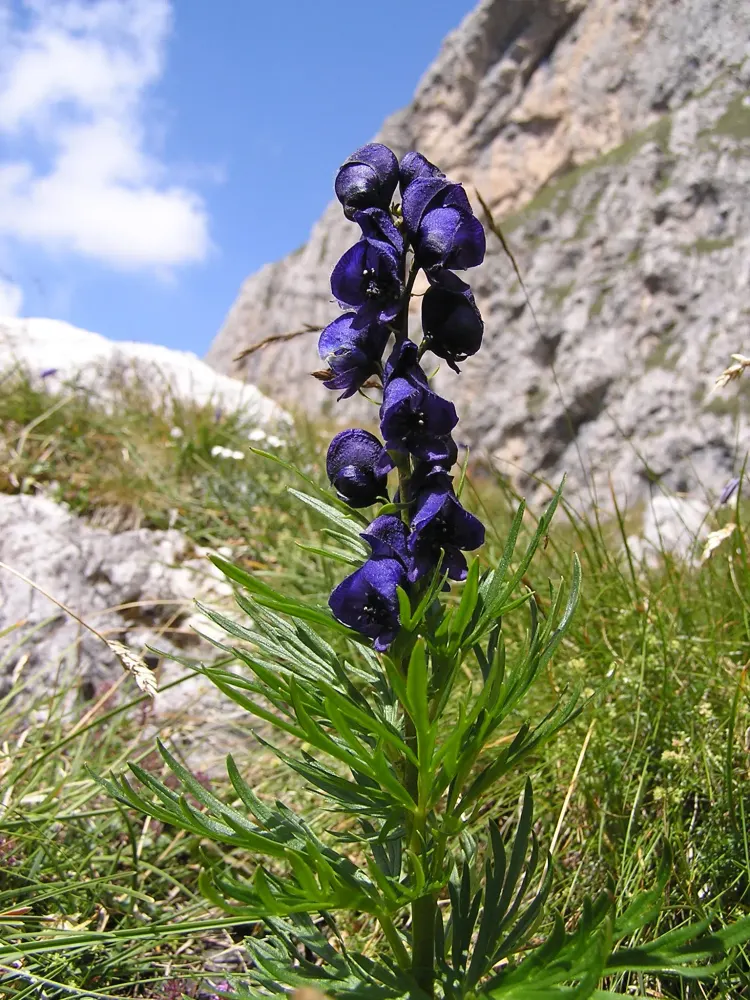
© Axel Mauruszat · Attribution · Commons
Aconitum napellus
Toxic🐾Blauer Eisenhut · (Aconitum napellus)
Buttercup family (Ranunculaceae)
Description
Aconitum napellus, monkshood, aconite, Venus' chariot or wolfsbane, is a species of highly toxic flowering plants in the genus Aconitum of the family Ranunculaceae, native and endemic to western and central Europe. A perennial plant, it is herbaceous and grows to 1 m tall, with hairless stems and leaves. The leaves are rounded, 5–10 cm (2.0–3.9 in) diameter, palmately divided into five to seven deeply lobed segments.
🌿 Risk of confusion — read before wild-harvesting!
LETHALLY TOXIC — ENTIRE PLANT, ESPECIALLY THE ROOT TUBER. Aconitum napellus is considered the most poisonous plant in Central and Western Europe. As little as 2–4 g of fresh root can kill an adult within 30–45 minutes; the lethal dose of pure aconitine is approximately 2 mg orally. Aconitine is absorbed percutaneously — merely touching the flowers can cause numbness in the fingertips. Poisoning symptoms usually appear within an hour: tingling and burning in mouth, face and extremities; nausea, vomiting, hypotension, bradycardia, ventricular arrhythmias. Death usually within 2–6 hours from respiratory paralysis or ventricular fibrillation. NO specific antidote available — therapy is symptomatic (antiarrhythmics, mechanical ventilation). In case of suspected poisoning: IMMEDIATELY call emergency services and poison control. NEVER touch without protective gloves. No lay use whatsoever. Even homeopathic mother tincture D1–D3 must be regarded as highly toxic.
External use only!
This plant must NOT be taken internally. Use only as compress, salve, or bath.
CONTRAINDICATED during pregnancy
Aconitine crosses the placental barrier and is embryotoxic. Any use of Aconitum napellus or aconite preparations below homeopathic D6 potency is absolutely contraindicated in pregnancy.
CONTRAINDICATED during breastfeeding
Aconitine and related diterpene alkaloids pass into breast milk and can trigger life-threatening cardiac arrhythmias and respiratory paralysis in the infant. Breastfeeding: strictly contraindicated.
CONTRAINDICATED for children
Children are extremely sensitive to aconitine. Even contact with flower pollen or chewing a single bloom can be life-threatening. The attractive blue-violet flower colour and turnip-shaped tuber pose particular danger. No application whatsoever — not even homeopathic potencies below D12 without medical instruction.
Critical drug interactions with:
Klasse-I-Antiarrhythmika (Chinidin, Procainamid, Flecainid, Lidocain) · Calciumkanalblocker (Verapamil, Diltiazem) · Herzglykoside (Digoxin, Digitoxin) · Beta-Blocker (Metoprolol, Bisoprolol, Propranolol)
- TinctureRootExternalTraditional use
Historical topical use of aconite tincture (Tinctura Aconiti) as an external remedy for neuralgia, trigeminal neuralgia, lumbago and rheumatic pain — applied to intact skin only, never to wounds. The analgesic effect rests on blockade of peripheral nerve fibres. Obsolete in Western medicine since the mid-20th century due to unpredictable systemic toxicity from transdermal absorption.
Preparation & dosage
[#src_grieve_aconitum_napellus] [#src_pfaf_aconitum_napellus]
- SalveRootExternalFolk medicine
Folk-medicinal use of aconite ointment (Unguentum Aconiti) for rheumatic joint complaints and sciatica by local rubbing. The historical application required completely intact skin without cuts or abrasions, since aconitine is rapidly systemically absorbed via broken skin. Due to documented fatalities from percutaneous poisoning, this application is considered obsolete and contraindicated today.
Preparation & dosage
[#src_grieve_aconitum_napellus] [#src_pfaf_aconitum_napellus]
- RawRootExternalFolk medicine
Historical use of the tubers as arrow and murder poison in pre-Christian and ancient times: Celtic hunters may have used aconite extracts as arrow poison, the Roman Empire used it as poison against political opponents (banned for private cultivation under Emperor Trajan). In Germanic folklore the plant was 'wolfsbane', used to poison wolves — this tradition explains the English name. Documentation only, no application recommendation whatsoever.
[#src_wp_en_aconitum_napellus] [#src_wp_de_aconitum_napellus]
- TinctureLeafExternalFolk medicine
Medieval use of aconite leaf extracts in so-called 'witches' ointments' together with henbane, datura and belladonna. The mixtures were applied to sensitive skin areas and were said to induce hallucinogenic 'flight dreams' — presumably through aconitine-induced paraesthesia combined with tropane-alkaloid effects. Pure ethnographic documentation, no application recommendation.
Preparation & dosage
[#src_wp_de_aconitum_napellus] [#src_grieve_aconitum_napellus]
Historical documentation only — do NOT use
These internal applications are historically documented. This plant is highly toxic — self-treatment can cause severe poisoning or death. For documentation only, explicitly NOT a recommendation.
- TinctureRootInternalTraditional use
Widespread 19th-century internal use of extremely low-dosed aconite tincture (typically 1–2 drops) as antipyretic and sedative in acute febrile states, pleurisy and pericarditis. The historical practice exploited aconitine's negative chronotropic effect to lower heart rate. Strictly obsolete today — no therapeutic window, documented fatalities from minimal dosing errors.
Preparation & dosage
[#src_grieve_aconitum_napellus] [#src_wp_en_aconitum_napellus]
- TinctureWhole plantInternalFolk medicine
Homeopathic use of Aconitum napellus (first proven by Samuel Hahnemann in 1805) for acute-onset fever, sudden fright, anxious restlessness and early inflammation. Usual dilution levels from D6 upwards (commonly D12, D30) contain no pharmacologically active aconitine amounts. Homeopathic medicinal products are licensed in Germany, Austria and Switzerland under medicinal-products law.
Preparation & dosage
[#src_wp_de_aconitum_napellus] [#src_grieve_aconitum_napellus]
- RawRootInternalFolk medicine
In traditional Chinese medicine (TCM), the heat-detoxified root of related Aconitum species ('fùzǐ' from Aconitum carmichaelii) has been used for over 2,000 years for 'cold-yang-deficiency syndromes'. The Mawangdui manuscripts (168 BCE) already list aconite among the most frequent recipe ingredients. This application does NOT apply to the Central European Aconitum napellus, whose toxicity is barely reduced by heating. Pure documentation of historical practice.