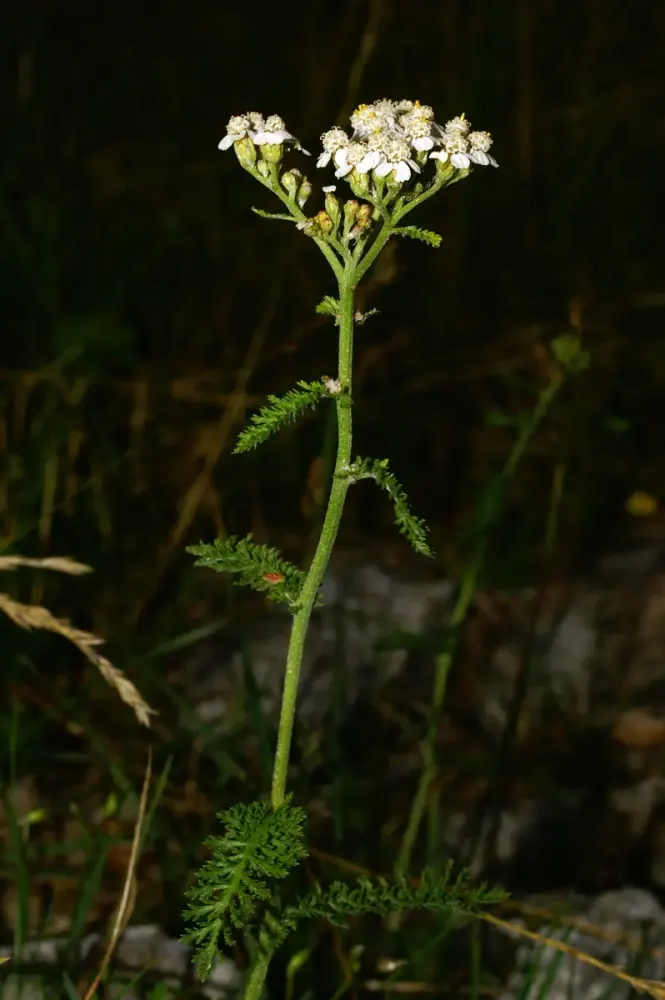
© Benjamin Zwittnig · CC BY 2.5 · Commons
Yarrow
CautionSchafgarbe · (Achillea millefolium)
Daisy family (Asteraceae)
Description
Yarrow is a perennial meadow plant with finely feathered leaves and white to pale-pink umbel flowers. It ranks among the oldest medicinal plants of Europe and is used both for digestive complaints and for wound treatment. Its Latin name honours the hero Achilles, who according to legend staunched his soldiers' wounds with this plant.
CONTRAINDICATED during pregnancy
Yarrow must not be used during pregnancy — uterine stimulation possible.
CONTRAINDICATED during breastfeeding
Insufficient data for breastfeeding.
CONTRAINDICATED for children
Per EMA not for children under 12 (oral/wound) or under 18 (sitz bath).
- TeaAerial partsInternalTraditional use
Bitter tea for temporary loss of appetite and mild digestive complaints.
Preparation & dosage
INFUSION: Place 1.5–2 g of finely cut yarrow herb (about 1 teaspoon) in a cup, pour 150 ml boiling water, cover, steep 10 minutes, strain. For loss of appetite drink half an hour before meals; for digestive complaints between/after meals. 3 cups a day, daily max ~4.5 g.
- Dry amount
- 1.5–2 g
- Doses per day
- 3×
- Max duration
- 2 weeks
⚠ Age restriction: ≥ 12 years — Per EMA, only from 12 years onwards.
- TeaAerial partsInternalTraditional use
Relieves mild abdominal cramps during menstruation.
Preparation & dosage
Cramp tea: 1.5–2 g in 150 ml boiling water, steep 10 min, strain. 3× daily, starting 1–2 days before period. Max 1 week per cycle.
- Dry amount
- 1.5–2 g
- Doses per day
- 3×
- Max duration
- 1 weeks
⚠ Age restriction: ≥ 12 years — From 12 years.
- BathAerial partsExternalTraditional use
Classic warm sitz-bath for mild pelvic cramp-like complaints.
Preparation & dosage
SITZ BATH: 100 g + 1–2 L boiling water, steep 20 min, strain, add to bath (37–38 °C). 10–20 min, once daily.
- Dry amount
- 100–100 g
- Doses per day
- 1×
- Max duration
- 2 weeks
⚠ Age restriction: ≥ 18 years — Sitz baths per EMA only for adults from 18 years.
- CompressAerial partsExternalTraditional use
Moist compress for small superficial skin wounds.
Preparation & dosage
COMPRESS: 3 g + 100 ml boiling water, steep 15 min, cool. Soak cloth, apply 15–20 min. 1–2× daily.
- Dry amount
- 3–3 g
- Doses per day
- 2×
- Max duration
- 1 weeks
⚠ Age restriction: ≥ 12 years — From 12 years.
Classical quotes
"Yarrow is a magnificent wound-healing plant and an excellent stomach tonic."
Distribution in Europe
🤝 Permaculture Partners
In your garden, this plant acts as:
✨ Best symbiotic partners
- 🌿 Lavandula angustifolia Classic companion-planting partner.
- 🌿 Matricaria chamomilla Classic companion-planting partner.
- 🌿 Oregano Classic companion-planting partner.
Source: Helga und Margarete Langerhorst, Mein gesunder Naturgarten (eigene Kuration)