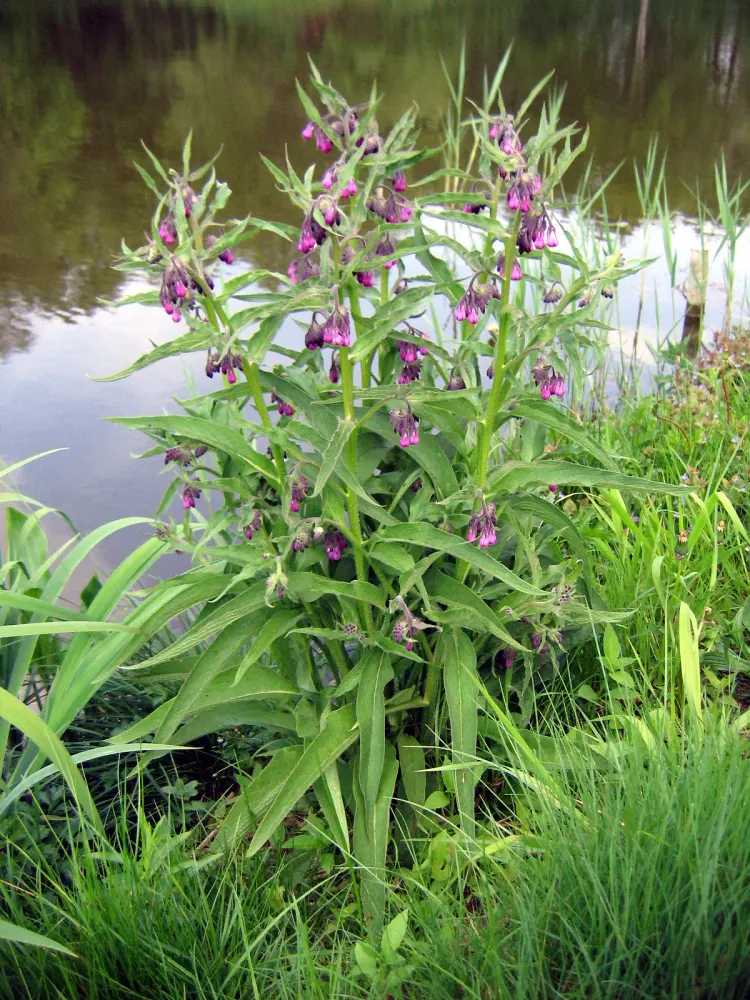
© Agnieszka Kwiecień (Nova) · CC BY 2.5 · Commons
Symphytum officinale
CautionEchter Beinwell · (Symphytum officinale)
Borage family (Boraginaceae)
Description
The old German name „Wallwurz“ – from „to weld“ – hints at this borage-family root's traditional purpose: applied as a salve or compress on unbroken skin, it has been used for generations for bruises, sprains and the aftercare of closed bone fractures, a use the EMA itself recognises as established. The key compound is allantoin, which stimulates tissue regeneration, supported by mucilage and rosmarinic acid with soothing, mildly anti-inflammatory effects. Crucially, the root also contains pyrrolizidine alkaloids, which damage the liver and are considered carcinogenic if taken internally – so comfrey is used strictly externally, only on intact skin, limited to a few weeks per year and only from low-PA cultivars. Application is off-limits on open wounds, in pregnancy and breastfeeding, and in children under three. The leaf salve once common in folk practice is now considered outdated because of its unpredictably high PA content.
External use only!
This plant must NOT be taken internally. Use only as compress, salve, or bath.
CONTRAINDICATED during pregnancy
-
CONTRAINDICATED during breastfeeding
-
CONTRAINDICATED for children
Contraindicated under 3-4 years; in older children only on intact skin, short-term
Blunt trauma: bruises, sprains, strains
Preparation & dosage
Closed fractures, post-fracture support (traditional name 'Wallwurz' = wound-healer)
Preparation & dosage
Acute swelling after sports injury (cold compress)
Preparation & dosage
Muscle and joint pain (osteoarthritis-adjunct, external)
Preparation & dosage
Traditional leaf salve for skin irritations (today controversial due to PA)
Preparation & dosage
⚠ External use only
EXTERNAL USE ONLY - NEVER INTERNAL! Pyrrolizidine alkaloids (symphytine, echimidine, lycopsamine) are hepatotoxic (veno-occlusive disease/VOD) and carcinogenic when ingested. Do NOT apply on open wounds, damaged skin, fresh surgical scars or mucous membranes - dermal PA absorption rises sharply. Maximum use 4-6 weeks per year; EMA recommends only 10 days continuous use for some preparations. Daily limit PA dermal: max. 0.35 µg/day (EMA/BfArM); only use PA-reduced preparations (e.g. Kytta cultivar). Contraindicated in pregnancy and lactation (possible transplacental/transmammary PA passage).
⏱ Max continuous use: 6 weeks
-
-
Contraindicated under 3-4 years; in older children only on intact skin, short-term
Drug interactions
Hepatotoxic drugs (e.g. paracetamol high-dose, methotrexate, isoniazid, statins)
Theoretical additive hepatotoxicity with systemic PA absorption; low with proper external use, but relevant with prolonged/large-area application.
CYP3A4 inducers (e.g. rifampicin, phenobarbital, carbamazepine)
Increased metabolic activation of PA to toxic pyrrole metabolites - increased risk with chronic use.
Anticoagulants (warfarin, DOACs) - topical near skin lesions
Theoretically increased PA absorption through bleeding/injured areas; proper external use on intact skin largely unproblematic.
Contraindications
- Pregnancy, lactation, children under 3-4 years
- Open wounds, skin lesions, mucosal application
- Pre-existing liver disease (relative, caution even externally)
- Known allergy to Boraginaceae
Harvested part: root (autumn)
- AllantoinOtherContent: 0,6-4,7 %
Main wound-healing constituent: cell-proliferative, granulation-promoting, keratolytic; promotes callus formation.
- Mucilage (Fructan-Polysaccharide, Glucose/Fructose)MucilageContent: ca. 29 % (Wurzel)
Demulcent, locally anti-inflammatory, skin-soothing; forms protective film.
- Pyrrolizidinalkaloide (Symphytin, Echimidin, Lycopsamin, Intermedin)AlkaloidContent: 0,013-1,2 %
RISK CONSTITUENT! Orally hepatotoxic (VOD, liver cirrhosis) and carcinogenic. Therefore EXTERNAL USE ONLY on intact skin and only PA-reduced cultivars/extracts. BfArM daily limit dermal: 0.35 µg/day.
- Rosmarinic acid (Rosmarinsaeure)Phenolic acidContent: ca. 0,2 %
Antioxidant, anti-inflammatory; contributes to decongestant effect.
- Tannins (Pyrocatechol-Gerbstoffe)TanninContent: ca. 2,4 %
Astringent, contracting, antimicrobial - supports wound closure externally.
- Choline (Cholin)OtherContent: Spuren
Promotes local circulation, contributes to decongestant effect.
- Salvianolic / Lithospermic acidsPhenolic acidContent: 0,037 % (Lithospermin)
Strong antioxidants, protect tissue against oxidative stress in injuries.
- [1]MonographEU Herbal Monograph on Symphytum officinale L., radix (HMPC)(accessed: 2026-05-19)
- [2]MonographBfArM Stellungnahme Pyrrolizidinalkaloide in pflanzlichen Arzneimitteln(accessed: 2026-05-19)
- [3]MonographPlants For A Future: Symphytum officinale(accessed: 2026-05-19)
- [5]MonographKommission E Monographie: Symphyti radix (positiv extern) / Symphyti folium (negativ)(accessed: 2026-05-19)
- [7]MonographCliniTox Giftpflanzen — Symphytum officinale L.: schwach giftig (+) (Institut für Veterinärpharmakologie und -toxikologie, Universität Zürich)(accessed: 2026-08-10)
- [4]BookHeilkraeuter-Lexikon: Beinwell (Wallwurz)(accessed: 2026-05-19)
- [6]WikipediaWikipedia: Symphytum officinale (Echter Beinwell)(accessed: 2026-05-19)
Distribution in Europe
🤝 Permaculture Partners
In your garden, this plant acts as: