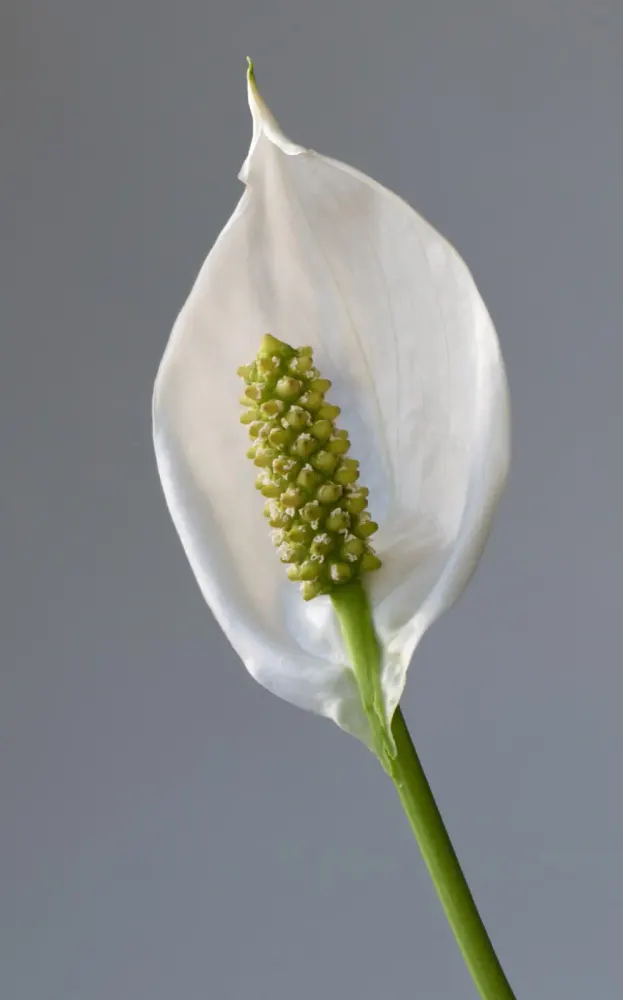
© W.carter · CC BY-SA 4.0 · Commons
Spathiphyllum wallisii
Toxic🐾Einblatt · (Spathiphyllum wallisii)
Arum family (Araceae)
Description
With its white, sail-like bracts rising above glossy dark green foliage, this houseplant of tropical origin, belonging to the arum family (Araceae), is among the most popular indoor greenery for homes and offices. Indoor air-quality studies have tested the plant's ability to take up pollutants such as trichloroethylene and acetone from the air; folk belief also credits it with slightly raising room humidity through transpiration. The plant is used purely for decoration — internal use is explicitly not intended. IMPORTANT: all plant parts contain calcium oxalate raphides and saponins and are toxic to humans, dogs and cats. Contact with the sap irritates skin and eyes, and ingestion causes burning in the mouth, salivation and difficulty swallowing. The plant should be kept out of reach of children and pets; if ingestion is suspected, contact poison control immediately.
External use only!
This plant must NOT be taken internally. Use only as compress, salve, or bath.
When kept as a living houseplant, the peace lily absorbs benzene, formaldehyde, and trichloroethylene from indoor air according to the NASA Clean Air Study (Wolverton et al. 1989). It ranks among the top 5 tested plants. The mechanism relies on uptake through leaves and soil microorganisms.
Preparation & dosage
A follow-up study (Kim et al. 2014, PMC4334964) examined 86 houseplant species for their ability to remove benzene, formaldehyde, and toluene. Spathiphyllum wallisii showed measurable absorption rates for formaldehyde and benzene in closed test chambers.
Preparation & dosage
Sources: [2]
Spathiphyllum wallisii releases water vapour through transpiration, raising relative humidity in dry indoor spaces. In heated winter rooms this can measurably improve the indoor climate.
Preparation & dosage
The peace lily is one of the few houseplants that flower in partial shade. Its white spathes are regarded as a symbol of peace. Biophilia research associates flowering houseplants with psychological relaxation effects.
Preparation & dosage
⚠ External use only
TOXIC to dogs, cats, and humans. All plant parts contain calcium oxalate raphides and saponins. Contact with plant sap causes skin and eye irritation. If ingested: burning and numbness in the mouth, salivation, vomiting, difficulty swallowing. If ingestion is suspected, contact poison control immediately. Wash hands after handling the plant. ASPCA classification (accessed 2026-08-10): toxic to dogs and cats. The ASPCA classifies the whole genus this way.
No data on systemic human toxicity. As a houseplant (no ingestion) no systemic risk; avoid contact with plant sap.
No medicinal use. Avoid contact with plant sap.
Place out of reach of small children — all plant parts toxic if ingested. If ingestion suspected, contact poison control (UK: 111, US: 1-800-222-1222).
Contraindications
- Any internal use — strictly ornamental plant.
Harvested part: whole plant (decorative)
- Time of day:
- Morning — cuttings or division during spring repotting.
- Drying:
- Not applicable — strictly ornamental plant, no drying of constituents.
- Time of day:
- Daytime — cutting off spent flower spikes promotes reblooming.
- Drying:
- No drying — flowers are removed for plant care only.
- Calcium oxalate raphidesOtherWhole plant
Needle-shaped calcium oxalate crystals in idioblasts of leaves, stems and roots. Cause mechanical mucous membrane irritation — primary toxicity mechanism of Araceae.
- SaponinsSaponinWhole plant
Steroidal saponins in all plant parts. Amplify membrane irritation and contribute to vomiting and gastrointestinal distress.
- Alkaloids (unspecified Araceae type)AlkaloidWhole plant
Alkaloid compounds in minor amounts — contributing to overall toxicity; specific compounds not fully characterised for S. wallisii.
- Chlorophyll a/bOtherLeaf
High chlorophyll content underlies the pronounced shade tolerance. Photosynthetic activity even at 50–100 lx.
- Quercetin glycosidesFlavonoidLeaf
Flavonoids in the leaves — no known medicinal significance for this species.
- [1]MonographInterior Landscape Plants for Indoor Air Pollution Abatement — Wolverton et al., NASA TM-101766 (1989)(accessed: 2026-05-24)
- [2]MonographEfficiency of Volatile Formaldehyde Removal by Indoor Plants — Kim et al. (2014), HortScience, PMC4334964(accessed: 2026-05-24)
- [4]MonographRHS — Spathiphyllum cultivation and toxicity advice(accessed: 2026-05-24)
- [5]MonographASPCA Animal Poison Control — Mauna Loa Peace Lily (Spathiphyllum)(accessed: 2026-08-10)
- [3]WikipediaSpathiphyllum wallisii (Wikipedia EN)(accessed: 2026-05-24)
Distribution in Europe
🪴 Grow at home
- ☀ Light
- low light
- 💧 Water
- weekly
- 🌱 Soil
- Loose potting compost
- 🪴 Pot
- 20 cm
- ⭐ Difficulty
- ★☆☆ beginner
- 🐾 Pets
- toxic to pets
Tips:
- Droopy leaves = thirsty — water immediately, recovers in hours.
- Blooms reliably even in partial shade.
- TOXIC if eaten — mouth irritation.
Care tips are general indoor-gardening recommendations, not scientific sources.