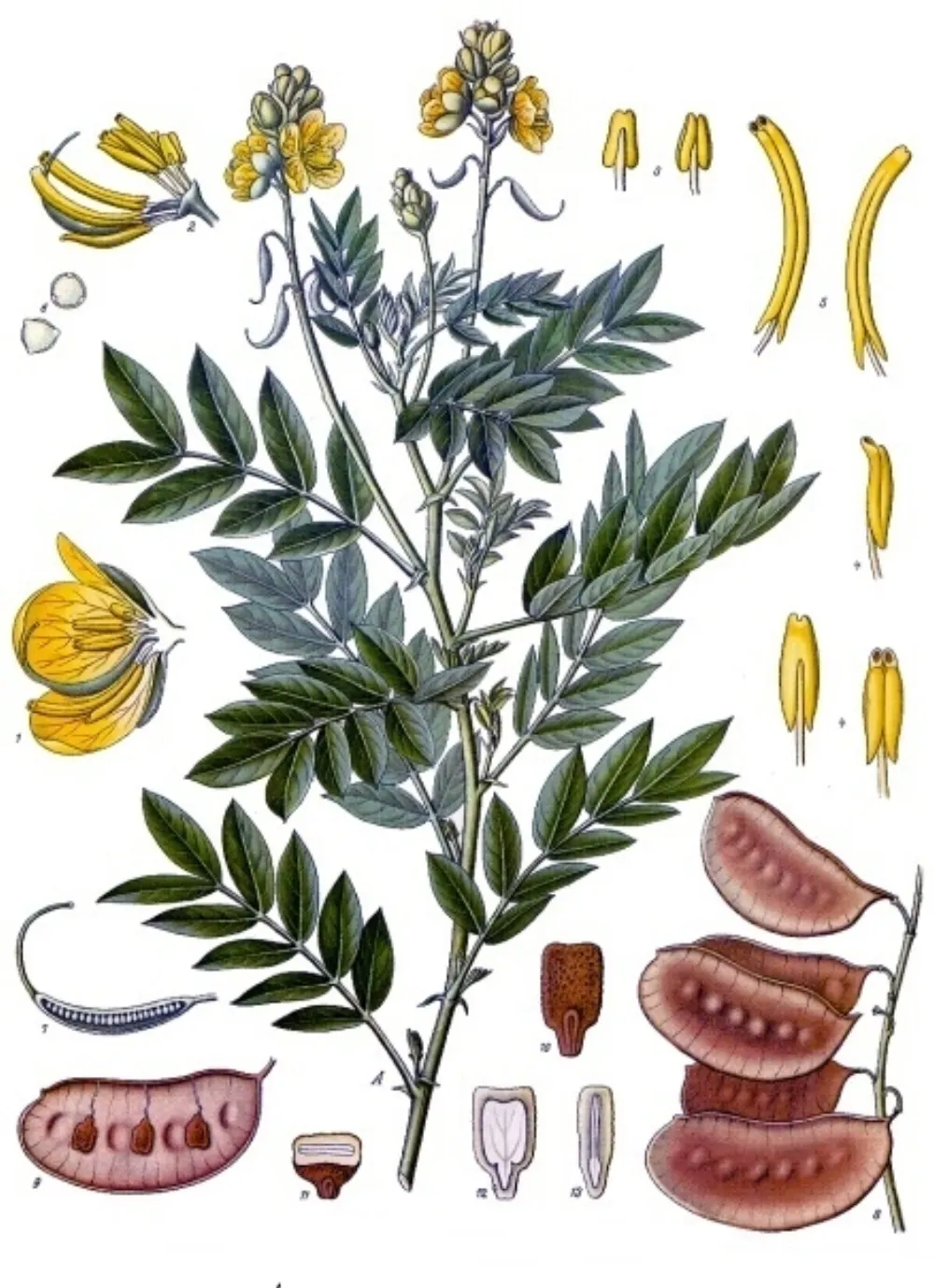
© Franz Eugen Köhler, in Köhler's Medizinal-Pflanzen (1887), Plate 264 · Public domain · Commons
Senna
Caution🐾Alexandriner Senna · (Senna alexandrina)
Legume family (Fabaceae (Caesalpinioideae))
Description
Alexandrian senna (Senna alexandrina, syn. Cassia senna, Cassia angustifolia, Cassia acutifolia) is a deciduous subshrub or shrub of 0.5 to 3 metres in the legume family. The plant is native to north-eastern Africa, the Arabian Peninsula and India, and is cultivated mainly in the upper Nile region and in southern India (Tinnevelly). The medicinal parts are the dried leaflets (senna leaf, Sennae folium) and the flat, brown pods (senna pods, Sennae fructus). Both drugs contain sennosides (dianthrone glycosides, chiefly sennoside A and B), which act as a stimulant laxative on the large intestine.
CONTRAINDICATED for children
Do not use in children under 12 years of age.
Critical drug interactions with:
Herzglykoside (z. B. Digoxin)
Short-term occasional constipation
Preparation & dosage
Pour 150 ml of hot water over 0.5 to 2 g of cut, dried senna leaves, steep 10 minutes, then strain. Take once daily, preferably in the evening. The dose is standardised to 15 to 30 mg hydroxyanthracene derivatives (calculated as sennoside B) per day; always use the lowest dose that produces a soft formed stool. The effect appears only after 8 to 12 hours, hence the evening dose. Do not use for longer than one to two weeks without medical advice.
- Dry amount
- 0.5–2 g
- Doses per day
- 1×
- Max duration
- 1 weeks
⚠ Age restriction: ≥ 12 years — Only for adults and adolescents over 12 years of age.
Short-term occasional constipation
Preparation & dosage
An infusion of cut, dried senna pods is dosed to deliver 15 to 30 mg hydroxyanthracene derivatives (calculated as sennoside B) per day. Take once daily in the evening, always at the lowest effective dose. The effect sets in after 8 to 12 hours. Short term only, maximum one to two weeks. Standardised commercial products are more reliably dosed than home-made pod tea.
- Dry amount
- 1–2 g
- Doses per day
- 1×
- Max duration
- 1 weeks
⚠ Age restriction: ≥ 12 years — Only for adults and adolescents over 12 years of age.
Bowel cleansing before medical procedures
Preparation & dosage
For bowel cleansing before diagnostic procedures or surgery, senna pods are used as a single dose, dosed to 15 to 30 mg hydroxyanthracene derivatives (as sennoside B). Use only on medical advice and not for continuous use. Ensure adequate fluid intake.
- Doses per day
- 1×
- Max duration
- 1 weeks
⚠ Age restriction: ≥ 12 years — Only for adults and adolescents over 12 years of age.
Senna (senna leaf and senna pods) is an anthranoid-containing stimulant laxative and should be used only short term (at most one to two weeks) and not continuously without medical advice. During pregnancy use only on medical advice, avoid during breastfeeding; do not use in children under 12 years. Senna must not be used in cases of intestinal obstruction (ileus), inflammatory bowel disease (Crohn's disease, ulcerative colitis), appendicitis or abdominal pain of unknown cause. Prolonged or excessive use causes loss of potassium, which can dangerously enhance the action of cardiac glycosides, as well as habituation, a harmless dark pigmentation of the intestinal lining (melanosis coli) and, in the long term, a sluggish, atonic colon. Possible genotoxic effects are discussed for isolated anthranoids, so continuous use should be avoided. A harmless red to brown discolouration of the urine may occur. Seek medical advice if symptoms persist.
Use during pregnancy only on medical advice; stimulant anthranoid laxatives are not recommended in pregnancy.
Avoid during breastfeeding, as small amounts of active metabolites (rhein) may pass into breast milk.
Do not use in children under 12 years of age.
Drug interactions
Herzglykoside (z. B. Digoxin)
Potassium loss from prolonged use can dangerously increase the action and toxicity of cardiac glycosides.
Diuretika (z. B. Thiazide)
Concurrent use can intensify potassium loss and aggravate electrolyte imbalance.
Kortikosteroide
Increased potassium loss when used together with adrenocortical steroids.
Süßholzwurzel (Liquiritiae radix)
Liquorice also promotes potassium loss; concurrent use can intensify the electrolyte imbalance.
Antiarrhythmika
Electrolyte imbalance from potassium loss may affect the action of antiarrhythmic medicines.
Contraindications
- Intestinal obstruction (ileus) and intestinal narrowing (stenosis)
- Inflammatory bowel disease (Crohn's disease, ulcerative colitis)
- Appendicitis
- Abdominal pain of unknown cause
- Severe dehydration with water and salt loss
- Children under 12 years of age
Harvested part: Leaflets and ripe pods
- Time of day:
- On dry days in late summer, when the leaflets are fully developed.
- Drying:
- Dry the leaflets airily in the shade until brittle; avoid direct sun and high temperatures to preserve the sennosides.
- Storage:
- 24 months — Store dry, protected from light and moisture in tightly closed containers.
- Time of day:
- In autumn, when the flat pods are ripe and turned brown.
- Drying:
- Air-dry the pods until hard and well suited for storage.
- Storage:
- 24 months — Store dry, protected from light and moisture.
- Sennosid AGlycosideContent: Blätter ca. 1,5-3%, Früchte 2,5-5%Leaf
Dianthrone glycoside and the principal active marker substance; converted by bacteria in the colon into active anthrones that stimulate secretion and peristalsis.
- Sennosid BGlycosideContent: Blätter ca. 1,5-3%, Früchte 2,5-5%Fruit
Dianthrone glycoside; the reference substance to which the hydroxyanthracene content of the drugs is calculated (senna pods at least 3.4%).
- RheinGlycosideLeaf
Anthraquinone aglycone and active metabolite; passes in small amounts into breast milk.
- Aloe-EmodinGlycosideLeaf
Anthraquinone aglycone that, together with rhein, contributes to the laxative effect.
- Naphthalinglykoside (z. B. Tinnevellin-Glykosid)GlycosideLeaf
Characteristic accompanying glycosides used to distinguish the senna drugs.
- Schleimstoffe (Mucilage)PolysaccharideLeaf
Swelling polysaccharides accompanying the drugs, with a mild soothing effect.
- FlavonoideFlavonoidLeaf
Secondary plant compounds (including kaempferol derivatives) present in smaller amounts.
- [1]MonographSenna leaf (Sennae folium) - herbal medicinal product - European Medicines Agency(accessed: 2026-06-12)
- [2]MonographEuropean Union herbal monograph on Senna alexandrina Mill. (Cassia senna L.; Cassia angustifolia Vahl), folium(accessed: 2026-06-12)
- [3]MonographSenna pods (Sennae fructus) - herbal medicinal product - European Medicines Agency(accessed: 2026-06-12)
- [4]MonographFinal European Union herbal monograph on Senna alexandrina Mill. (Cassia senna L.; Cassia angustifolia Vahl), fructus (Revision 1)(accessed: 2026-06-12)
- [5]WikipediaAlexandrinische Senna - Wikipedia (deutsch)(accessed: 2026-06-12)
- [6]WikipediaSenna alexandrina - Wikipedia(accessed: 2026-06-12)
- [8]CommonsFile:Senna alexandrina - Köhler's Medizinal-Pflanzen-264.jpg - Wikimedia Commons(accessed: 2026-06-12)
- [7]WikidataSenna alexandrina (Q925211) - Wikidata(accessed: 2026-06-12)
🤝 Permaculture Partners
In your garden, this plant acts as: