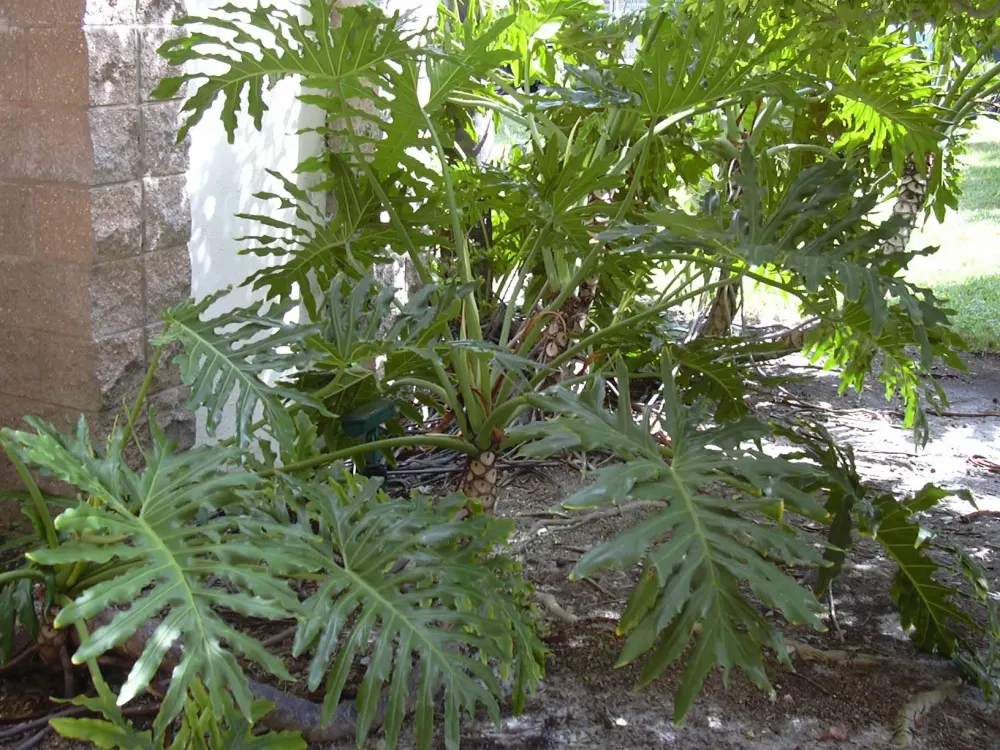
© Forest & Kim Starr · CC BY 3.0 · Commons
Philodendron
Toxic🐾Philodendren · (Philodendron hederaceum)
Arum family (Araceae)
Description
With its glossy, heart-shaped leaves on loosely climbing or trailing stems, philodendron is one of the easiest-care houseplants and is grown year-round purely as an ornamental; botanically it belongs to the arum family. Every part of the plant contains needle-shaped calcium oxalate crystals (raphides), along with saponins, trace cyanogenic glycosides, anthocyanins and chlorophyll. It is used exclusively for decoration – its foliage is popularly associated with a pleasant indoor climate and higher humidity. Important: philodendron is toxic to dogs, cats AND humans. Mere contact with the sap irritates skin and mucous membranes, and swallowing any part can cause burning in the mouth, drooling, vomiting and difficulty swallowing. It should be regarded strictly as an ornamental for external display and never used internally; keep it out of reach of young children and pets, and wash hands after contact with the sap.
External use only!
This plant must NOT be taken internally. Use only as compress, salve, or bath.
When kept as a living houseplant, the heartleaf philodendron absorbs formaldehyde from indoor air according to the NASA Clean Air Study (Wolverton 1989). The study recorded measurable reduction in sealed test chambers.
Preparation & dosage
As an ornamental plant, Philodendron hederaceum is valued for its mood-enhancing effect through indoor greening. Scientific studies on biophilia confirm positive psychological effects of houseplants in general.
Preparation & dosage
Large-leaved houseplants like Philodendron hederaceum release water vapour through transpiration, increasing relative humidity in dry indoor spaces.
Preparation & dosage
⚠ External use only
TOXIC to dogs, cats, and humans. All plant parts contain calcium oxalate raphides: skin and mucous membrane irritation on contact, burning in mouth, drooling, vomiting, difficulty swallowing if ingested. Do not use medicinally. Wash hands after contact with plant sap. ASPCA classification (accessed 2026-08-10): toxic to dogs and cats.
No data on systemic human toxicity. Avoid contact with plant sap as calcium oxalate raphides irritate mucous membranes.
No medicinal use — as a houseplant no systemic risk, but avoid contact with plant sap.
Place out of reach of small children. Ingestion of leaves causes mouth irritation and vomiting. If ingestion is suspected, contact poison control immediately.
Contraindications
- Any internal use — this plant is strictly ornamental.
- Not for persons with known oxalate hypersensitivity or kidney stones (preventively).
Harvested part: all plant parts
- Time of day:
- Morning (cuttings or repotting preferred in humid ambient air).
- Drying:
- Not applicable — strictly decorative plant, no harvesting of constituents.
- Time of day:
- Any time — wipe leaves to remove dust and optimise transpiration.
- Drying:
- No drying — leaves are not harvested.
- Calcium oxalate raphidesOtherWhole plant
Needle-shaped calcium oxalate crystals (raphides) in specialised idioblasts. Cause mechanical irritation of mucous membranes on contact or ingestion — characteristic of Araceae.
- SaponinsSaponinWhole plant
Saponins contribute to the toxic effect upon ingestion and amplify mucous membrane irritation.
- Cyanogenic glycosides (traces)GlycosideWhole plant
Detected in trace amounts; clinically less relevant than the raphides, but contribute to overall toxicity.
- AnthocyaninsFlavonoidLeaf
Secondary plant compounds contributing to the green to bronze leaf colouration. No known medicinal significance.
- ChlorophyllOtherLeaf
High chlorophyll content enables photosynthesis even in low light — explains shade tolerance.
- [1]MonographInterior Landscape Plants for Indoor Air Pollution Abatement — Wolverton et al., NASA TM-101766 (1989)(accessed: 2026-05-24)
- [3]MonographASPCA Animal Poison Control — Philodendron(accessed: 2026-05-24)
- [4]MonographRHS — Philodendron hederaceum cultivation advice(accessed: 2026-05-24)
- [5]MonographASPCA Animal Poison Control — Heartleaf Philodendron (Philodendron hederaceum)(accessed: 2026-08-10)
- [6]MonographCliniTox Giftpflanzen — Philodendron scandens K.Koch & Sello: giftig + (Institut für Veterinärpharmakologie und -toxikologie, Universität Zürich)(accessed: 2026-08-10)
- [2]WikipediaPhilodendron hederaceum (Wikipedia EN)(accessed: 2026-05-24)