© J.M.Garg · CC BY-SA 3.0 · Commons
Moringa
CautionMoringa (Meerrettichbaum) · (Moringa oleifera)
Moringa family (Moringaceae)
Description
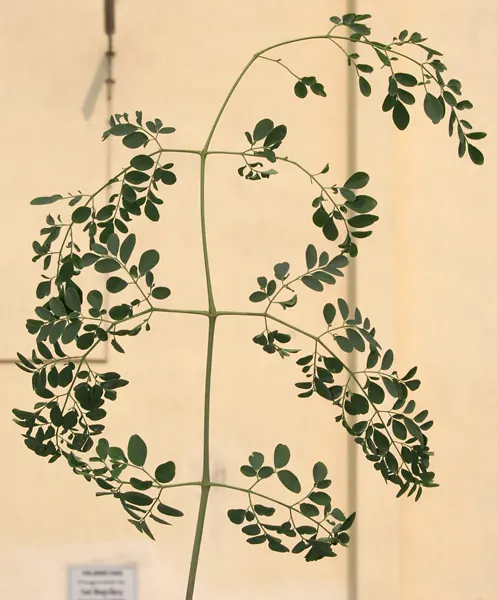
The moringa tree, also called the drumstick or horseradish tree, is a fast-growing tropical tree of the moringa family. It comes from north-western India at the foot of the Himalayas and is now grown throughout the tropics; in good conditions it puts on several metres in its first year. The name horseradish tree comes from the taste of the root — and that is exactly the part to avoid. The parts mainly used are the nutrient-rich, multiply pinnate leaves, which contain vitamins (C, E, provitamin A), minerals such as iron and calcium, and flavonoids and glucosinolates. A stable oil is pressed from the seeds, and the crushed press cake is used in several countries to clarify drinking water, because it binds suspended particles. In the growing regions the leaves, pods and seeds are an everyday food and are considered safe in normal culinary amounts. The far-reaching effects promoted for it as a supplement are so far only sparsely supported in humans. Root and bark are best avoided.
CONTRAINDICATED during pregnancy
Avoid root, bark and flowers — they are credited with a uterus-stimulating effect. Safety data are lacking for leaf powder in supplement amounts. Leaves eaten as a vegetable in culinary amounts are not affected by this.
The leaves are traditionally eaten as a nutritious vegetable and as dried powder, providing protein, vitamins and minerals. In the cooking of the growing regions they go into soups and curries like spinach, and the young pods are cooked like beans.
A few small human trials suggest modest reductions in blood sugar and blood lipids, but the evidence is limited and inconsistent and a proven benefit is not established. Most of the studies ran for a few weeks with small numbers of participants — not enough for a sound conclusion.
Moringa is one of the few galactagogue plants with actual human studies. A pooled review found a significant increase in prolactin and milk volume; in one study mothers expressed a mean of 947 instead of 618 ml. Infant growth did not differ. Study quality varies considerably, however, and the lactation database LactMed stresses that galactagogues never replace looking for the underlying cause.
Sources: [4]
Leaves, fruit and seeds are considered safe in normal food amounts. Root and bark contain concerning substances (e.g. spirochin) and should be avoided. Special caution in pregnancy: root, bark and flowers may stimulate the uterus and are traditionally linked to miscarriage, and the safety of moringa supplements in pregnancy is not well established. Consult a doctor first if you have a medical condition or take medication. Food supplements are not subject to approval — contents and label do not always match.
Avoid root, bark and flowers — they are credited with a uterus-stimulating effect. Safety data are lacking for leaf powder in supplement amounts. Leaves eaten as a vegetable in culinary amounts are not affected by this.
According to LactMed there are no data on levels in breast milk; in the studies the growth of breastfed infants did not differ from the comparison groups. Moringa is used deliberately to increase milk supply — that belongs with a doctor or midwife, not in self-experiments.
Part of the ordinary diet as a vegetable in the growing regions. Concentrated leaf powder as a supplement has not been adequately studied in children.
Drug interactions
Blutzuckersenkende Mittel (Insulin, orale Antidiabetika)
Moringa leaf powder lowered blood sugar in small studies. Combined with ongoing diabetes treatment, hypoglycaemia is conceivable — monitor readings more closely.
Gerinnungshemmer und Thrombozytenhemmer
LactMed notes that moringa may stimulate blood clotting. With anticoagulants this can work against the treatment; restraint is advisable for anyone at raised risk of clots.
Schilddrüsenhormone (Levothyroxin)
An influence on thyroid function is discussed for moringa. Anyone taking thyroid hormones should not add supplements without consulting a doctor.
Contraindications
- Root, bark and root extracts — they contain spirochin and other concerning alkaloids.
- Pregnancy, as far as root, bark, flowers and concentrated supplements are concerned.
Harvested part: Leaves
- Time of day:
- All year round in a tropical climate. Young, light-green leaflets taste milder than old ones; the whole shoot is cut and the plant regrows quickly.
- Drying:
- Dry the leaves in the shade, not in the sun — direct light degrades the vitamin C and provitamin A. Then strip the leaflets from the stalk and grind them to powder.
- Storage:
- 6 months — Store the powder airtight, dark and dry. After roughly half a year the nutrient content noticeably declines.
- Vitamine (C, E, Provitamin A)VitaminLeaf
Sensitive to light and heat — dried powder contains less than fresh leaves.
- Mineralstoffe (Eisen, Calcium, Kalium)MineralLeaf
- Flavonoide (Quercetin, Kaempferol)FlavonoidLeaf
- Glucosinolate / Isothiocyanate (u. a. Moringin)OtherLeaf
Mustard-oil glycosides — the same group of compounds as in horseradish and mustard; they explain the pungent aftertaste.
- Pflanzliches Eiweiß und BallaststoffeOtherLeaf
- Spirochin (Wurzel, Rinde)AlkaloidRoot
The reason root and bark should be avoided.
- [1]MonographReview of the Safety and Efficacy of Moringa oleifera (Stohs & Hartman, Phytotherapy Research 2015, PMC6680322)(accessed: 2026-06-23)
- [2]MonographMoringa: Overview, Uses, Side Effects, Precautions (WebMD)(accessed: 2026-06-23)
- [3]MonographPotential of Moringa oleifera to Improve Glucose Control: A Systematic Review (Nutrients 2020, PMC7400864)(accessed: 2026-06-23)
- [4]MonographMoringa — Drugs and Lactation Database (LactMed), NCBI Bookshelf NBK501899(accessed: 2026-08-20)
- [5]CommonsFile:Sonjna (Moringa oleifera) leaf at Kolkata W IMG 2119.jpg — Wikimedia Commons(accessed: 2026-06-23)