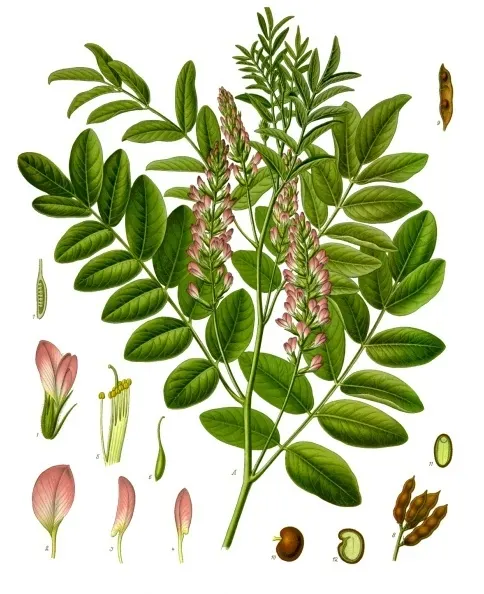
© Franz Eugen Köhler, Köhler's Medizinal-Pflanzen (1887), plate 207 · Public domain · Commons
Liquorice
CautionSüßholz · (Glycyrrhiza glabra)
Legume family (Fabaceae)
Description
Liquorice (Glycyrrhiza glabra), the source of liquorice confectionery, is a perennial herbaceous legume reaching 1–2 m. Erect stems with imparipinnate leaves arise from an extensively branched system of roots and underground stolons. Pale violet to bluish pea-type flowers are borne in axillary racemes. Native to the Mediterranean and south-west Asia, it is the dried root and stolons (Liquiritiae radix) that are used medicinally.
CONTRAINDICATED during pregnancy
Animal studies showed reproductive toxicity; safety not established — do not use during pregnancy.
CONTRAINDICATED during breastfeeding
Insufficient data — not recommended during lactation.
CONTRAINDICATED for children
Not for children and adolescents under 18 due to lack of data.
Critical drug interactions with:
Blutdrucksenker (Antihypertensiva) · Entwässerungsmittel (Diuretika), stimulierende Abführmittel · Herzglykoside (z. B. Digoxin) · Kortikosteroide (Cortison)
Tea for heartburn and digestive complaints (dyspepsia) — short-term.
Preparation & dosage
INFUSION/DECOCTION (digestive complaints): Pour 150 ml boiling water over 1.5–2 g of the comminuted root, or simmer briefly, then strain. One cup two to four times daily after meals, for heartburn and dyspepsia. Do NOT use for more than 4 weeks. If symptoms persist for more than 2 weeks, consult a doctor.
- Dry amount
- 1.5–2 g
- Doses per day
- 4×
- Max duration
- 4 weeks
⚠ Age restriction: ≥ 18 years — Not for children and adolescents under 18 due to lack of data.
Sources: [1]
Expectorant tea for cough with a cold — short-term.
Preparation & dosage
INFUSION/DECOCTION (cough): Pour 150 ml boiling water over 1.5 g of the comminuted root, or simmer briefly, then strain. Twice daily as an expectorant in cough associated with a cold. Do NOT use for more than 4 weeks. If symptoms persist for more than 1 week, consult a doctor.
- Dry amount
- 1.5–1.5 g
- Doses per day
- 2×
- Max duration
- 4 weeks
⚠ Age restriction: ≥ 18 years — Not for children and adolescents under 18 due to lack of data.
Sources: [1]
IMPORTANT: Liquorice must NOT be used for more than 4 weeks. With prolonged use or high amounts, its glycyrrhizin can cause water retention, potassium deficiency (hypokalaemia), high blood pressure and cardiac rhythm disorders (a mineralocorticoid-like effect, "pseudoaldosteronism"). Do not take together with other liquorice-containing products. Do not use if you have hypertension, kidney, liver or cardiovascular disease, or hypokalaemia. The EU Scientific Committee on Food (SCF) advises not exceeding 100 mg glycyrrhizin per day from all sources. Not recommended during pregnancy and lactation. Not for children and adolescents under 18 due to lack of data.
⏱ Max continuous use: 4 weeks
Animal studies showed reproductive toxicity; safety not established — do not use during pregnancy.
Insufficient data — not recommended during lactation.
Not for children and adolescents under 18 due to lack of data.
Drug interactions
Blutdrucksenker (Antihypertensiva)
Liquorice may counteract the antihypertensive action of prescribed medicines.
Entwässerungsmittel (Diuretika), stimulierende Abführmittel
Increased potassium loss — risk of dangerous hypokalaemia. Do not use concurrently.
Herzglykoside (z. B. Digoxin)
Liquorice-induced potassium deficiency may increase the effect and toxicity of cardiac glycosides.
Kortikosteroide (Cortison)
Glycyrrhetinic acid inhibits cortisol breakdown and may potentiate corticosteroid effects.
Contraindications
- Hypersensitivity to liquorice.
- Hypertension, hypokalaemia, kidney, liver or cardiovascular disease.
- Pregnancy and lactation.
- Children and adolescents under 18 years.
Harvested part: root and stolons
- Time of day:
- In late autumn as the plant dies back; the roots of 3–4-year-old plants are lifted.
- Drying:
- Wash the roots, cut into pieces and dry slowly in air or below 40 °C until they snap cleanly.
- Storage:
- 24 months — Store dry, protected from light and moisture, in well-closed containers.
- Glycyrrhizin (Glycyrrhizinsäure)SaponinContent: 5–10 %Root
Sweet-tasting triterpene saponin glycoside, the main active; responsible for the sweetness and for the mineralocorticoid-like adverse effects.
- GlycyrrhetinsäureSaponinRoot
Aglycone of glycyrrhizin; inhibits 11β-hydroxysteroid dehydrogenase, driving the blood-pressure and potassium effect.
- Flavanone (Liquiritin, Liquiritigenin)FlavonoidRoot
Characteristic flavanones of the root.
- Chalkone (Isoliquiritin, Isoliquiritigenin)FlavonoidRoot
Yellow chalcone-type flavonoids.
- GlabridinFlavonoidRoot
Lipophilic isoflavan, characteristic of G. glabra.
- Polysaccharide (Glycyrrhizan)PolysaccharideRoot
Mucilaginous polysaccharides of the root.
- [1]MonographCommunity herbal monograph on Glycyrrhiza glabra L. and/or Glycyrrhiza inflata Bat. and/or Glycyrrhiza uralensis Fisch., radix (EMA/HMPC/571119/2010)(accessed: 2026-06-10)
- [2]MonographOpinion of the EU Scientific Committee on Food on glycyrrhizinic acid (provisional limit 100 mg/day, SCF/CS/ADD/EDUL/225)(accessed: 2026-06-10)
- [3]WikipediaEchtes Süßholz — Wikipedia (DE)(accessed: 2026-06-10)
🤝 Permaculture Partners
In your garden, this plant acts as: