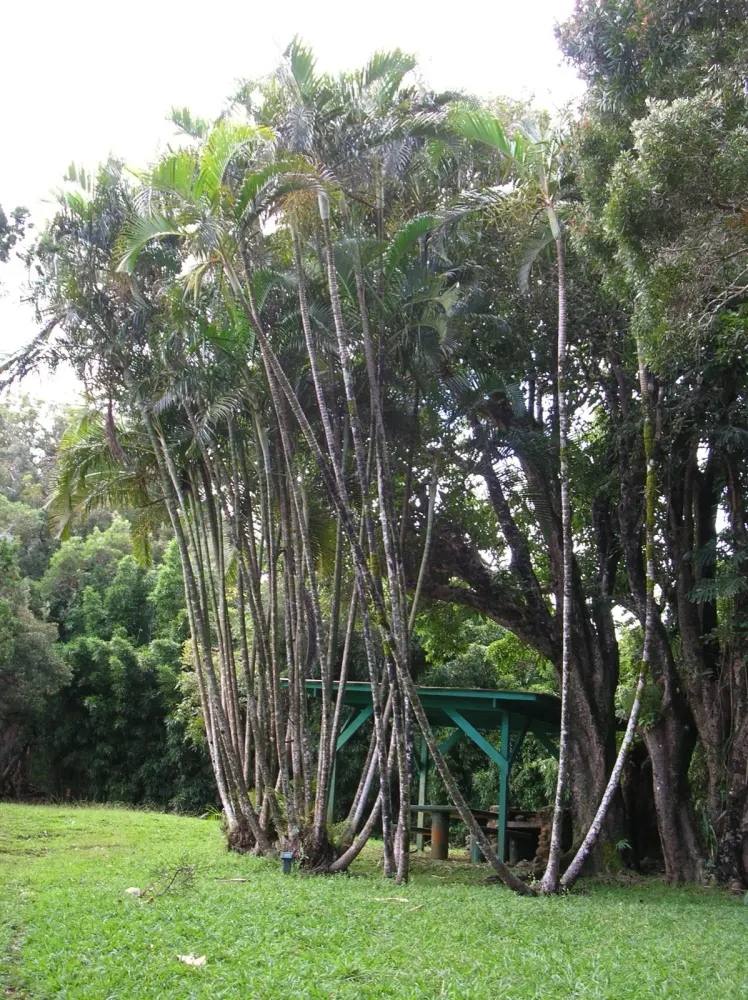
© Forest & Kim Starr · CC BY 3.0 · Commons
Goldfruchtpalme
Goldfruchtpalme · (Dypsis lutescens)
Palm family (Arecaceae)
Description
The areca palm comes from Madagascar, where it has become rare in the wild even as it spread worldwide as a houseplant. It grows in clumps: fresh reed-like shoots with yellow-green stalks push up from the rootstock, unfurling finely divided, arching fronds. Indoors it reaches two to three metres and wants bright light without harsh midday sun, in soil kept evenly moist but never wet. It became well known through indoor-air research: it releases a good deal of water into the room through its fronds and was among the species listed in the 1989 NASA study as taking up formaldehyde, xylene and toluene — though in an ordinary living room the measurable effect is small. It is considered harmless to dogs and cats, which sets it apart from many other houseplants.
The areca palm transpires up to one litre of water daily, making it the most effective natural humidifier according to Wolverton (NASA 1989). It simultaneously filters formaldehyde, xylene, and toluene from indoor air.
Elegant indoor palm with yellowish-green fronds; decorative in living and office spaces, including brighter environments.
Particularly effective at reducing formaldehyde — a common pollutant in new furniture, laminate flooring, and paints.
Sources: [1]
Safe for humans and pets (dogs and cats). No known toxicity issues. ASPCA classification (accessed 2026-08-10): non-toxic to dogs and cats.
Completely safe as a houseplant.
No known toxicity; pet- and child-safe.
Harvested part: whole plant (decorative)
- Time of day:
- Usable year-round as a houseplant.
- Time of day:
- Fruits ripen in late summer to autumn (under optimal indoor conditions).
- Drying:
- Fruits are not harvested medicinally; purely botanical interest.
- Flavonoids (luteolin, quercetin derivatives)FlavonoidLeaf
Antioxidant flavonoids in the leaves; not utilised pharmacologically.
- Carotenoids (beta-carotene, lutein)OtherFruit
Responsible for the yellowish-orange colouration of the fruits — hence the name areca/golden cane palm.
- Phenolic acidsPhenolic acidLeaf
Secondary metabolites with antioxidant properties.
- Polysaccharides (cellulose, hemicellulose)PolysaccharideWhole plant
Main structural components of palm fibres and trunk.
- Minerals (potassium, calcium, magnesium)MineralWhole plant
Typical mineral profile of a palm; no therapeutic interest.
- [1]MonographInterior Landscape Plants for Indoor Air Pollution Abatement (NASA TM-101766)(accessed: 2026-05-24)
- [4]MonographDypsis lutescens — RHS Gardening(accessed: 2026-05-24)
- [5]MonographASPCA Animal Poison Control — Areca Palm (Dypsis lutescens): Non-Toxic to Dogs, Non-Toxic to Cats, Non-Toxic to Horses(accessed: 2026-08-10)
- [2]WikipediaGoldfruchtpalme (Wikipedia DE)(accessed: 2026-05-24)
- [3]WikipediaDypsis lutescens (Wikipedia EN)(accessed: 2026-05-24)
Distribution in Europe
🪴 Grow at home
- ☀ Light
- bright, indirect
- 💧 Water
- every few days
- 🌱 Soil
- Palm compost, well-draining
- 🪴 Pot
- 30 cm
- ⭐ Difficulty
- ★★☆ intermediate
- 🐾 Pets
- non-toxic — verified against the ASPCA list
Tips:
- One of the most effective plants for humidifying air.
- Likes warm, bright rooms — no direct midday sun.
- Brown tips = too dry air or too hard water.
Care tips are general indoor-gardening recommendations, not scientific sources.